Your on-call team Is burning out: here's how to see it coming
Introducing On-Call Health, an open-source way of detecting responder overload.

Your on-call team Is burning out: here's how to see it coming
On this page
As a former SRE, I’ve seen far too many friends and co-workers suffer from on-call. The 2 AM pages that never let up, the “just one more weekend” that turns into three months straight. You watch it happen, and there’s no way to actually measure it; it’s always anecdotal.
At Rootly, most of our users are on-call responders. We hear their stories every day, and we see the toll that unsustainable patterns take on people. That’s why we built On-Call Health; a free, open-source tool to catch the signs of exhaustion before they turn into burnout. You can try it right now with mock data, no setup required.
What On-Call Health does
On-Call Health is a free, open-source tool that helps engineering teams detect signs of overload in on-call incident responders. It connects to the systems responders uses such as Rootly, PagerDuty, Slack, GitHub, Linear, Jira, and surfaces trends that are hard to spot in day-to-day operations.
It doesn’t diagnose, provide medical advice, or serve as a medical tool. It makes patterns visible before they might become problems.
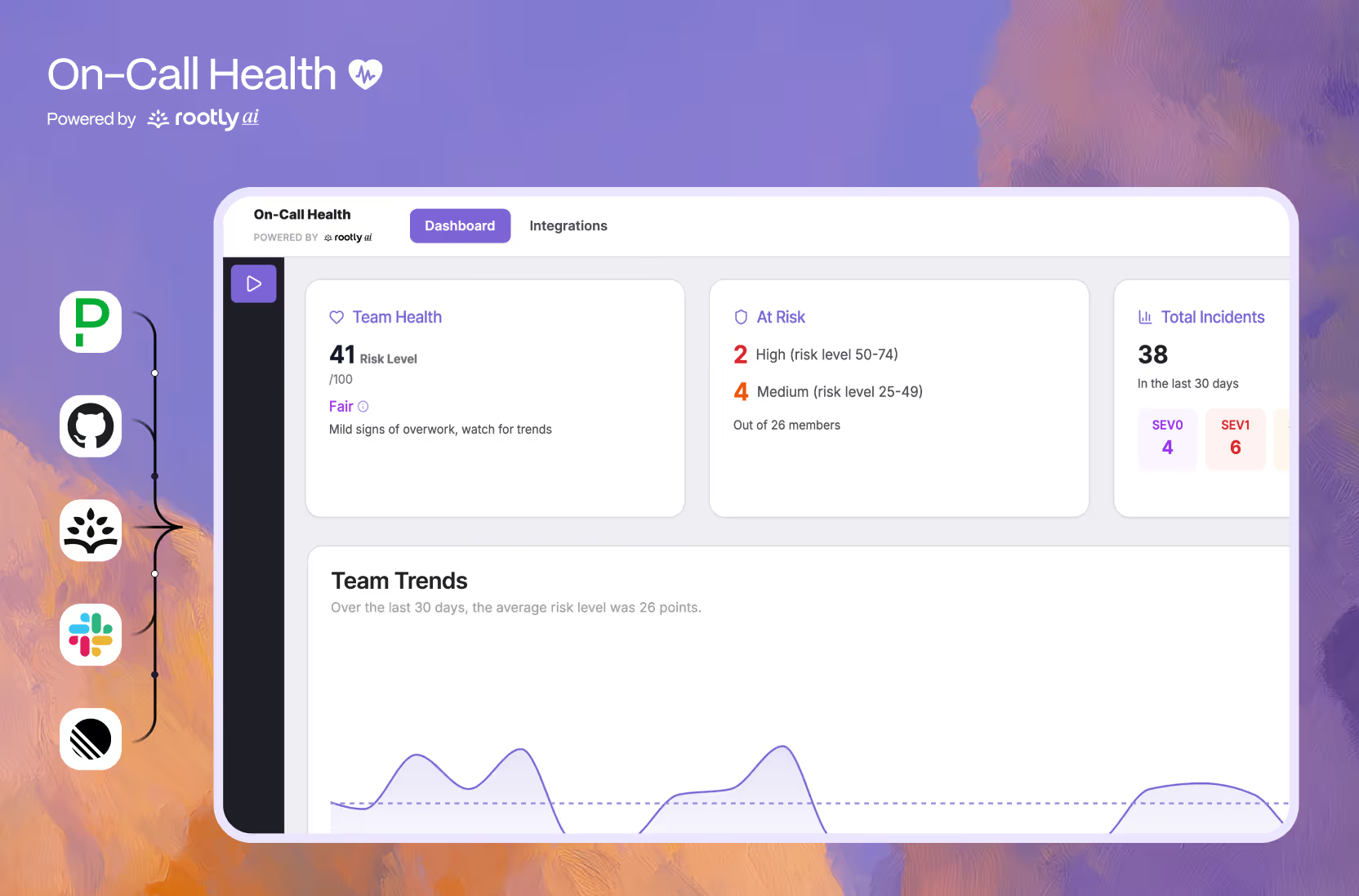
The tool tracks two types of signals. First, observed data pulled from your existing tools: incident volume and severity, after-hours pages, consecutive days with incidents, task load, commit patterns, and more. Second, optional self-reported check-ins where responders periodically share how they’re actually feeling, inspired by the Ecological Momentary Assessment methodology that Apple Health uses for its State of Mind feature.
These signals feed into a compound risk score (0–100). A high score doesn’t automatically mean something is wrong; some engineers genuinely thrive under high-severity incident response. But it’s a signal worth investigating.
Why trends matter more than snapshots
The real power isn’t in a single score but rather in what happens to that score over time.
On-Call Health tracks trends for both individuals and teams, relative to their own baselines. This matters because on-call load is personal. An incident volume that’s routine for a ten-year SRE veteran might be overwhelming for someone six months into their first on-call rotation. Static thresholds miss this. What you actually want to know is: is this person’s load shifting from their normal?
When you first set up the tool, you might spot existing high-load teams or individuals already running hot. Over time, you’ll see growing risk: scores climbing steeply above someone’s baseline, even if they haven’t crossed some arbitrary “danger” threshold yet.
“On-call issues rarely show up all at once. They build gradually. Without visibility, teams normalize unsustainable patterns.” – JJ Tang, CEO of Rootly
Many engineering orgs I’ve worked in have had some version of “oh, that’s just how it is during deploy week” or “yeah, the alerts are noisy, but we’re used to it.” On-Call Health gives you the data to question whether “used to it” is actually “slowly drowning in it :-).”
What you can actually do with this
If you’re an engineering leader, here’s what On-Call Health enables:
Catch problems early in 1:1s. Instead of asking “how’s on-call going?” and getting a polite “it’s fine,” you can look at the data together. If someone’s after-hours activity jumped 40% last month or their risk score has been climbing for three weeks, that’s a concrete starting point for a real conversation.
Make rotation decisions with evidence. Should you add another person to the rotation? Should you shift someone off for a sprint? On-Call Health gives you the data to justify these decisions to your team and to leadership.
Spot team-wide patterns. Maybe the whole backend team’s scores are elevated after a migration. Maybe one team consistently runs hotter than others. These patterns help you allocate resources and advocate for headcount where it’s genuinely needed.
Build a culture of sustainable on-call. When you make burnout risk visible, you signal that it matters. Engineers notice when leadership actually tracks this stuff, and it changes the conversation from “tough it out” to “let’s fix the system.”
Open source and free
On-Call Health is fully open source under Apache 2.0 and free to use. You can self-host it or use the hosted version at oncallhealth.ai at no cost. The hosted version includes mock data so you can explore the tool without connecting anything.
We also ship an MCP server, so you can pipe On-Call Health insights directly into AI tools your team already uses. And we have a REST API if you want to integrate the data into your own dashboards or workflows.
The project is built by Rootly AI Labs, and we’re actively welcoming contributions and feedback. If you’ve ever been on-call and thought “there has to be a better way to keep track of this,” we’d love to hear from you.
Related human stories
 Podcast
Your next internal developer platform is a library of agent skills

Michael Kutsch
Staff SRE and Team Lead, Cloud Foundations at PostHog
PostHog's Michael Kutsch explains why agent skills are becoming an internal developer platform, how autonomy drives adoption, and where deterministic guardrails still matter.
Nobody wants to review 1,000 lines of AI-generated code
Engineering leaders from CircleCI, Airbyte, Flare, Moloco, and Twingate reveal what their teams use instead of traditional code review.
 Podcast
Getting hired as an SRE is changing

James Duffy
Principal SRE at Fabric
Fabric Principal SRE James Duffy explains how AI is rewriting the SRE career path, from getting hired and developing judgment to continuous learning and AI platform engineering.