On-Call Policy & Wellbeing: Sleep, Time-Off, and the Human Side of Support
Learn how on-call policies impact sleep, stress, and burnout, and how fair scheduling, recovery time, and alert control protect long-term support wellbeing.

On-Call Policy & Wellbeing: Sleep, Time-Off, and the Human Side of Support
On this page
On-call support only works when policies protect sleep, recovery, and mental health as rigorously as they protect uptime. A healthy on-call policy reduces interruptions, compensates restricted freedom, enforces recovery time, and treats human capacity as a reliability requirement.
Modern organizations rely on 24/7 availability, yet many still design on-call as if people were interchangeable components. That gap is costly. When we ignore sleep, recovery, and the psychological load of availability, we increase errors, attrition, and long-term risk.
This article reframes on-call as a human system, explains the real health and performance impacts, and lays out practical policy designs that keep support sustainable.
Key Takeaways
- On-call disrupts sleep even when no incident occurs due to anticipatory stress.
- Fair rotations and predictability reduce anxiety, burnout, and errors.
- Compensation and time-off are safety controls, not perks.
- Fewer alerts matter more than faster responses.
- Recovery policies protect both people and reliability.
Defining On-Call Work in Modern Organizations
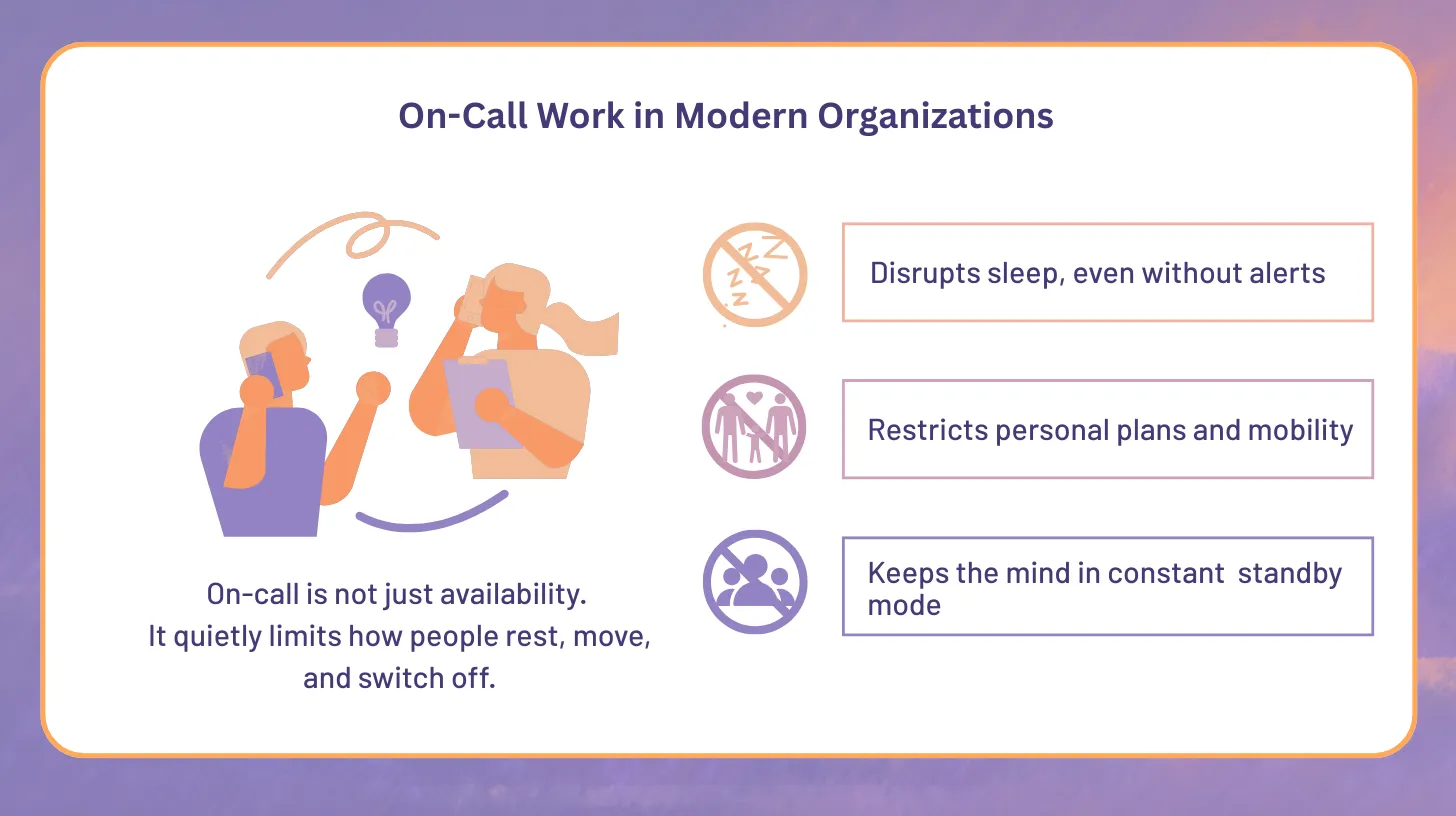
On-call work is availability under constraint, not just time spent responding to . The restriction of personal freedom creates measurable stress and sleep disruption.
What on-call actually means in practice
On-call is often described as “being available if something breaks,” but that framing misses the core issue. Availability limits how people sleep, travel, socialize, and mentally disengage.
Even when nothing happens, the requirement to be reachable changes behavior. People check phones at night. They avoid deep sleep. They stay half-alert. That constant low-grade vigilance is work. It carries a cost regardless of whether a pager goes off.
Common on-call models
Organizations typically use a mix of models, each with different wellbeing implications.
- Primary on-call where one person owns first response
- Secondary or backup on-call for escalation support
- Pager duty models with strict response times
- Escalation-only models intended to reduce noise
Problems arise when expectations are unclear or when escalation quietly becomes constant.
Why on-call is often poorly defined
Many teams lack a written policy that clearly defines boundaries. Response expectations are assumed rather than stated. Cultural pressure rewards immediate replies even when policy allows delay.
Over time, on-call quietly expands into a 24/7 expectation. Without clear definitions, people default to over-availability to avoid blame.
The Science of Sleep Loss and On-Call Stress
Anticipating an on-call alert disrupts sleep quality even when no alert occurs. Sleep fragmentation impairs cognition, judgment, and reaction time.
How on-call disrupts sleep quality
Sleep is structured in cycles. Deep sleep and REM sleep are critical for memory, emotional regulation, and decision-making. On-call disrupts those cycles in two ways.
First, alerts wake people abruptly, fragmenting sleep. Second, anticipation alone prevents deep sleep. When the brain expects interruption, it maintains a lighter sleep state. The result is shorter, poorer-quality rest even on quiet nights.
This is why people often report feeling exhausted after “uneventful” on-call weeks.
Cognitive and performance impact
Acute sleep loss has immediate effects that matter in high-stakes support roles.
- Slower reaction times
- Reduced vigilance
- Impaired judgment and problem-solving
- Increased likelihood of mistakes during incidents
Ironically, the moments when teams need clarity and precision are often when people are least cognitively equipped.
Long-term health risks
Repeated sleep disruption compounds over time. Chronic on-call exposure is associated with higher rates of burnout, anxiety, and depressive symptoms.
Physical health suffers as well, with increased risk tied to long-term sleep deprivation. Resilience is not an unlimited resource. It erodes when recovery is insufficient.
The Hidden Personal and Family Cost of On-Call
On-call does not affect only the person holding the phone. It spills into shared spaces and shared lives.
Partners often experience disrupted sleep from alerts or restless behavior. Family plans are adjusted around availability. Even when physically present, people remain mentally tethered to work. Over time, this creates strain that no amount of “thank you” can offset.
The emotional labor is subtle but persistent. People feel guilty for missing calls and guilty for prioritizing personal needs. That tension accelerates burnout and disengagement.
Core Principles of a Human-Centered On-Call Policy
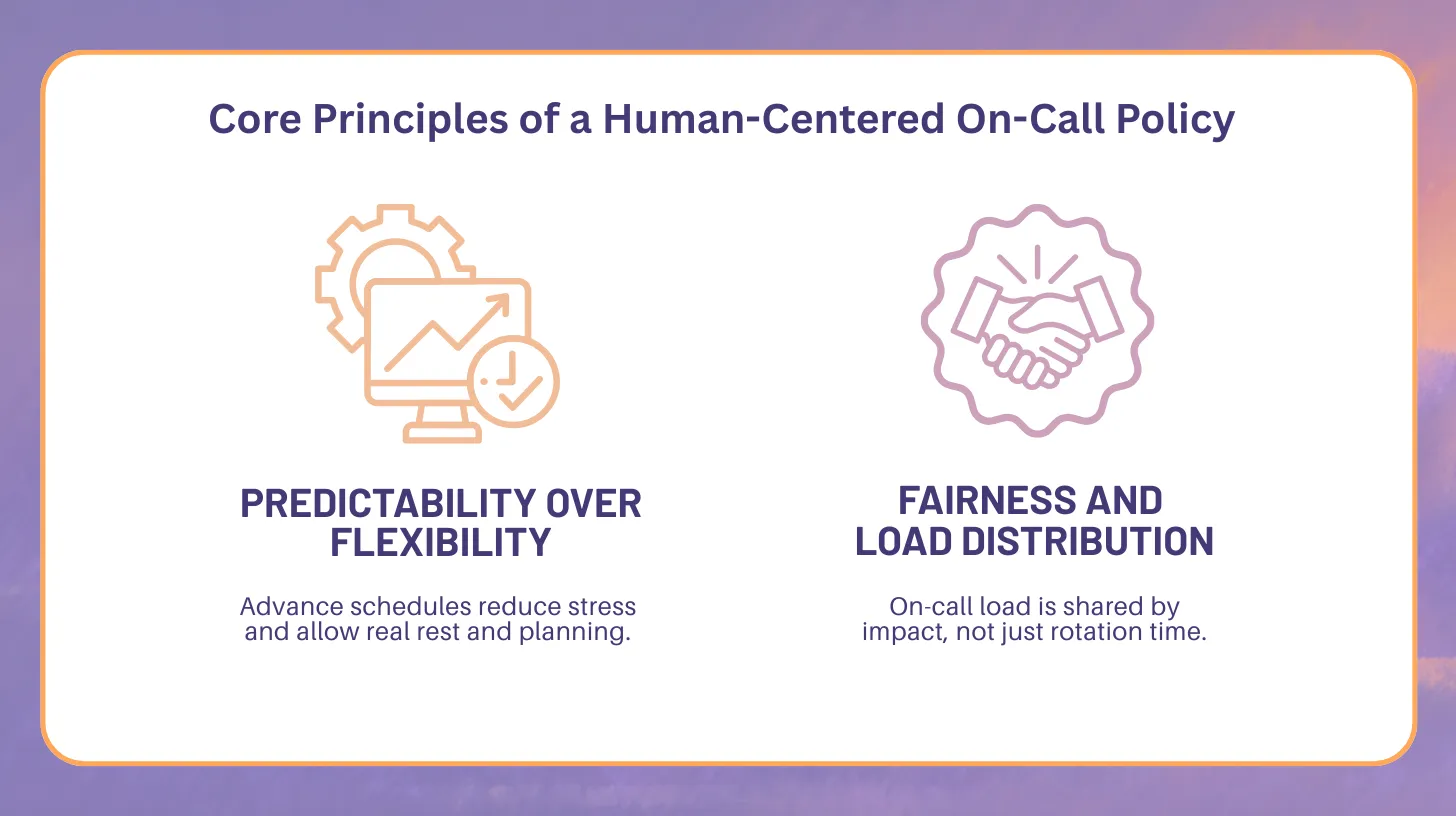
A healthy on-call policy prioritizes predictability, fairness, and recovery. It treats human limits as non-negotiable design constraints.
Predictability over flexibility
Flexibility sounds attractive, but unpredictability is stressful. Human-centered policies emphasize advance scheduling. People should know when they are on-call well ahead of time so they can plan sleep, family commitments, and recovery.
A common best practice is publishing schedules at least two weeks in advance. More is better when possible.
Fairness and load distribution
Fairness is not just about equal rotation length. It is about equal burden. Some weeks are quiet. Others are brutal.
Teams should track on-call load, including number of alerts and overnight interruptions, and adjust rotations accordingly. When the same people repeatedly absorb the hardest shifts, resentment and attrition follow.
Scheduling Models That Protect Wellbeing
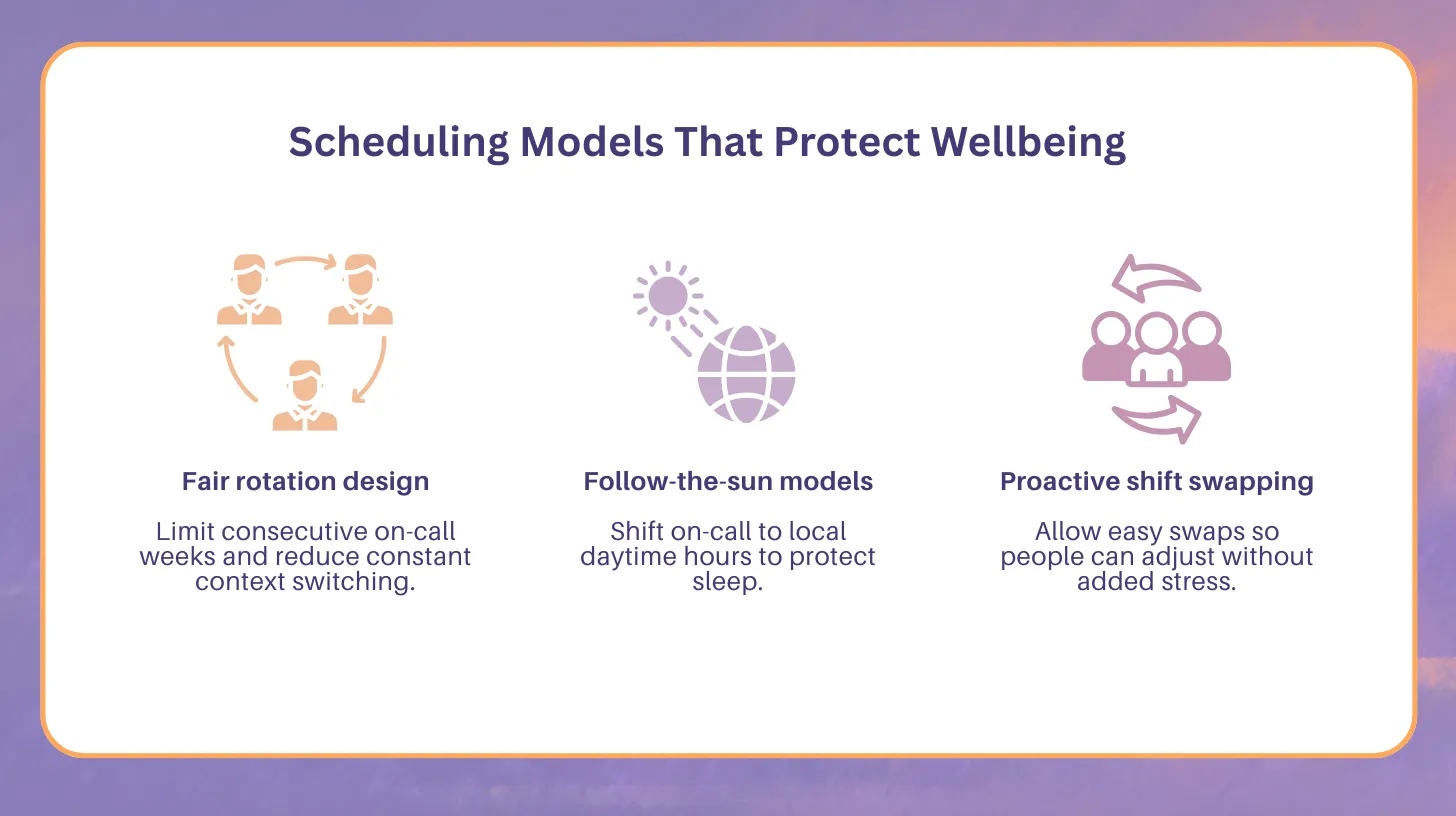
Scheduling determines stress more than individual resilience.
Fair rotation design
Effective rotations limit consecutive on-call periods and separate primary and secondary responsibilities. Weekly rotations are often more humane than daily swaps because they reduce constant context switching.
However, weekly rotations require stronger recovery policies. Teams should define maximum consecutive on-call weeks and enforce cooldown periods.
Follow-the-sun models
For global teams, follow-the-sun scheduling dramatically reduces overnight disruption. Coverage is handed off across regions so that on-call occurs during local daytime hours whenever possible.
This model requires coordination and trust, but it pays dividends in sleep quality and long-term sustainability.
Proactive shift swapping
Life happens. Human-centered policies allow easy, visible shift swapping without stigma. Guardrails matter to prevent quiet overwork, but autonomy reduces stress and increases perceived fairness.
Compensation, Time-Off, and Recovery Policies
On-call restricts personal freedom and must be compensated even when no call occurs. Time-off after disruption is a safety requirement, not a benefit.
Financial compensation models
Compensation acknowledges that availability has value. Common approaches include flat stipends per on-call period, additional pay for primary coverage, or incident-based bonuses.
The exact model matters less than the signal it sends. Unpaid availability communicates that human cost is invisible.
Time-in-lieu and recovery time
Money alone does not restore sleep. Recovery time is essential. Many teams provide a half-day or full day off after a week of primary on-call, with additional time granted after overnight incidents.
Some organizations implement mandatory rest periods after severe disruptions. This removes the burden of self-advocacy and protects performance.
Why time-off is a safety control
Fatigued people make more mistakes. Recovery time reduces incident recurrence, improves decision-making, and lowers attrition. Treating time-off as optional undermines its effectiveness.
Sleep Recovery and Post-Incident Flexibility
Sleep loss cannot be instantly reversed. Policies must support multi-day recovery when needed.
Post-call flexibility
After overnight calls, people should have flexibility to start later, skip meetings, or take a dedicated sleep day. Rigid schedules force people to choose between health and appearing committed. Clear guidelines remove ambiguity and guilt.
Managing sleep debt
Sleep debt accumulates across nights. One good night does not erase several bad ones. Managers should recognize that productivity may dip temporarily after heavy on-call weeks and plan workloads accordingly.
Alert Hygiene and Reducing Unnecessary Interruptions
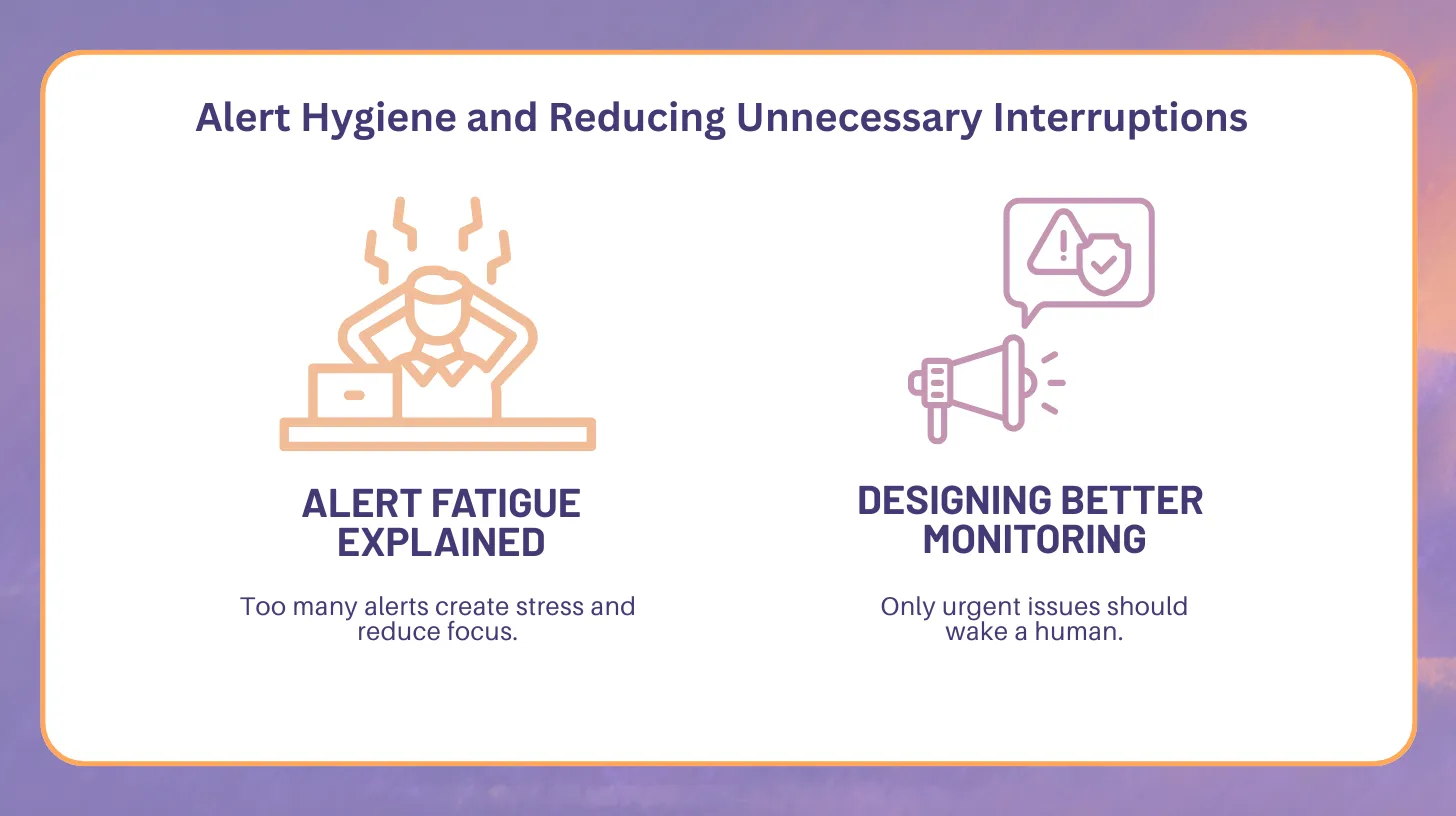
Reducing alerts improves wellbeing more than speeding up response times. Every unnecessary alert erodes trust and sleep.
Alert fatigue explained
Alert fatigue occurs when systems generate noise rather than actionable signals. False positives, low-severity alerts, and poorly tuned thresholds train people to expect interruption without value. Over time, this degrades response quality and increases stress.
Designing better monitoring
Healthy systems distinguish between issues that require immediate action and those that can wait. Techniques include severity thresholds, business-hours deferral for non-critical issues, and automation that resolves known failure modes. Every alert should justify the cost of waking a human.
Clear Boundaries and the Right to Disconnect
On-call boundaries protect rest and prevent cultural creep.
Defining on-call versus off-call time
Policies should explicitly state when people are allowed to disconnect. Devices should be silenced when not on-call. Escalation paths should respect these boundaries. When boundaries are vague, people assume constant availability.
Protecting rest periods
Rest periods should be guaranteed and enforced. This includes minimum downtime between shifts and protection from retaliation for using recovery time. Culture must support the policy, not undermine it.
Management’s Role in Protecting On-Call Wellbeing
Leadership behavior determines whether policies work.
- Transparent expectations: Managers must clearly define response times, escalation criteria, and what constitutes an emergency. Ambiguity drives anxiety and over-response.
- Training and preparation: Runbooks, simulations, and training reduce stress during real incidents. Confidence shortens resolution time and lowers cognitive load.
- Psychological safety and advocacy: People should feel safe asking for time off after difficult shifts. Normalizing recovery counters hero culture and protects long-term performance.
Continuous Improvement Through Review and Measurement
On-call systems should evolve to reduce human cost over time.
- Post-incident reviews: Blameless reviews identify recurring causes and systemic fixes. The goal is fewer interruptions, not faster heroics.
- Measuring on-call health: In addition to technical metrics, teams should monitor human indicators such as frequency of overnight calls, distribution of load, and reported fatigue. These metrics guide policy refinement.
Common On-Call Policy Mistakes to Avoid
Organizations often stumble in predictable ways.
- Treating on-call as “light work”
- Ignoring anticipatory stress
- Relying on individual resilience instead of system design
- Rewarding burnout disguised as dedication
Avoiding these traps requires intentional policy design and leadership commitment.
Sustainable Support Requires Human-Centered Design
At Rootly, we see every day how on-call policies shape how people sleep, think, and live. When organizations treat availability as free and recovery as optional, reliability eventually suffers. When systems are designed with real human limits in mind, both people and platforms perform better over time.
From our perspective, sustainable support is not built on faster responses alone. It is built by reducing unnecessary interruptions, compensating restricted freedom, and enforcing recovery as a core safety control. That is the human side of support, and it is the foundation of long-term reliability.
Related human stories
 Podcast
Your next internal developer platform is a library of agent skills

Michael Kutsch
Staff SRE and Team Lead, Cloud Foundations at PostHog
PostHog's Michael Kutsch explains why agent skills are becoming an internal developer platform, how autonomy drives adoption, and where deterministic guardrails still matter.
Nobody wants to review 1,000 lines of AI-generated code
Engineering leaders from CircleCI, Airbyte, Flare, Moloco, and Twingate reveal what their teams use instead of traditional code review.

 Podcast
Getting hired as an SRE is changing

James Duffy
Principal SRE at Fabric
Fabric Principal SRE James Duffy explains how AI is rewriting the SRE career path, from getting hired and developing judgment to continuous learning and AI platform engineering.