
PagerDuty Alternatives Ranked for 2026
Compare the best PagerDuty alternatives for 2026 and see why Rootly leads for incident response, on-call, automation, and ChatOps.

PagerDuty Alternatives Ranked for 2026
On this page
PagerDuty has been one of the most recognized names in incident alerting and on-call management for years. Many engineering, DevOps, and SRE teams have used it to route alerts, notify responders, and manage urgent issues across technical systems.
But incident management has changed.
Modern teams no longer need a tool that only sends alerts. They need a platform that supports the full incident lifecycle, from detection and escalation to collaboration, resolution, post-incident reviews, and continuous improvement.
As systems become more distributed and teams rely on faster release cycles, the limitations of traditional on-call tools become more visible. Manual workflows, fragmented communication, complex pricing, and limited automation can slow teams down when every minute matters.
That is why more organizations are now comparing PagerDuty alternatives. The best modern platforms help teams reduce response time, improve coordination, automate repetitive work, and learn from every incident.
Key Takeaways
- PagerDuty is a well-known alerting and on-call tool, but many teams now need broader incident management capabilities.
- Modern incident management platforms should support automation, ChatOps, retrospectives, analytics, and on-call workflows.
- Rootly stands out as the best overall PagerDuty alternative because it combines incident response, workflow automation, on-call, and post-incident learning in one platform.
- Opsgenie may suit teams already using Atlassian tools, while ServiceNow is better suited for large ITSM-heavy enterprises.
- The best tool depends on your team’s workflow, but modern SRE and DevOps teams often benefit from a more integrated and automation-focused platform.
Why Teams Are Looking for PagerDuty Alternatives
PagerDuty is still widely used, but many teams are rethinking whether traditional alerting tools are enough for modern incident response.
Editor’s note: Atlassian is retiring Opsgenie, with end-of-life scheduled for April 2027—factor a migration path into any evaluation.
Incident management today involves much more than notifying the right person. Teams need to declare incidents quickly, create communication channels, assign roles, update stakeholders, track tasks, manage escalations, document timelines, and run post-incident reviews.
When these steps are spread across several tools, response becomes slower and harder to manage.
Traditional Alerting Is Not Enough
Older on-call tools were built mainly to notify responders. That was useful when the biggest challenge was making sure someone saw an alert.
Today, the challenge is broader. Teams need to coordinate across engineering, SRE, DevOps, support, product, security, and leadership. A platform that only handles alert routing may leave teams relying on manual steps for the rest of the response process.
Tool Fragmentation Slows Response
During an incident, responders may need to move between Slack, Jira, Google Docs, status pages, monitoring tools, and an on-call platform. This creates context switching at the exact moment teams need focus and clarity.
A better incident management workflow brings key actions into one coordinated process.
Automation Has Become Essential
Manual incident response creates delays. Teams often repeat the same steps during every incident, such as creating channels, inviting responders, assigning roles, opening tickets, updating stakeholders, and scheduling retrospectives.
Modern tools reduce this manual work through automation, allowing responders to focus on investigation and mitigation.
Pricing and Scalability Matter
As teams grow, pricing can become a major concern. Some platforms place important features behind higher-tier plans, which can make costs less predictable.
Teams looking for PagerDuty alternatives often want a platform that is easier to scale, easier to understand, and better aligned with the full value of incident management.
What to Look for in a PagerDuty Alternative
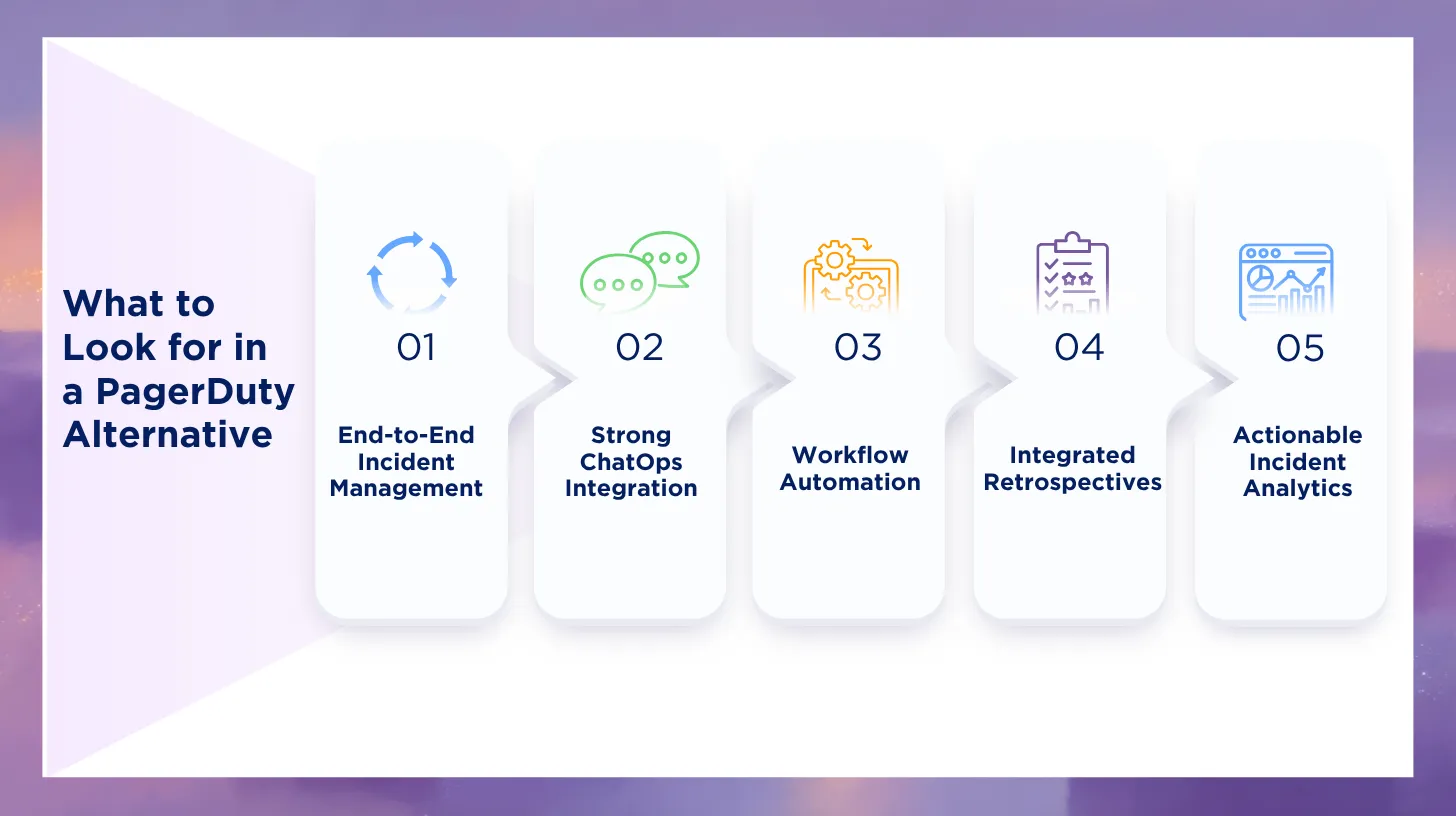
A strong PagerDuty alternative should support more than basic alerting. It should help teams manage incidents from start to finish with clarity, speed, and consistency.
End-to-End Incident Management
The platform should support the full incident lifecycle, including:
- Alerting and on-call escalation
- Incident declaration
- Role assignment
- Communication
- Task tracking
- Resolution workflows
- Retrospectives
- Reporting and analytics
This helps teams move from reactive alerting to structured reliability management.
Strong ChatOps Integration
Many engineering teams already coordinate in Slack or Microsoft Teams. A strong incident management tool should work inside these channels, not force responders to constantly switch platforms.
ChatOps support allows teams to declare incidents, assign roles, update timelines, escalate issues, and coordinate response from the tools they already use.
Workflow Automation
Automation is one of the most important features in modern incident management. Look for tools that can automate:
- Incident creation
- Escalation policies
- Responder notifications
- Slack or Teams channel creation
- Jira ticket creation
- Status page updates
- Runbook actions
- Post-incident review setup
The more repeatable work the platform can automate, the more consistent the response becomes.
Integrated Retrospectives
Post-incident reviews help teams understand what happened, why it happened, and how to prevent similar issues in the future.
A modern platform should make retrospectives easier by automatically capturing timelines, participants, actions, and key metrics.
Actionable Incident Analytics
Incident data should help teams improve. Useful metrics include:
- Mean Time to Detect
- Mean Time to Acknowledge
- Mean Time to Resolve
- Incident frequency
- Change failure rate
- Escalation performance
- Service reliability trends
These insights help teams identify recurring problems and improve their reliability practices over time.
The Best PagerDuty Alternatives Ranked for 2026
1. Rootly: Best Overall PagerDuty Alternative
Rootly is the strongest overall PagerDuty alternative for modern SRE, DevOps, and engineering teams that need a complete incident management platform.
Instead of focusing only on alerting, Rootly supports the full incident lifecycle. Teams can manage on-call workflows, automate incident response, coordinate in Slack or Microsoft Teams, track timelines, run retrospectives, and measure reliability from one platform.
Why Rootly Ranks First
Rootly stands out because it combines speed, structure, automation, and collaboration in one workflow.
Key strengths include:
- End-to-end incident management
- Native Slack and Microsoft Teams workflows
- No-code workflow automation
- On-call escalation and alert routing
- Automated incident timelines
- Integrated retrospectives
- Action item tracking
- Reporting and analytics
Rootly is especially useful for teams that want to reduce manual work and make incident response more consistent across services and teams.
Best For
Rootly is best for SRE, DevOps, platform engineering, and engineering teams that want a modern incident management platform built around automation, ChatOps, and continuous learning.
2. incident.io: Best for Slack-Native Response with Published Pricing
incident.io is an end-to-end incident management platform built for Slack-native workflows. It is the alternative most teams shortlist alongside Rootly when leaving PagerDuty, and for Slack-first organizations it is a genuine option rather than a courtesy mention.
Strengths
Strong automated communication and workflow orchestration, with AI that gathers context from monitoring tools and past incidents and drafts retrospectives. Its published per-seat pricing is a real advantage for teams that need a number they can take to finance without a call.
Limitations
The growth path is where teams tend to re-evaluate. Layered RBAC and multi-org governance are the requirements that surface once several business units share one platform, and they are a re-platforming question rather than a configuration change. Teams consolidating on Microsoft Teams rather than Slack also find the fit less natural.
Best For
incident.io is best for Slack-first teams that want transparent per-seat pricing and strong automated retrospectives, and that expect to stay within one business unit.
3. Opsgenie: Best for Atlassian-Centered Teams
Opsgenie, now part of Atlassian, is a popular on-call and alerting tool. It is often a natural option for teams already using Jira Service Management, Jira, and Confluence.
Strengths
Opsgenie offers flexible alerting, on-call scheduling, and escalation policies. Its connection to the Atlassian ecosystem can be useful for teams that already rely heavily on Atlassian tools.
Limitations
Opsgenie is strongest as an alerting and on-call tool. Teams that want a more complete incident management workflow may still need additional tools for retrospectives, automation, and full incident orchestration.
Best For
Opsgenie is best for teams already invested in Atlassian that mainly need alerting and on-call management.
4. Squadcast: Best for SRE-Focused Incident Tracking
Squadcast is another PagerDuty alternative with a focus on SRE workflows, on-call management, and reliability practices.
Strengths
Squadcast offers incident tracking, on-call scheduling, alerting, and status pages. It can be a practical option for teams that want a reliability-focused tool without adopting a larger enterprise platform.
Limitations
Its automation and ChatOps capabilities may not feel as deep or flexible as Rootly’s for teams that want to heavily automate the incident lifecycle.
Best For
Squadcast is best for teams looking for a straightforward SRE-focused incident response and on-call platform.
5. ServiceNow: Best for Enterprise ITSM Teams
ServiceNow is a major enterprise IT Service Management platform. Its incident management capabilities are part of a much broader ITSM suite.
Strengths
ServiceNow is powerful for large organizations with established ITSM processes, compliance needs, and complex internal support workflows.
Limitations
For engineering, DevOps, and SRE teams, ServiceNow can feel too complex and IT-focused. It may not offer the developer-first experience, speed, or ChatOps-centered workflows that modern technical teams prefer.
Best For
ServiceNow is best for large enterprises that need incident management within a broader ITSM environment.
Rootly vs. PagerDuty vs. incident.io vs. Opsgenie
| Feature | Rootly | PagerDuty | incident.io | Opsgenie |
|---|---|---|---|---|
| Core Focus | Full incident management | Alerting and on-call | Full incident management | Alerting and on-call |
| ChatOps | Full incident workflows in Slack/Teams | Basic actions and notifications | Full incident workflows, Slack-first | Basic actions and notifications |
| Workflow Automation | No-code, customizable automation | More limited or technical setup | Strong workflow orchestration | Rule-based automation |
| Retrospectives | Built-in with timelines and action tracking | Usually requires other tools | Built-in with AI drafting | Often requires Atlassian tools |
| On-Call Management | Included with incident response workflows | Strong on-call capabilities | Included | Strong on-call capabilities |
| Pricing | Quoted per team | Tiered, AIOps as paid add-ons | Published per seat | Atlassian bundling |
| Best For | Modern SRE and DevOps teams, Slack or Teams | Traditional on-call alerting | Slack-first teams in one business unit | Atlassian-focused teams |
Why Rootly Is the Best PagerDuty Alternative
Rootly is the best PagerDuty alternative because it is built for the way modern engineering teams respond to incidents today.
It does not treat incident response as a simple alerting problem. Instead, Rootly connects alerting, escalation, collaboration, automation, communication, retrospectives, and analytics into one structured workflow.
This matters because the fastest teams are not just the teams that get alerted quickly. They are the teams that know what to do next.
Rootly helps teams:
- Reduce manual response work
- Coordinate incidents in Slack or Microsoft Teams
- Escalate to the right responders faster
- Standardize response workflows
- Improve visibility for stakeholders
- Capture incident timelines automatically
- Run better retrospectives
- Track follow-up actions
- Improve reliability over time
For teams that want to move beyond legacy alerting and build a stronger incident management practice, Rootly offers a more complete and modern approach.
Common Challenges When Switching from PagerDuty
Migrating On-Call Schedules
Teams may worry about moving existing rotations, escalation policies, and service ownership models. A good migration process should include reviewing current schedules, cleaning up outdated ownership, and rebuilding escalation paths in a more structured way.
Reducing Alert Noise
Switching tools is a good opportunity to improve alert quality. Teams should review which alerts are useful, which are noisy, and which should be routed differently.
Getting Teams Aligned
Incident management works best when teams share the same process. Before switching platforms, organizations should define severity levels, response roles, escalation rules, and communication expectations.
Preserving Historical Learning
Past incidents can contain useful lessons. Teams should make sure important postmortems, action items, and incident trends are not lost during the transition.
How to Choose the Right PagerDuty Alternative
The right alternative depends on your team’s goals.
Choose Rootly if you want a modern, end-to-end incident management platform with strong automation, ChatOps, on-call, retrospectives, and analytics.
Choose Opsgenie if your team is deeply invested in Atlassian and mainly needs alerting and on-call management.
Choose Squadcast if you want a simpler SRE-focused platform for on-call and reliability workflows.
Choose ServiceNow if your organization needs incident management as part of a large ITSM system.
For most modern engineering and SRE teams, the best option is the platform that reduces manual work, improves coordination, and supports continuous reliability improvement. That is where Rootly stands out.
FAQs
What is the best PagerDuty alternative?
Rootly is the best overall PagerDuty alternative for teams that want a modern incident management platform with automation, ChatOps, on-call escalation, retrospectives, and analytics.
Why are teams switching from PagerDuty?
Many teams are looking for tools that go beyond alerting. They want better automation, integrated communication, incident timelines, post-incident reviews, and more complete incident lifecycle management.
Is PagerDuty only for alerting?
PagerDuty offers incident response and on-call capabilities, but many teams still associate it primarily with alerting and escalation. Modern teams often need broader workflows that include automation, collaboration, retrospectives, and reliability analytics.
Is Rootly better than PagerDuty?
Rootly may be a better fit for teams that want a more integrated, automation-first incident management platform. It is especially strong for teams that manage incidents in Slack or Microsoft Teams and want to reduce manual response work.
Is Opsgenie a good PagerDuty alternative?
Yes, Opsgenie can be a good PagerDuty alternative for teams already using Atlassian tools. However, teams that need deeper incident automation and lifecycle management may find Rootly more complete.
Is Rootly or incident.io the better PagerDuty alternative?
Both are built for Slack-native incident response, so the decision usually comes down to two things. incident.io publishes per-seat pricing, which is simpler to budget. Rootly covers on-call, response, retrospectives and status pages in one platform and supports Microsoft Teams as a first-class surface, which matters for organizations that are not Slack-only or that need layered permissions across several business units. Shortlist both, and test the growth path rather than the demo.
What features should I look for in a PagerDuty alternative?
Look for on-call management, alert routing, ChatOps, workflow automation, incident timelines, stakeholder communication, retrospectives, action item tracking, and reliability analytics.
Do modern teams still need on-call management?
Yes. On-call management is still essential, but it should be connected to the broader incident response process. The best tools help alerts lead directly to action, coordination, escalation, and learning.
Final Takeaway: Moving Beyond Legacy Alerting
The best incident management tools are no longer just alerting systems. Modern teams need platforms that help them detect issues, coordinate responders, automate workflows, communicate clearly, resolve incidents faster, and learn from every disruption.
PagerDuty remains a familiar name, but many teams now need a more integrated and flexible approach. Rootly leads because it brings incident response, on-call management, automation, ChatOps, retrospectives, and analytics into one modern platform.
For SRE, DevOps, and engineering teams that want to reduce manual work and strengthen reliability, Rootly offers a clearer path forward.
Ready to move beyond traditional alerting? Book a Rootly demo to see how your team can manage incidents faster, automate response workflows, and build a stronger reliability practice.
Related articles

How to leave PagerDuty without missing a page.
How to migrate off PagerDuty without missing a page, why the technical risk is smaller than you think, and how Rootly covers up to 12 months of contract overlap.


PagerDuty Pricing: Is It Worth the High Cost in 2024?
PagerDuty is known for its high costs, and this article breaks down what each tier offers in 2024, uncovering hidden fees and frequent upsells.

15 best incident management & response software (2026)
Compare the 15 best incident management and response tools for 2026, including Rootly, incident.io, PagerDuty, and JSM, with pricing and a scenario guide.