Best On-Call Software Compared: What Engineering Teams Actually Use in 2026
Compare the best on-call software in 2026 for alerting, escalation, incident response, automation, and engineering reliability.

Best On-Call Software Compared: What Engineering Teams Actually Use in 2026
On this page
Modern engineering teams cannot afford missed alerts, unclear ownership, or slow incident response. As systems become more distributed and customer expectations rise, on-call management has evolved from simple alerting into a structured reliability discipline that blends escalation, automation, incident coordination, and post-incident learning.
The best on-call software is no longer just about paging the right person. Teams now need flexible scheduling, escalation policies, alert routing, Slack or Microsoft Teams workflows, stakeholder communication, AI-assisted incident response, and reliability insights that improve operational maturity over time. What works for a startup managing a handful of services may not work for a global engineering organization handling mission-critical infrastructure.
Learning about the best on-call software in 2026 means understanding how engineering teams actually operate. Some prioritize enterprise-grade reliability and mature escalation systems. Others care more about Slack-native workflows, automation, incident orchestration, or affordable alerting for smaller teams. The right platform depends on your team’s size, complexity, communication style, and long-term incident management goals.
Key Takeaways
- The best on-call software should support more than alerting, including escalation, incident coordination, automation, and post-incident workflows.
- Rootly is a strong choice for teams wanting full incident lifecycle management with Slack-native workflows and automation.
- PagerDuty remains a leading option for large enterprises that need mature alerting and high reliability.
- Incident.io works well for teams that prefer lightweight Slack-native incident coordination.
- Grafana OnCall is ideal for observability-heavy engineering teams already using Grafana, Prometheus, or Kubernetes.
- OnPage stands out for industries that require guaranteed alert delivery and persistent notifications.
- Smaller teams may prefer more affordable platforms like TaskCall or lightweight tools that reduce operational overhead.
- Choosing the right platform depends on alert complexity, integrations, incident maturity, team size, and scalability.
What to Look for in On-Call Software
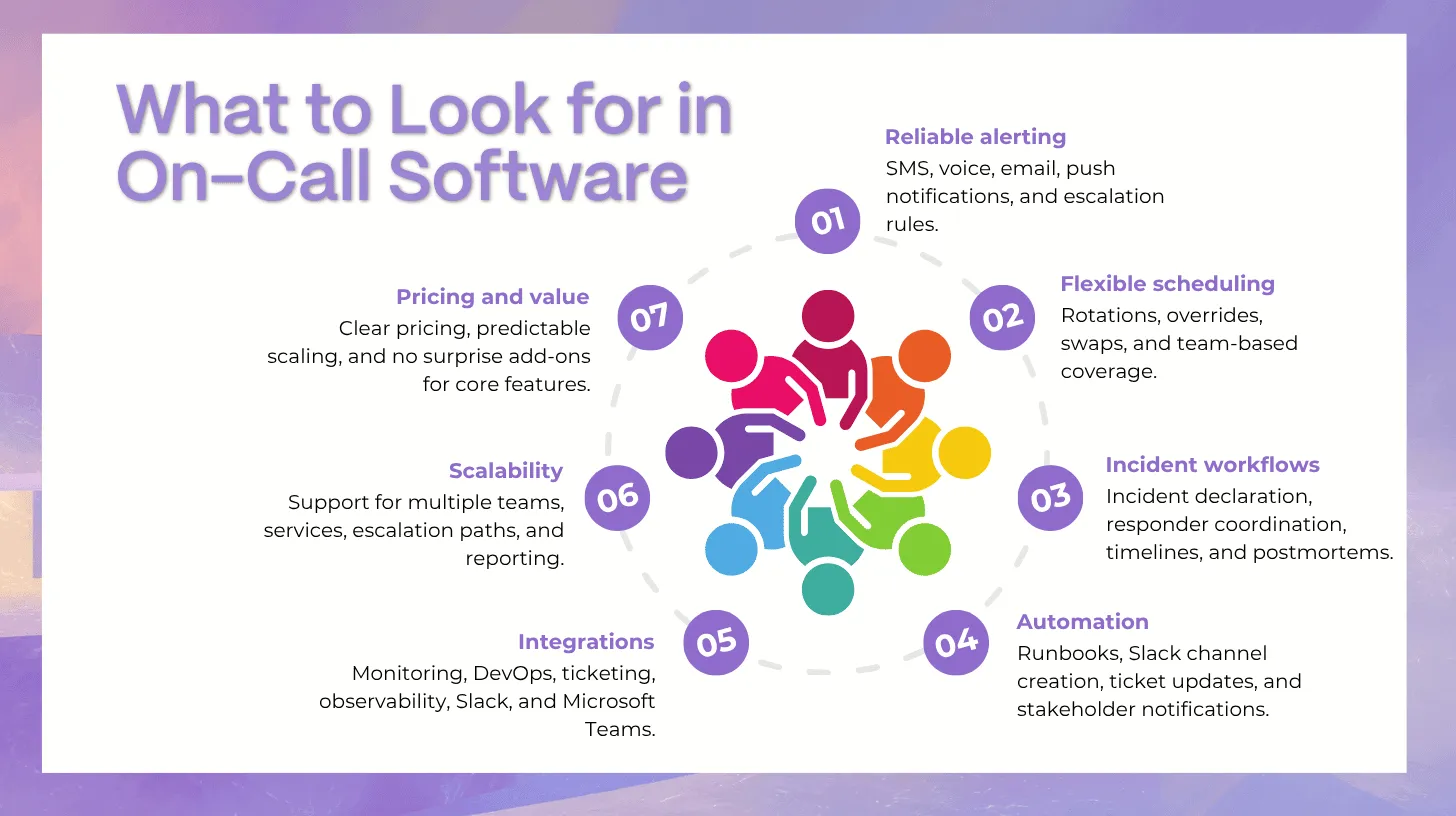
Choosing on-call software starts with understanding how your engineering team responds to incidents under pressure. The right platform should help reduce noise, speed up response, improve accountability, and support long-term reliability.
Alerting Reliability and Escalation Policies
At the core of any on-call system is reliable alert delivery. Missed alerts can quickly turn small outages into major incidents.
Look for software that supports:
- Escalation chains
- Multi-channel notifications (SMS, voice, email, push)
- Alert routing rules
- Retry logic and acknowledgement tracking
- Flexible responder policies
Some engineering organizations also need persistent paging that bypasses silent mode or Do Not Disturb settings for critical systems.
Flexible Scheduling and Rotations
Managing on-call schedules becomes more difficult as teams grow.
Strong platforms should support:
- Rotating schedules
- Vacation overrides
- Temporary coverage swaps
- Follow-the-sun support
- Team-based routing
Without good scheduling tools, burnout and missed ownership become major risks.
Slack and Microsoft Teams Workflows
Many modern engineering teams manage incidents inside chat tools.
Slack-native or Teams-native workflows help teams:
- Coordinate faster
- Reduce context switching
- Create incident channels automatically
- Assign responders quickly
- Keep communication centralized
This becomes increasingly important for distributed engineering organizations.
Incident Lifecycle Support
On-call software increasingly overlaps with incident management.
Modern teams often prefer platforms that support:
- Incident declaration
- Responder coordination
- Stakeholder communication
- Status updates
- Timelines
- Postmortems
Alerting alone is often no longer enough for scaling teams.
Automation and Workflow Orchestration
Manual incident coordination creates delays.
The strongest platforms automate repeatable actions such as:
- Paging the right responder
- Creating Slack channels
- Triggering runbooks
- Opening tickets
- Sending updates
- Preparing post-incident reports
Automation reduces human error during high-pressure moments.
Integrations With Your Engineering Stack
Your on-call platform should integrate with existing monitoring and infrastructure systems.
Key integrations often include:
- Datadog
- Splunk
- Jira
- Kubernetes
- Grafana
- Prometheus
- AWS CloudWatch
- New Relic
- Microsoft Teams
- Slack
The faster alerts flow into response workflows, the faster teams recover.
Scalability for Growing Teams
Small engineering teams may only need alert routing.
Larger organizations often need:
- Service ownership mapping
- Advanced reporting
- Multi-team escalations
- AI assistance
- Automation
- Cross-functional coordination
Choosing software that scales can prevent expensive migrations later.
Best On-Call Software Engineering Teams Actually Use in 2026
Not all on-call software solves the same problem. Some tools prioritize reliable alerting and escalation, while others focus on incident coordination, automation, Slack-native workflows, or full lifecycle reliability management.
To compare the strongest on-call platforms, we evaluated each tool based on alerting reliability, scheduling flexibility, escalation capabilities, incident response workflows, automation, integrations, pricing scalability, and overall suitability for modern engineering teams.
1. Rootly — Best Overall for Modern On-Call and Incident Management
Why engineering teams choose Rootly
Rootly has evolved beyond traditional incident management and now offers strong on-call capabilities combined with full incident lifecycle orchestration. For teams that want alerting, scheduling, incident coordination, automation, stakeholder communication, and postmortems in one platform, Rootly stands out as one of the strongest modern choices.
Unlike traditional paging-only tools, Rootly helps engineering teams manage what happens after the alert. Teams can coordinate incidents directly in Slack, automate workflows, assign responders, generate timelines, and improve reliability over time.
This makes Rootly especially valuable for engineering organizations that are scaling and need more operational maturity without introducing fragmented tooling.
Standout capabilities
- Native on-call scheduling and escalation policies
- Slack-native incident coordination
- Automated incident workflows and playbooks
- AI-generated summaries and timelines
- Stakeholder communication and status pages
- Postmortem generation and reporting
- Strong DevOps and SRE integrations
Where Rootly stands out
Many on-call tools stop at alert delivery. Rootly extends into incident orchestration, allowing teams to automate repetitive response work and standardize reliability practices.
For teams already running incidents inside Slack, Rootly reduces friction significantly by keeping responders inside existing workflows.
Trade-offs to consider
- More advanced than what small teams may initially need
- Best value comes with operational maturity
- Requires thoughtful setup to maximize automation
Best fit teams
- Scaling engineering teams
- SRE and platform teams
- Slack-first organizations
- Teams standardizing incident response
2. PagerDuty — Best for Enterprise-Grade Reliability
Why engineering teams choose PagerDuty
PagerDuty remains one of the most widely adopted on-call and incident response platforms in large engineering organizations.
Its reputation comes from mature escalation systems, reliable alert delivery, event intelligence, and broad integration support. For enterprises managing complex infrastructure across many teams, PagerDuty continues to be one of the safest choices.
PagerDuty performs particularly well when organizations need highly structured escalation paths, alert deduplication, and enterprise-grade operational resilience.
Standout capabilities
- Advanced alert routing and escalation
- Flexible on-call scheduling
- Event intelligence and noise reduction
- Enterprise reporting and analytics
- Extensive integration ecosystem
- Proven reliability at scale
How it compares to newer platforms
PagerDuty remains stronger than many tools for large-scale alerting reliability. However, modern platforms increasingly compete by offering more Slack-native workflows and deeper incident automation.
Some engineering teams also find PagerDuty expensive as usage expands.
Trade-offs to consider
- Higher pricing as teams grow
- More complex configuration
- Less Slack-native than newer tools
Best fit teams
- Large enterprises
- Mission-critical infrastructure teams
- Mature DevOps organizations
- Complex multi-service environments
3. Incident.io — Best for Slack-First Engineering Teams
Why engineering teams choose Incident.io
Incident.io became popular by making incident response feel native to Slack.
Instead of forcing responders into dashboards, teams can declare incidents, assign ownership, coordinate communication, and track resolution directly inside Slack channels.
For organizations already managing engineering collaboration in Slack, Incident.io often feels faster and more lightweight than traditional enterprise tools — though lightweight and prescriptive are the same property seen from two sides, and the teams that outgrow the prescribed process are the ones that end up maintaining workarounds around it.
Standout capabilities
- Strong Slack-native workflows
- Incident channels and responder coordination
- AI-assisted incident summaries
- Simple onboarding and fast adoption
- Structured incident timelines
Where Incident.io performs best
Incident.io works particularly well for fast-moving engineering teams that prioritize speed and simplicity over heavy operational structure.
Smaller and mid-sized organizations often appreciate its lower operational overhead.
Trade-offs to consider
- Less workflow automation than Rootly
- Fewer enterprise-grade escalation features than PagerDuty
- Better for coordination than complex alerting
Best fit teams
- Slack-native engineering teams
- Mid-sized tech companies
- Fast-moving DevOps organizations
- Teams wanting fast adoption
4. Grafana OnCall — Best for Observability-Driven Teams
Why engineering teams choose Grafana OnCall
Grafana OnCall is a strong fit for teams already invested in observability tooling.
Engineering organizations running Grafana, Prometheus, and Kubernetes often prefer Grafana OnCall because alerts move naturally from monitoring dashboards into incident workflows.
For observability-heavy teams, this reduces tooling friction.
Standout capabilities
- Native Grafana ecosystem support
- Kubernetes and Prometheus integrations
- On-call scheduling and escalations
- Alert grouping and routing
- Open-source flexibility
Trade-offs to consider
- Best experience requires existing Grafana stack
- Less polished incident orchestration
- May require more engineering ownership
Best fit teams
- SRE teams
- Kubernetes-heavy environments
- Cloud-native organizations
- Teams already using Grafana
5. Squadcast — Best for SRE-Focused Reliability Workflows
Squadcast is a strong option for engineering teams that want on-call management connected to reliability practices. It combines alerting, escalation, incident response, runbooks, status pages, and reporting in one platform.
For SRE and platform teams, Squadcast is useful because it does not treat alerts as isolated events. It helps teams connect incident response with reliability goals, making it easier to track patterns, improve processes, and reduce repeat incidents over time.
Standout capabilities
- On-call scheduling and escalation
- Alert routing and incident response
- Built-in runbooks
- Status pages
- Reliability reporting
- SRE-focused workflows
Trade-offs to consider
- May not offer the same automation depth as Rootly
- Smaller ecosystem than PagerDuty
- Best suited for teams already using SRE practices
Best fit teams
- SRE teams
- Platform engineering teams
- Cloud-native organizations
- Teams focused on reliability improvement
6. OnPage — Best for Guaranteed Critical Alert Delivery
Why engineering teams choose OnPage
OnPage focuses heavily on ensuring critical alerts are never missed.
Unlike standard push notifications, OnPage delivers loud, persistent alerts that continue until acknowledged, even bypassing Do Not Disturb settings.
This makes it especially valuable in regulated industries where delayed response creates major operational or compliance risks.
Standout capabilities
- Persistent alerting
- Critical notification escalation
- Compliance-friendly workflows
- Reliable emergency communication
Best fit teams
- Healthcare organizations
- Finance and regulated industries
- Critical infrastructure teams
- Teams needing guaranteed delivery
7. TaskCall — Best for Affordable On-Call Management
TaskCall is a practical choice for small to mid-sized engineering teams that need reliable alerting, on-call scheduling, and escalation without enterprise-level complexity.
It works well for teams that want to replace manual alert handling with a more structured system but do not yet need deep workflow automation or full incident lifecycle orchestration.
Standout capabilities
- On-call scheduling
- Alert routing
- Escalation management
- Incident response workflows
- Cost-conscious pricing
- Simple operational setup
Trade-offs to consider
- Less advanced automation than Rootly
- Smaller integration ecosystem than PagerDuty
- May not be ideal for complex enterprise environments
Best fit teams
- Small engineering teams
- Mid-sized DevOps teams
- Startups with basic on-call needs
- Organizations looking for affordable alerting software
At-a-Glance: Best On-Call Software Feature Matrix
Compare the strongest on-call software platforms by scheduling, escalation, incident response, AI features, integrations, enterprise fit, and startup usability.
Rootly
PagerDuty
Incident.io
Grafana OnCall
Squadcast
OnPage
TaskCall
| Feature | Rootly | PagerDuty | Incident.io | Grafana OnCall | Squadcast | OnPage | TaskCall |
|---|---|---|---|---|---|---|---|
| Core Strength | Full incident lifecycle + on-call | Enterprise alerting | Slack-native incident response | Observability workflows | SRE-focused reliability | Guaranteed alert delivery | Affordable on-call |
| On-Call Scheduling | ✓ | ✓ | ◐ | ✓ | ✓ | ✓ | ✓ |
| Escalation Policies | ✓ | ✓ | ◐ | ✓ | ✓ | ✓ | ✓ |
| Slack-Native Workflows | ✓ | ◐ | ✓ | ◐ | ◐ | × | × |
| Microsoft Teams Support | ✓ | ✓ | ◐ | × | ◐ | ◐ | × |
| Incident Management Built-In | ✓ | ◐ | ✓ | ◐ | ✓ | × | ◐ |
| AI-Generated Incident Summaries | ✓ | ◐ | ✓ | × | × | × | × |
| AI-Assisted Incident Response | ✓ | ◐ | ◐ | × | × | × | × |
| Automated Runbooks / Workflows | ✓ | ◐ | ◐ | × | ◐ | × | × |
| Status Pages | ✓ | ◐ | ◐ | × | ✓ | × | × |
| Post-Incident Reviews | ✓ | ◐ | ✓ | × | ◐ | × | × |
| Monitoring Integrations | ✓ | ✓ | ◐ | ✓ | ✓ | ◐ | ◐ |
| Kubernetes / Prometheus Friendly | ✓ | ◐ | × | ✓ | ✓ | × | × |
| Terraform Provider | ✓ | ✓ | × | ◐ | ◐ | × | × |
| Mobile App Quality | ✓ | ✓ | ✓ | ◐ | ✓ | ✓ | ◐ |
| Persistent Critical Alerting | ✓ | ✓ | × | ◐ | ◐ | ✓ | ◐ |
| Best for Enterprise Teams | ✓ | ✓ | ◐ | ◐ | ◐ | ✓ | × |
| Best for Startups / Small Teams | ◐ | × | ✓ | ◐ | ✓ | × | ✓ |
| Predictable Pricing | ✓ | × | ◐ | ✓ | ◐ | ◐ | ✓ |
✓ Strong support ◐ Partial or moderate support × Limited or not supported
Which On-Call Software Should You Choose?
The best on-call software depends on your team size, incident complexity, workflow preferences, and reliability goals.
- Startups and smaller teams: TaskCall, Incident.io, and Grafana OnCall are practical choices for simpler setup, affordable on-call coverage, or observability-first workflows.
- Scaling engineering teams: Rootly, Squadcast, and Incident.io are stronger options for incident coordination, automation, reliability workflows, and repeatable response processes.
- Enterprise environments: PagerDuty, Rootly, and OnPage are better suited for mature escalation, operational resilience, compliance needs, and mission-critical alert delivery.
- Slack-first teams: Rootly and Incident.io are the strongest choices because they allow responders to coordinate incidents directly inside Slack with less context switching.
- SRE and reliability-focused teams: Rootly, Squadcast, and Grafana OnCall are strong fits for reliability practices, observability workflows, and structured post-incident learning.
Frequently Asked Questions About On-Call Software
What is the best on-call software?
The best on-call software depends on your team’s needs. Rootly is a strong choice for teams wanting full incident lifecycle management, PagerDuty is ideal for enterprise-grade alerting, and Incident.io works well for Slack-first engineering teams.
What does on-call software do?
On-call software helps engineering teams manage alerts, schedules, escalations, and incident response. It ensures the right responders are notified quickly when systems fail or operational issues occur.
What is the difference between on-call software and incident management software?
On-call software focuses on alerting, escalation, and scheduling. Incident management software goes further by helping teams coordinate responders, communicate updates, automate workflows, track timelines, and complete post-incident reviews.
Is PagerDuty still the best on-call software?
PagerDuty remains one of the strongest enterprise-grade options for alerting and escalation. However, newer platforms such as Rootly and Incident.io offer stronger Slack-native workflows, automation, and broader incident lifecycle support.
Which on-call software works best with Slack?
Rootly and Incident.io are among the strongest Slack-native platforms. They allow teams to coordinate incidents, assign responders, automate workflows, and manage communication directly inside Slack.
What is the best on-call software for small engineering teams?
Smaller teams often prefer TaskCall, Incident.io, or Grafana OnCall because they are easier to adopt and typically require less operational overhead than enterprise platforms.
Do engineering teams still need separate incident management tools?
Not always. Some modern platforms combine on-call scheduling, alerting, incident response, stakeholder communication, automation, and postmortems into one system.
Choosing the Right On-Call Software for Long-Term Reliability
Choosing on-call software is not just about replacing a pager or routing alerts faster. It is about building a more reliable engineering organization that can respond quickly, reduce downtime, and improve operational consistency over time.
As systems become more distributed and incidents more complex, engineering teams increasingly need more than basic alerting. They need structured response workflows, automation, clear ownership, communication tools, and post-incident learning that helps prevent repeat failures.
The best platform depends on your team’s current needs and long-term goals. Smaller teams may benefit from lightweight tools that prioritize simplicity, while larger engineering organizations often need deeper automation, incident orchestration, and enterprise-grade reliability.
At Rootly, we believe modern on-call management should extend beyond alerts alone. Engineering teams need a connected system that supports incident coordination, automation, stakeholder communication, and continuous learning so reliability improves over time, not just during outages.
Ultimately, the goal is not simply to respond to incidents faster. The goal is to build a system where incidents become opportunities to strengthen reliability, improve engineering collaboration, and create more resilient operations over time.
Related articles

Why our retrospective template doesn't ask for root cause
The seven sections of the Rootly Retrospective Template, why each one is there, and where AI helps a retrospective and where it should stay out.

Audit-ready incident records: what SOC 2 auditors look for and how to evaluate tools
How to create incident records that hold up in SOC 2 audits and reviews, what evidence auditors ask for, and a checklist for evaluating incident management software on audit readiness.

Best Incident Response Tools for SRE and Platform Engineering Teams
Platform teams buy incident tooling for other teams to use. A comparison built around that constraint — adoption, multi-team governance, and what breaks at scale.