

Designing an on-call schedule influences how teams operate, how individuals handle operational stress, and how reliably services perform when incidents occur. A poorly structured schedule creates uneven workloads, unpredictable interruptions, and higher fatigue, which leads to slower responses and a greater chance of missing critical alerts. The reason on-call scheduling has such a strong impact on team health and reliability is that it determines how often people are disrupted, how fairly responsibilities are shared, and how effectively the team can react to incidents at any hour. A stable and predictable structure gives responders the clarity and confidence they need to perform at a high level.
Modern operations teams including SRE, DevOps, platform engineering, cloud infrastructure, and service owners depend on thoughtful scheduling to maintain continuous coverage without harming personal well-being. Effective planning preserves focus time, protects rest periods, and prevents any individual from absorbing more than their share of difficult shifts. When the schedule supports both people and performance, teams become more resilient, incident response improves, and the organization benefits from a healthier, more sustainable operational culture.
What is an on-call schedule?
An on-call schedule defines who is responsible for responding to alerts, incidents, and service disruptions at any given time. It provides continuous coverage, especially outside regular business hours, so issues are acknowledged and investigated as soon as they appear. A well-structured schedule makes sure no critical event is left unattended and that responders know exactly when they are expected to take ownership.
A complete on-call schedule typically includes:
- Clear shift blocks
- Rotation cadence such as daily, weekly, or hybrid patterns
- Escalation layers including primary, secondary, and duty manager
- Handoff windows for smooth transitions between responders
- Weekend and holiday coverage plans
- Backup responders for unexpected absences
- Rules for shift swaps and schedule adjustments
- Fairness and load-balancing practices for equal workload distribution
The goal is not simply to assign someone to be available. The real purpose is to uphold reliable service operations while protecting responder wellbeing, reducing unnecessary interruptions, and creating a predictable system that supports both team performance and individual health.
Core principles of effective on-call scheduling
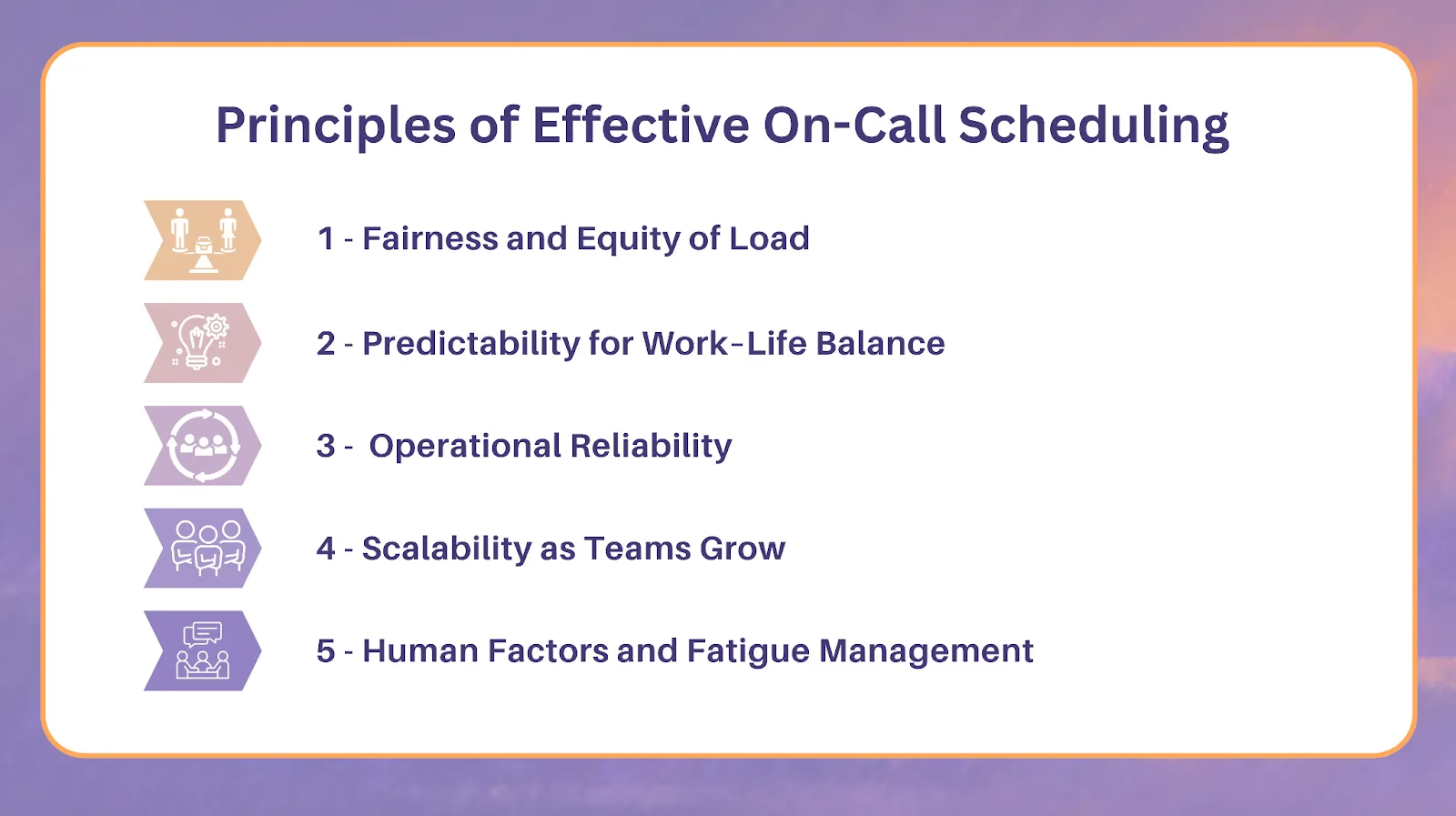
- Fairness and Equity of Load
Fairness is not only about equal hours. True equity considers the real impact each shift has on a responder’s time, energy, and personal commitments. This includes:
- Even distribution of weekends, holidays, and night hours
- Rotating difficult or high-pressure shifts so no one carries the burden repeatedly
- Respecting personal constraints such as family schedules, medical needs, or religious observances
- Accounting for alert volume so one person is not responsible for supporting an excessively noisy service
A schedule may appear balanced on paper yet still be unfair if certain times of day consistently generate more alerts or higher stress.
- Predictability for Work–Life Balance
Predictable scheduling is essential for maintaining wellbeing, planning personal time, and reducing stress. Strong on-call systems:
- Are published weeks or even months in advance
- Avoid last-minute changes
- Allow shift swaps without unnecessary friction
- Build in recovery time after demanding rotations
Predictability is a core requirement for maintaining healthy teams and retaining experienced engineers.
- Operational Reliability
Reliable on-call systems are essential for maintaining service stability and ensuring incidents are handled quickly and accurately. Strong schedules prevent:
- Single points of failure
- Overreliance on one “hero” engineer
- Teams or individuals being repeatedly overloaded with high-pressure shifts
Achieving this level of reliability requires well-defined escalation layers, dependable backup responders, and consistent handoff practices that keep context flowing across shifts. When these elements are in place, teams can respond to incidents confidently and maintain a predictable level of service quality.
- Scalability as Teams Grow
A rotation that works for a small team often becomes unsustainable as the organization expands. Growth brings new challenges such as higher headcount, wider geographic distribution, and more complex service ownership. These changes require scheduling systems that can adapt and scale without creating bottlenecks or overloading certain individuals.
As teams grow, on-call rotations should evolve into more sophisticated models. This may include follow-the-sun coverage for global teams, shared responsibility across related groups, or domain-specific rotations that align expertise with the systems being supported. Scalable scheduling ensures that coverage stays reliable while keeping workloads fair and manageable for everyone involved.
- Human Factors and Fatigue Management
Alert fatigue and frequent interruptions can slow response times, reduce accuracy, and significantly increase the risk of burnout. To keep teams healthy and effective, on-call scheduling must account for human limits and the cognitive load that comes with being responsible for critical systems. Healthy practices include:
- Limiting the number of night shifts each engineer is expected to cover
- Preventing long stretches of continuous on-call duty
- Automatically removing responders who are out of office, unwell, or already overloaded
- Protecting downtime and ensuring people have meaningful opportunities to recover
When scheduling acknowledges these human factors, responders feel supported and are better able to perform under pressure. The most effective systems always recognize that responders are people first and engineers second.
On-call scheduling models explained
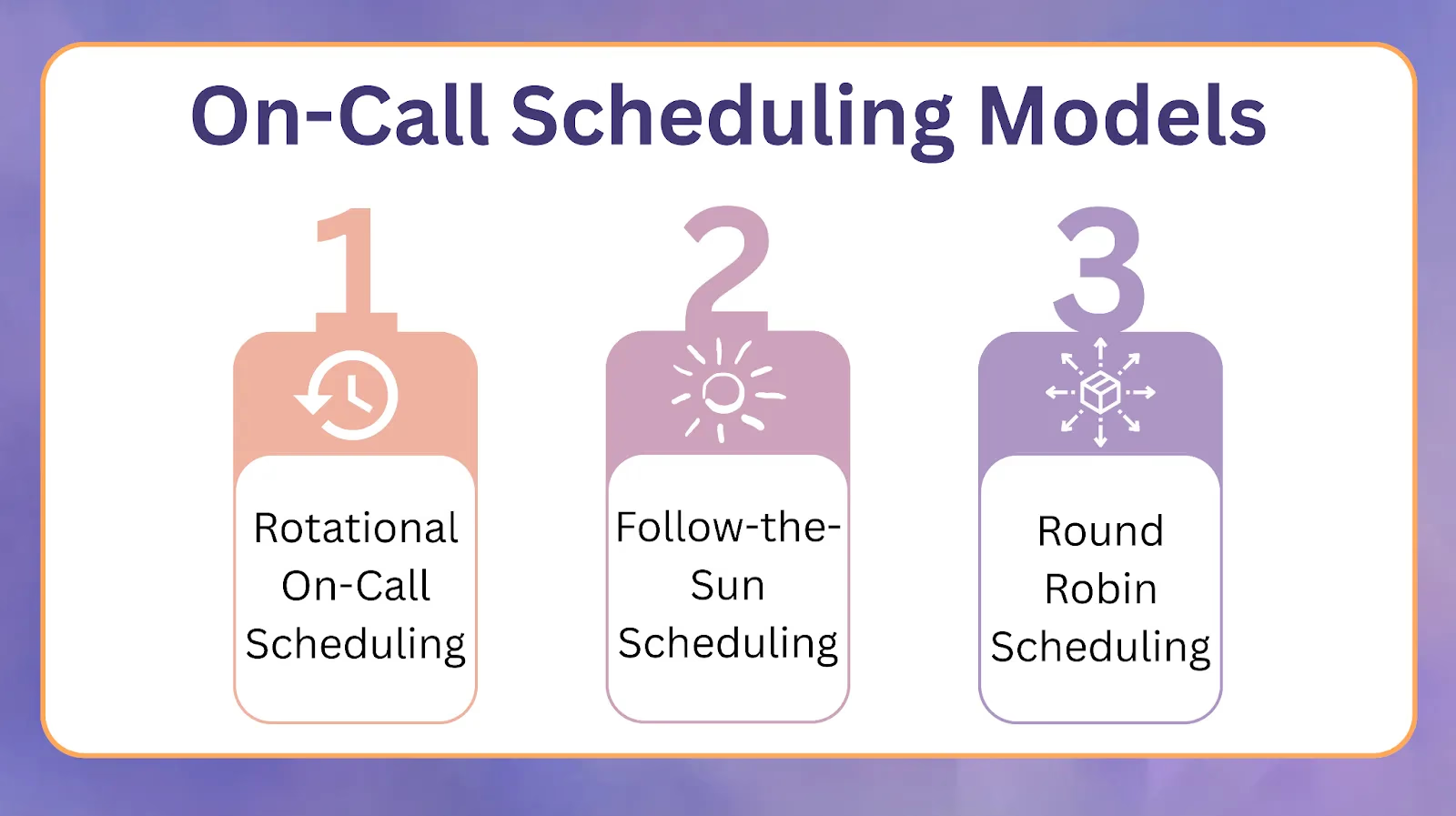
- Rotational On-Call Scheduling
Rotational scheduling is the most widely used approach. Team members take turns covering predefined shift blocks that may span a day, multiple days, or a full week. This structure is flexible enough for small teams and scalable enough for large organizations.
Why teams choose it
- Simple to implement and manage
- Suitable for teams of any size
- Easy to scale as headcount grows
- Allows customization of shift length and cadence
Shift length options
- 24-hour shifts, often used in smaller teams but can increase fatigue
- 12-hour shifts, common in high-alert environments
- Daily rotations, predictable but create more handoffs
- Weekly rotations, ideal for deep focus but intense for busy or noisy services
Avoiding inequity
Rotational systems can become unfair if they are not carefully managed. Common issues include:
- One person consistently covering weekends
- Night hours concentrating on the same individual
- High-risk periods such as launches or migrations falling on senior staff every time
Rotational scheduling works best when supported by rules that rebalance uneven load and ensure no one repeatedly absorbs the most difficult shifts.
- Follow-the-Sun Scheduling
Follow-the-sun scheduling uses global time zones to provide business-hour coverage around the clock. Teams in different regions hand off responsibilities as their workday begins. For example:
- San Francisco covers daytime hours in the Americas
- London handles daytime in EMEA
- Singapore supports daytime in APAC
Benefits
- Eliminates or significantly reduces overnight paging
- Lowers burnout by aligning on-call duty with normal waking hours
- Speeds up response times because alerts reach someone who is awake and active
Challenges
- Requires skilled engineers in each region
- Handoffs must be precise to maintain context
- Holidays vary across countries, complicating coverage
- Expertise may be uneven across time zones
Best practices
- Create overlap windows for smooth handoff
- Rotate holiday responsibilities fairly across regions
- Document active or high-risk incidents clearly
- Maintain consistent skills and knowledge across each location
Most global teams pair follow-the-sun with traditional rotations to cover weekends or lower-staffed hours.
- Round Robin Scheduling
Round Robin scheduling distributes incoming alerts across a group of responders instead of assigning all responsibility to a single engineer. This approach spreads the workload more evenly and helps reduce pressure during busy periods.
Good for
- High-volume alert environments where one person would otherwise be overwhelmed
- Gradually training junior engineers by exposing them to real incidents
- Reducing fatigue for primary responders during demanding shifts
Strengths
- More even distribution of alerts across the team
- Lower risk of any single responder becoming overloaded
- Encourages shared ownership and broader familiarity with system behavior
Weaknesses
- Still requires reliable backup responders and escalation rules
- Less suitable for very small teams
- Random variation means some responders may still receive more alerts than others
Round Robin is most effective when used at escalation layers or in environments with high alert volume. It supplements other scheduling models by balancing load and giving teams a structured way to share responsibilities without overwhelming individuals.
Weekend, holiday, and night coverage strategies
Coverage outside normal business hours is one of the most important factors in creating a fair, sustainable on-call rotation. These periods often carry higher alert volume, fewer available responders, and greater personal impact, which means fairness and balance are essential.
Weekend coverage options
Teams can approach weekend coverage in several ways depending on size, global distribution, and workload patterns.
- Full weekend rotation covered by a single assigned engineer
- Split weekends with separate coverage for Saturday and Sunday
- Follow-the-sun weekend coverage when global staffing allows it
- A dedicated weekend engineer who receives compensatory time off during the week
Well-planned weekend scheduling prevents burnout and avoids one responder repeatedly losing personal time.
Holiday coverage
Holiday periods introduce additional challenges. Coverage must remain reliable even when many responders are unavailable or services experience seasonal surges.
Challenges
- Holidays differ across countries and regions
- Certain services peak during holidays, such as retail, travel, and payments
- Senior engineers often absorb holiday duty by default
Fair strategies
- Rotate global holidays across teams and regions
- Offer additional compensation or recovery days
- Allow voluntary opt-in with clear incentives
- Respect religious, cultural, and personal observances
Addressing holiday coverage fairly helps maintain trust and reduces resentment across global teams.
Night coverage
Night shifts carry higher cognitive load and disrupt normal rest patterns, making thoughtful scheduling critical.
Options
- A dedicated night shift engineer or small night rotation
- Follow-the-sun scheduling that removes night coverage entirely
- Pager shadowing to train junior engineers without overwhelming them
- Lower alert thresholds or reduced noise during overnight hours
Fairness rule:
No one should repeatedly cover night shifts unless it is a clearly defined and compensated part of their role.
Night coverage should always balance operational needs with the wellbeing of responders, ensuring teams stay healthy, alert, and confident in their ability to manage incidents.
Shift length and rotation cadence best practices
Choosing the right shift length
The length of each on-call shift has a significant impact on team fatigue, response quality, and scheduling complexity. Selecting the right shift duration depends on several factors:
- Alert volume and how frequently pages occur
- Team size and the number of available responders
- Fatigue levels and the recovery time engineers need
- Global coverage distribution and time zone alignment
Different teams use different shift models based on their operational needs.
Common models
- 8-hour shifts, which are the most humane but more complex to schedule
- 12-hour shifts, commonly used in operations-heavy or high-alert environments
- 24-hour shifts, suitable for low-alert services where interruptions are rare
- Weekly rotations, ideal for high-context services that require deeper continuity
There is no universal shift length that works for every team. The best choice is the one that aligns with your alert density, team capacity, and tolerance for overnight or high-pressure periods.
How often should someone be on-call
The frequency of on-call duty directly affects fatigue, morale, and overall team health. How often a responder should take a shift depends on team size, alert volume, and the complexity of the services being supported.
Benchmarks
- SRE standard: every six to eight weeks when using a weekly rotation
- Small teams: every two to three weeks due to limited headcount
- High-alert teams: responsibilities shared across a wider pool of responders to prevent overload
The golden rule
Responders should not be scheduled so frequently that meaningful downtime becomes impossible. Adequate spacing between shifts is essential for recovery, sustained performance, and long-term retention.
Handling volume spikes
Certain periods naturally bring higher incident volume or increased operational risk, and these require special scheduling considerations. Preparing targeted rotations for high-demand seasons prevents reactive reshuffling and protects responder wellbeing.
Create dedicated coverage plans for:
- Major product launches
- Black Friday or other seasonal retail surges
- Large-scale migrations or infrastructure changes
- Onboarding phases for new teams or services
Anticipating these spikes ensures that on-call duty remains manageable and that the team is prepared without last-minute disruptions or excessive pressure on individual responders.
Designing an equitable on-call rotation
Shared ownership across Teams
Equitable on-call rotations rely on spreading responsibility across the groups that build and maintain the systems. Shared models often include:
- Product teams owning and supporting the services they develop
- SRE or platform teams providing operational guardrails and escalation support
- Rotations that span multiple interdependent teams when services overlap
This approach distributes expertise, prevents operational silos, and avoids placing the entire on-call burden on a single group.
Avoiding hidden inequities
Even schedules that appear balanced can conceal unfair patterns. Common examples include:
- Teams responsible for noisier or less stable services receiving disproportionately more pages
- One region repeatedly covering holidays due to time zone differences
- Senior engineers consistently handling the most complex outages
- Junior engineers receiving limited exposure to meaningful learning opportunities
Reviewing these patterns regularly ensures that responsibility stays balanced and no group quietly absorbs more than its fair share.
Metrics that reveal fairness
Data is essential for identifying inequities that may not be obvious at a glance. Useful metrics include:
- Alerts per person
- Number of night alerts per month
- Weekend and after-hours coverage per quarter
- Recovery time required after major incidents
- Escalation frequency across individuals and teams
If one responder or team consistently appears at the top of these metrics, the rotation is not equitable and needs adjustment. Metrics turn fairness from a subjective perception into something measurable and actionable.
Practical on-call schedule templates
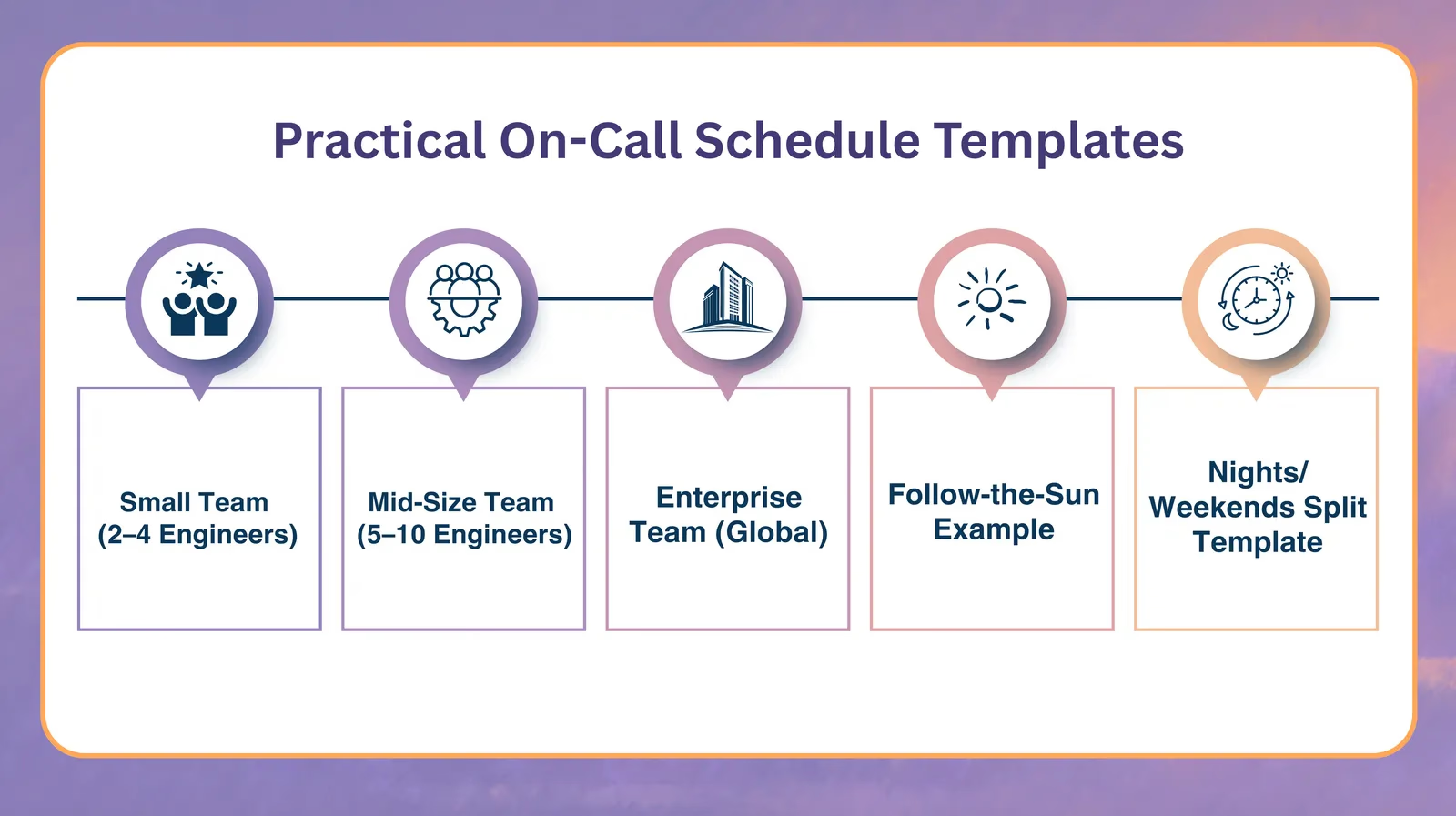
Small Team (2–4 Engineers)
- Alternating weekly on-call
- Secondary backup rotation
- Optional weekend split
Mid-Size Team (5–10 Engineers)
- Weekly rotation
- Separate weekend coverage
- Follow-the-sun for business hours
- Dedicated escalation layer
Enterprise Team (Global)
- Full follow-the-sun primary coverage
- Night or weekend rotation team
- Domain-specific responder groups
- On-call manager for major incidents
Follow-the-Sun Example
- APAC → EMEA → AMER
- One to two hour handoff overlap
- Daily synchronous handoff
Nights/Weekends Split Template
- Business-hours weekday rotation
- Short night-only shifts
- Weekend-only rotation with compensation
How teams build on-call rotations in Rootly
In Rootly On-Call, a schedule holds the rotations that decide who is on call. Each rotation sets its members, a rotation type (daily, weekly, biweekly, monthly, or custom shift lengths such as 8 or 12 hours), the handoff time, active days and hours, and its own timezone, so you can model a business-hours rotation or a global rotation in UTC. A schedule pages no one until it is linked to an escalation policy. With 24/7 coverage turned on, Rootly flags gaps the rotation rules leave and pages the schedule owner or a fallback assignee instead of dropping the page. A holiday calendar overlays team PTO from an iCal feed and highlights shifts that collide with it, and responders resolve those conflicts with coverage requests instead of editing the schedule.
Escalation policies: ensuring redundancy without over-paging
A healthy on-call system depends on redundancy. If only one person is responsible for handling every alert, the schedule will fail quickly. Escalation policies create safety nets that ensure incidents are acknowledged, investigated, and resolved even if the primary responder is unavailable or overwhelmed.
Multi-layer escalation
A strong escalation chain typically includes multiple layers of support:
- Layer 1: Primary responder
- Layer 2: Secondary responder
- Layer 3: Duty manager for complex or high-severity incidents
- Layer 4: Executive or on-call specialist, used only in rare or critical situations
This structure prevents single points of failure and ensures someone with the right context or authority can always take over.
Round robin escalation layer
Round Robin can be used within escalation layers to distribute load more evenly. It is especially effective for:
- Primary rotations that frequently become overloaded
- Environments with high alert density
- Supporting junior engineers by exposing them to real incidents in a controlled way
Round Robin ensures that no single person consistently absorbs the heaviest work at escalation levels.
Paging rules
Clear paging rules protect both incident response quality and responder well-being. Common practices include:
- Setting an expected acknowledgment window (for example, within a few minutes)
- Automatically retrying the page once if no response is received
- Escalating to the next layer after a defined time threshold
These timing rules must balance urgency with sleep preservation, ensuring critical alerts are handled quickly without unnecessarily waking responders for low-value noise.
How do you prevent burnout from constant secondary on-call shifts?
Treat the secondary shift as on-call work: schedule it deliberately, measure how often it is paged, and pay for it. Secondary shifts burn people out when they are invisible. An engineer is “only backup” for weeks at a time, gets pulled in whenever the primary is slow to acknowledge, and none of it shows up in the schedule, the metrics or the pay. Rootly’s escalation policies, schedules, On-Call Metrics and On-Call Pay Calculator cover each fix below.
- Stop the secondary becoming a second primary. If the secondary is paged on most alerts, either the acknowledgment window is too short or the primary rotation is overloaded. Give the escalation step that reaches the secondary a realistic delay, and cut the primary’s alert volume at the source (alert fatigue covers how). In Rootly, each escalation step carries its own delay, counted from the previous step.
- Keep secondary weeks away from primary weeks. Scheduling someone as secondary directly before or after their primary week gives them two or three consecutive weeks of pager. Offset the two rotations so every engineer gets a full week off between them.
- Measure who actually gets paged. Rootly’s On-Call Metrics dashboard shows response effort and alert distribution by responder, so a secondary who is quietly absorbing a third of the pages shows up in the data.
- Count it and pay it. If standby is compensated, secondary standby should be too. The Rootly On-Call Pay Calculator builds reports from the schedules your team actually ran and can break out active incident-response time from passive standby.
- Make cover easy to get. Engineers on a long secondary stretch need a way to hand a shift off. Rootly coverage requests work from the web, Slack (
/rootly override) and the mobile app, and create the override automatically when a teammate accepts. Holiday calendars overlay PTO on the schedule so gaps are visible before they happen. - Use shadowing to train new responders. Putting a new engineer on the secondary rotation to learn adds pages to someone who can’t yet act on them. Rootly shadow users are notified alongside the primary, can be limited to business hours, and are removed automatically when the shadowing period ends.
Handoff and handover best practices
Strong on-call schedules rely on consistent handoff practices. Clear transitions ensure that incoming responders understand the current state of the system and can take ownership without confusion or lost context.
What a shift handoff should include
- Ongoing incidents that require continued attention
- Active alerts that may escalate or recur
- Known high-risk systems or unstable components
- Relevant customer or stakeholder context
- Planned changes, deploy freezes, or scheduled maintenance
Providing this information upfront helps the next responder start their shift fully prepared.
Effective handoff formats
- A concise Slack or chat summary
- A short daily five-minute sync
- A written email or document digest
The format can vary, but consistency is essential. Reliable handoffs reduce gaps in coverage, improve response accuracy, and help teams maintain trust and continuity across every shift.
Compensation, rewards, and team health
Compensation and support systems play a major role in how teams experience on-call work. Fair pay, meaningful recovery time, and strong wellness practices help responders manage stress and maintain long-term engagement.
Monetary models
Organizations use several compensation structures to recognize the added responsibility of on-call duty, including:
- Flat per-shift payment
- Per-alert payment
- Hybrid models that combine shift and alert pay
- On-call stipends paired with overtime for active incidents
The right model depends on alert frequency, team expectations, and local labor regulations.
Non-monetary support
Monetary rewards matter, but non-monetary support is equally important for maintaining team health. Helpful practices include:
- Guaranteed recovery days after demanding shifts
- Reduced workload following major incidents
- Protected focus time to prevent ongoing context-switching
- Access to wellness and mental health resources
These measures help responders recover and feel valued beyond financial compensation.
Managing burnout
Proactive burnout prevention ensures that on-call remains sustainable rather than draining. Effective approaches include:
- Rotating night and weekend shifts fairly
- Avoiding excessive back-to-back rotations
- Reducing noise by eliminating unactionable or low-value alerts
- Using SLOs and alert tuning to control alert volume
Burnout is not inevitable. With the right support and scheduling practices, teams can stay healthy, engaged, and consistently effective in their incident response work.
How to continuously improve your on-call schedule
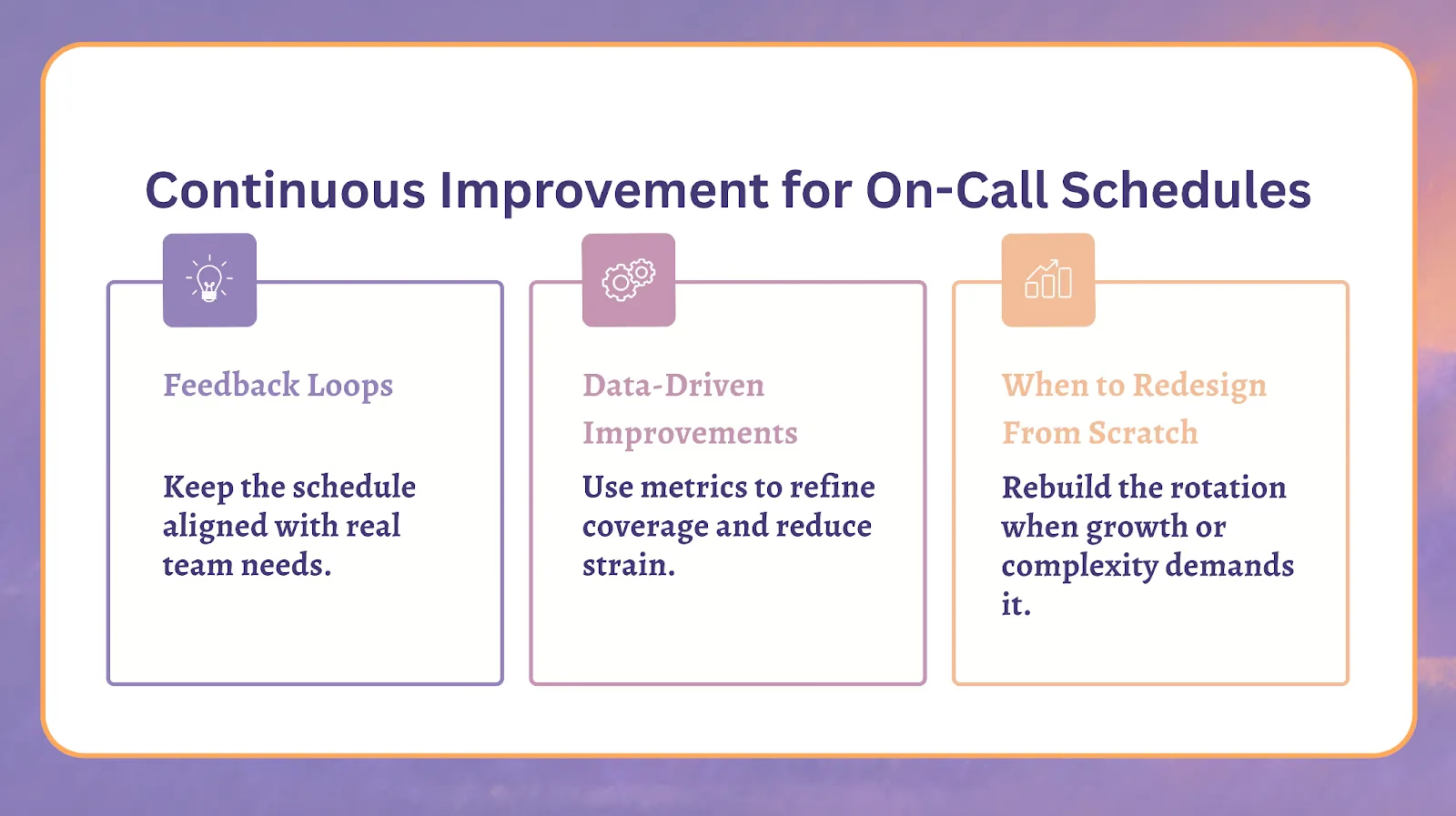
Strong on-call systems require ongoing refinement. As teams grow, services evolve, and incident patterns shift, the rotation must adapt to stay fair, sustainable, and reliable.
Feedback loops
Regular feedback helps surface issues early and ensures the schedule reflects real team needs. Useful methods include:
- Monthly surveys to gather trends and concerns
- Post-incident retrospectives that highlight scheduling gaps
- Anonymous check-ins that encourage honest input
Consistent feedback builds trust and keeps the rotation aligned with day-to-day realities.
Data-driven improvements
Objective data provides clarity on where adjustments are needed. Helpful metrics include:
- Alert density over time
- Patterns that reveal high-risk or high-volume windows
- Performance data that shows whether workloads should be redistributed
Using data ensures improvements are informed, measurable, and targeted.
When to redesign from scratch
Incremental tweaks are not always enough. A full redesign may be necessary when:
- The team doubles in size
- Services grow more complex or interdependent
- The organization expands globally
- Alert fatigue increases or morale declines
- A small number of specialists hold most of the operational knowledge
On-call scheduling is never a set-and-forget responsibility. It evolves with the team, the services they maintain, and the operational demands of the organization.
Build a sustainable, fair, human-centered on-call system
A strong on-call schedule protects engineers, improves reliability, and supports long-term resilience across the organization. Fairness, predictability, thoughtful global coverage, and continuous refinement form the foundation of healthy 24-hour operations. Whether your team is small and growing or fully distributed across multiple regions, the right rotation helps people feel supported and keeps your systems stable.
At Rootly, we help modern teams design on-call programs that balance operational excellence with individual wellbeing. Our AI-native platform streamlines scheduling, clarifies escalation paths, and accelerates incident response so teams can resolve issues faster and with less stress. If you want to build an on-call system that is both reliable and sustainable, you can explore Rootly’s capabilities by booking a demo to see how everything works in practice.
Frequently asked questions
How do you prevent burnout from constant secondary on-call shifts?
Schedule the secondary rotation deliberately, keep it offset from each engineer’s primary week, give the escalation step that reaches the secondary a realistic delay, measure how often the secondary is paged, and compensate secondary standby the same way as primary. Rootly supports each step with escalation policies, schedules, On-Call Metrics and the On-Call Pay Calculator.
Should secondary on-call be paid?
If your team compensates on-call standby, secondary standby should be included, because the secondary gives up the same freedom and is paged when the primary can’t respond. Many teams pay active incident time at a different rate from passive standby. The Rootly On-Call Pay Calculator reports both from real schedule data and exports to Excel or CSV for payroll.
What does a secondary on-call responder do?
The secondary responder is the next step in the escalation policy: they are paged when the primary doesn’t acknowledge an alert in time, and they back up the primary on incidents that need a second pair of hands. In Rootly, the secondary is a schedule on a later escalation step, reached after that step’s delay.
On-call rotation design: schedules that avoid burnout