








.svg)









Enterprise incident management is no longer just an operational necessity. It has become a defining capability for organizations that rely on complex, distributed systems to deliver consistent customer experiences. As systems scale across services, regions, and teams, incidents become harder to contain.
Failures are rarely isolated. They spread across dependencies, affect multiple user segments, and require coordinated response across engineering, SRE, security, support, and leadership teams. Without a structured process, even a small disruption can turn into a high-impact operational event.
In this environment, incident management is not simply about fixing problems. It is about minimizing impact, maintaining trust, and continuously improving system reliability. Organizations with mature incident management practices can detect issues faster, communicate with more clarity, reduce downtime, and prevent recurring failures before they become larger business risks.
Key Takeaways
- Enterprise incident management helps large organizations reduce downtime, protect customer trust, and improve reliability across complex systems.
- Clear ownership, severity levels, escalation paths, and response roles prevent confusion during high-pressure incidents.
- Automation improves incident response by reducing manual work, speeding up escalations, and keeping workflows consistent.
- On-call management connects detection to action by ensuring the right responders are available when incidents occur.
- Post-incident reviews, metrics, and continuous improvement help enterprises prevent recurring failures and strengthen long term operational maturity.
What Is Enterprise Incident Management?
Enterprise incident management is the end to end process of detecting, responding to, resolving, and learning from disruptions in large scale systems. It spans the full lifecycle of an incident and involves multiple teams working together under defined processes.
Unlike smaller environments, enterprise incident management must support:
- Highly distributed architectures across cloud and infrastructure layers
- Cross functional collaboration between engineering, SRE, security, and leadership
- Strict service level agreements and uptime expectations
- Regulatory requirements that demand traceability and documentation
The objective is not only to restore service quickly, but to reduce the frequency and impact of future incidents through continuous improvement.
Why Incident Management Becomes More Complex at Scale
Interconnected Systems Increase Risk
Enterprise systems consist of services that depend on one another. A failure in a single component can cascade across the entire system. Identifying the origin of the issue becomes more difficult when signals are spread across multiple tools and environments.
Coordination Across Teams Slows Response
As organizations grow, ownership becomes distributed. During incidents, delays often occur because teams are unsure who is responsible or how to escalate issues. Clear coordination becomes as important as technical expertise.
Business Impact Is Immediate and Measurable
At scale, downtime directly affects revenue and customer trust. Even short disruptions can lead to SLA violations and churn. Incident management must focus on reducing both duration and user impact.
Compliance Adds Additional Requirements
Large organizations must maintain detailed records of incidents. This includes timelines, decisions, and outcomes. These records are critical for audits, security reviews, and regulatory compliance.
Types of Enterprise Incidents

Understanding the types of incidents that occur in enterprise environments helps teams prepare appropriate response strategies.
Service Outages
These incidents involve complete or partial unavailability of a service. They are often classified as high severity due to their direct impact on users.
Performance Degradation
Systems remain available but operate below acceptable performance levels. Examples include slow response times or increased latency. These incidents can be harder to detect but still significantly affect user experience.
Infrastructure Failures
Failures in underlying infrastructure such as servers, databases, or cloud services. These incidents often trigger cascading effects across dependent services.
Deployment and Change Failures
Incidents caused by recent code changes, configuration updates, or releases. These are among the most common incident types in modern DevOps environments.
Security Incidents
These include breaches, unauthorized access, or vulnerabilities being exploited. They require coordination between engineering and security teams and often involve additional compliance considerations.
Data Integrity Issues
Corrupted or inconsistent data can lead to incorrect outputs or system failures. These incidents may not be immediately visible but can have long term consequences.
Third Party Dependency Failures
External services such as APIs or payment gateways fail, impacting your system even though internal components are functioning correctly.
The Enterprise Incident Management Lifecycle
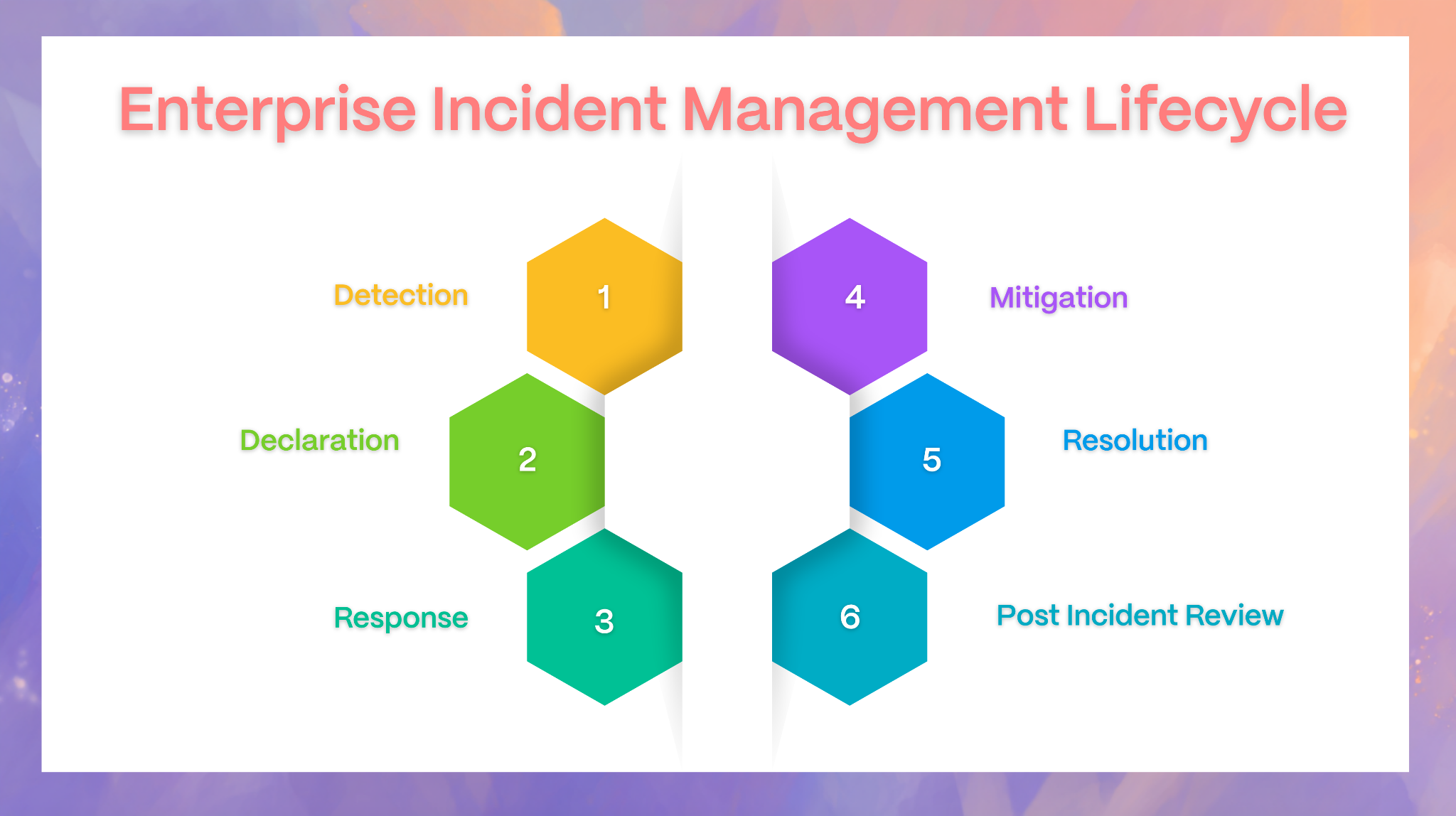
The enterprise incident management lifecycle gives teams a repeatable structure for moving from early detection to full recovery and learning. By defining each stage clearly, large organizations can reduce confusion, coordinate faster, and turn incidents into lasting reliability improvements.
Detection
Incidents begin with signals such as alerts, anomalies, or user reports. Effective detection depends on strong observability across metrics, logs, and traces. High quality alerting ensures that teams are notified of real issues rather than noise.
Declaration
Once confirmed, the issue is declared as an incident. This includes assigning a severity level and notifying stakeholders. Clear declaration ensures that everyone understands the impact and urgency.
Response
Teams mobilize to investigate and stabilize the system. Roles are assigned, communication channels are established, and coordination begins. The focus is on quickly understanding the scope of the issue.
Mitigation
Mitigation aims to reduce user impact as quickly as possible. This may involve rolling back changes, redirecting traffic, or disabling affected features.
Resolution
The underlying issue is fixed and systems are restored to full functionality. Validation ensures that the solution is effective and stable.
Post Incident Review
Teams analyze the incident to identify root causes and contributing factors. Action items are created to prevent recurrence.
Core Components of an Enterprise Incident Management Framework

An enterprise incident management framework gives teams the structure they need to respond consistently under pressure. Its core components help improve visibility, clarify responsibilities, reduce delays, and support continuous reliability improvements.
Observability and Monitoring
A strong observability system provides visibility into system behavior. It includes:
- Metrics for system performance
- Logs for debugging
- Traces for tracking requests across services
The goal is to provide actionable insights that help teams detect and diagnose issues quickly.
Incident Triage and Prioritization
Not all incidents require the same level of urgency. Severity levels should be defined based on business impact. This ensures that resources are allocated effectively.
Structured Response Roles
Defined roles improve coordination:
- Incident Commander manages the process
- Technical Lead focuses on resolution
- Communications Lead handles updates
This structure prevents confusion and keeps teams aligned.
Runbooks and Playbooks
Runbooks provide step by step guidance for handling common incidents. They reduce decision making time and enable consistent responses.
Postmortems and Continuous Improvement
Blameless postmortems focus on improving systems rather than assigning blame. They help organizations learn from incidents and strengthen resilience.
Enterprise Incident Management Best Practices
Establish Clear Ownership
Every service and incident must have a defined owner. This eliminates delays and ensures accountability during critical moments.
Standardize Severity Levels
Severity definitions should align with business impact. Consistency across teams improves prioritization and response speed.
Centralize Communication
Using a single communication channel for each incident improves visibility and coordination. It ensures that all stakeholders receive consistent updates.
Automate Repetitive Tasks
Automation reduces manual effort and speeds up response. Key areas include alert routing, escalation, and runbook execution.
Maintain Real Time Status Communication
Providing timely updates to customers builds trust and reduces support inquiries. Status pages should be clear and regularly updated.
Conduct Regular Simulations
Incident drills help teams practice response procedures and identify gaps in processes.
Adopt a Blameless Culture
Encouraging transparency and learning improves team collaboration and leads to better long term outcomes.
How Enterprise Incident Management Strengthens Reliability
Enterprise incident management is not only about responding to failures. It plays a critical role in improving overall system reliability.
Faster Detection Reduces Impact
Improved monitoring and alerting enable teams to identify issues early. Early detection limits the spread of failures and reduces downtime.
Structured Response Minimizes Chaos
Clear roles and processes ensure that teams act quickly and efficiently during incidents. This reduces confusion and accelerates resolution.
Consistent Learning Prevents Recurrence
Post incident reviews identify root causes and systemic weaknesses. Addressing these issues prevents similar incidents in the future.
Automation Increases Consistency
Automated workflows ensure that incidents are handled consistently across teams. This reduces variability and improves reliability.
Improved Communication Builds Trust
Transparent communication during incidents maintains customer confidence and strengthens relationships.
Alignment with SLOs and Error Budgets
Incident management provides data that helps teams manage service reliability targets. This alignment ensures that reliability is continuously measured and improved.
Metrics That Matter in Enterprise Incident Management

Mean Time to Resolution
Mean Time to Resolution measures how quickly incidents are fully resolved after detection. Lower MTTR usually indicates faster recovery, stronger coordination, and more effective response workflows.
Mean Time to Detect
Mean Time to Detect tracks how quickly teams identify an issue after it begins. Faster detection reduces user impact and gives responders more time to contain the incident before it spreads.
Mean Time to Acknowledge
Mean Time to Acknowledge measures how quickly an alert is accepted by the responsible team or on-call responder. It shows whether escalation paths, alert routing, and ownership are working effectively.
Incident Frequency
Incident frequency shows how often incidents occur across systems, services, or teams. A rising incident rate may point to unstable deployments, weak monitoring, technical debt, or recurring reliability gaps.
Change Failure Rate
Change failure rate tracks how often deployments, configuration changes, or releases cause incidents. This metric helps teams improve release quality, strengthen testing, and reduce preventable disruptions.
SLA and SLO Compliance
SLA and SLO compliance measures whether services are meeting agreed reliability and availability targets. It helps enterprises connect incident performance to customer expectations, business commitments, and long term reliability goals.
Building an Enterprise Incident Management Strategy
Assess Current State
Evaluate existing incident processes, tools, ownership models, and performance metrics. Identify where delays happen across detection, escalation, communication, and resolution. This helps teams prioritize the highest-impact improvements first.
Define Standard Processes
Create consistent workflows for each stage of the incident lifecycle. Every team should understand how incidents are declared, escalated, communicated, resolved, and reviewed. Standard processes reduce confusion and make response more predictable.
Select Scalable Tools
Choose tools that support automation, integrations, on-call management, communication, and post-incident reviews. Enterprise teams need systems that can scale across multiple services, teams, and regions. The right tools should reduce manual work rather than adding more complexity.
Train Teams
Provide regular training on incident roles, severity levels, tools, and response expectations. Well-prepared teams can act faster during high-pressure situations. Training also helps new team members understand how incident response works across the organization.
Continuously Improve
Review metrics, postmortems, and recurring incident patterns on a regular basis. Use these insights to refine runbooks, alerts, escalation paths, and ownership models. Continuous improvement turns incident management into a reliability practice rather than a reactive process.
Common Challenges and How to Overcome Them
Alert Fatigue
Alert fatigue happens when teams receive too many low-value or noisy alerts. This makes engineers slower to respond when a real incident occurs. Reduce noise by improving alert thresholds, routing alerts to the right owners, and removing alerts that do not require action.
Lack of Documentation
Missing or outdated documentation slows down incident response. Teams should keep runbooks, escalation paths, and service ownership details updated and easy to access. Good documentation helps responders act quickly without relying on memory.
Communication Silos
Communication silos happen when updates are scattered across different channels, tools, or teams. This creates confusion and makes it harder to maintain a shared understanding of the incident. Use centralized incident channels, clear update cadences, and assigned communication owners.
Inconsistent Processes
Inconsistent processes make incident response unpredictable across teams. One team may escalate quickly while another relies on informal coordination. Standardized workflows help large organizations respond with more consistency, speed, and accountability.
The Role of Automation and AI in Modern Incident Management
Automation is essential for managing incidents at scale. It enables faster response and reduces human error.
Automation Use Cases
- Automatic incident creation from alerts
- Escalation based on severity
- Runbook execution
- Status updates
AI Driven Capabilities
- Predictive detection of anomalies
- Assistance with root cause analysis
- Automated summaries and reporting
- Decision support during incidents
These capabilities reduce cognitive load and improve efficiency.
Incident Management Maturity Model
Reactive
At the reactive stage, incident response is unstructured and inconsistent. Teams rely on ad hoc communication and individual knowledge to resolve issues. This often leads to slower resolution times and repeated incidents.
Defined
At the defined stage, basic processes and roles are established across teams. There is some level of consistency in how incidents are declared and handled. However, execution may still vary depending on the team or situation.
Standardized
At the standardized stage, workflows are consistent across the organization. Teams follow shared processes, and key metrics are tracked to measure performance. This improves coordination, visibility, and overall response efficiency.
Automated
At the automated stage, repetitive tasks are handled through automation. Alert routing, escalations, and runbook execution become faster and more reliable. This reduces manual effort and allows teams to focus on higher-value decision making.
Predictive
At the predictive stage, systems detect patterns and anticipate potential failures before they occur. Teams can take proactive action to prevent incidents or reduce their impact. This level reflects a mature, reliability-focused organization.
Enterprise Incident Communication Strategy
Internal Communication
Internal communication ensures that all teams involved in an incident stay aligned. It requires real time updates, clearly defined ownership, and structured timelines. This helps teams coordinate actions and avoid duplication or delays.
External Communication
External communication focuses on keeping customers and stakeholders informed. Updates should be timely, accurate, and easy to understand without exposing unnecessary technical details. Clear communication reduces uncertainty, builds trust, and helps manage expectations during incidents.
On-Call Management in Enterprise Incident Management
On-call management ensures that the right responder is available when a critical incident occurs. In enterprise environments, this requires more than a simple rotation. Teams need clear schedules, escalation policies, alert routing, and service ownership so incidents do not stall while teams figure out who should respond.
A strong on-call process should include:
- Fair rotation schedules that distribute responsibility across the team
- Backup responders for critical services and high-severity incidents
- Severity-based escalation paths
- Clear service ownership for every alert
- Runbooks that help engineers act quickly under pressure
- Automated escalation when alerts are not acknowledged on time
On-call management also protects reliability by reducing alert fatigue. If engineers receive too many low-value alerts, they become slower to respond to real incidents. Enterprises should continuously refine alert rules, route alerts to the correct service owner, and remove noisy alerts that do not require action.
When integrated with the broader incident management workflow, on-call becomes the link between detection and response. It ensures that:
- Alerts lead to action
- Incidents are escalated properly
- The right teams are notified quickly
- Mitigation begins as early as possible
FAQs
What is the main goal of enterprise incident management?
The main goal is to reduce the impact of incidents on customers, systems, and business operations. It helps large organizations respond faster, coordinate better, and learn from every disruption.
Who should be involved in enterprise incident management?
Enterprise incident management usually involves engineering, SRE, DevOps, security, customer support, product, and leadership teams. Each group plays a different role in detection, response, communication, or decision making.
What makes an incident high severity?
A high-severity incident usually affects many users, critical services, revenue, security, or business continuity. Severity should be based on real customer and business impact, not only technical complexity.
How often should enterprises review their incident management process?
Enterprises should review incident management processes regularly, especially after major incidents, repeated issues, or organizational changes. Reviews help keep runbooks, escalation paths, and ownership models accurate.
What is the difference between an incident and a problem?
An incident is an active disruption that needs immediate response. A problem is the underlying cause or recurring issue that must be investigated and fixed to prevent future incidents.
Why do large organizations need incident management software?
Large organizations need incident management software to coordinate response across teams, automate workflows, centralize communication, and maintain accurate incident records. Manual processes often become too slow and inconsistent at enterprise scale.
How does incident management support customer trust?
Incident management supports customer trust by reducing downtime and improving communication during disruptions. When customers receive timely, clear updates, they are less likely to feel ignored or uncertain.
From Incident Response to Enterprise Reliability
Enterprise incident management is no longer only about reacting when something breaks. For large organizations, it is a reliability discipline that connects people, processes, tools, and data into one coordinated system. The stronger this system becomes, the easier it is to detect issues early, reduce customer impact, and turn every incident into a source of operational learning.
The most resilient teams do not wait for major incidents to expose gaps in ownership, communication, escalation, or documentation. They build repeatable workflows, review performance metrics, improve runbooks, and continuously refine how teams respond under pressure. This creates a stronger foundation for uptime, customer trust, and long term operational maturity.
At Rootly, we help enterprise teams manage incidents with greater speed, structure, and clarity. From automated workflows and on-call escalation to stakeholder communication and post-incident learning, Rootly gives organizations the tools they need to respond effectively, reduce manual work, and strengthen reliability at scale. Book a demo to see how Rootly can support your enterprise incident management process.