Incident vs problem management: key differences
Incident management restores service fast. Problem management finds the root cause. Master both approaches to build resilient IT operations.

Incident vs problem management: key differences
On this page
When things break, people look to you for answers—fast. Whether it’s a system crash, a service outage, or a nagging bug that keeps resurfacing, how you respond matters. That’s where ITSM comes in. It helps us turn chaos into coordination.
Among its most essential components? Incident management and problem management. One restores; the other prevents. And while they serve different purposes, they’re better together. Incident management brings systems back online fast. Problem management ensures the issue doesn’t return.
Key takeaways
- Incident management focuses on restoring service fast to reduce downtime and meet SLAs.
- Problem management digs into root causes to stop recurring issues and strengthen long-term stability.
- Incidents are reactive and urgent, while problems are proactive and require in-depth analysis.
- Effective ITSM links incidents to problems so teams can fix both symptoms and causes efficiently.
What is incident management?
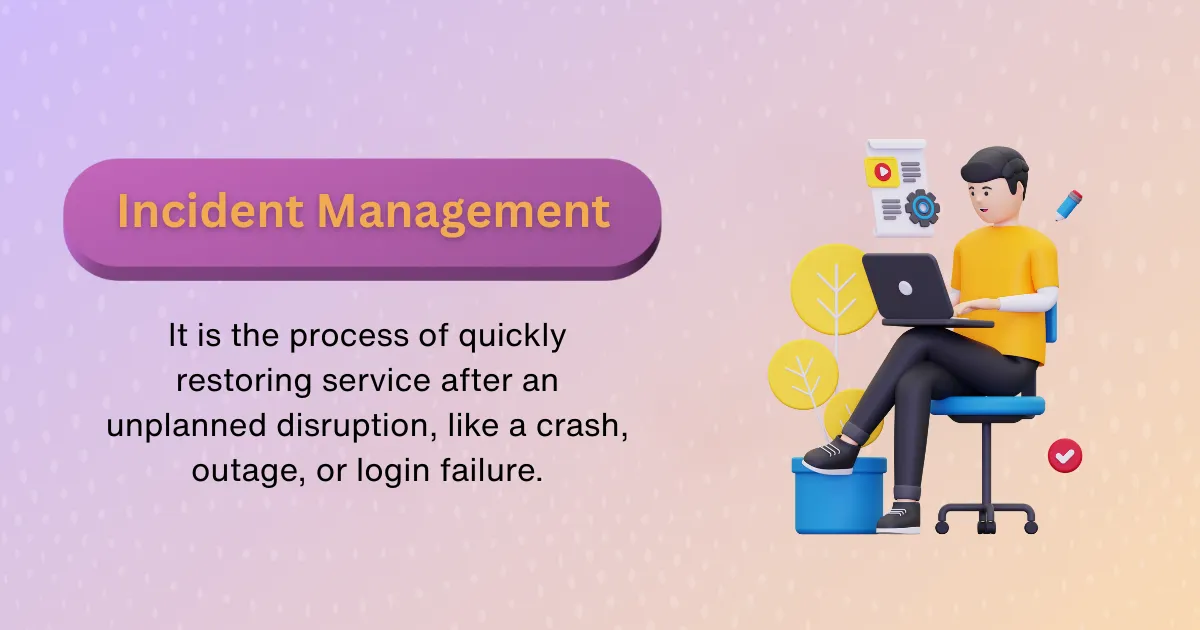
An incident is any unplanned disruption or degradation of service. It’s the thing your team wakes up to at 2 a.m., the fire in the middle of a deployment, or the spike in support tickets from users who can’t log in. In the ITIL framework, incident management is the process of restoring normal service operation as quickly as possible.
Goals of incident management
- Rapid restoration of service. Time matters. Every minute of downtime chips away at customer trust and internal momentum.
- Minimize business impact. The goal isn’t perfection—it’s containment.
Common incident types
- Application crashes during user interactions
- Network outages affecting internal systems or customer-facing platforms
- Authentication failures that lock users out of key functionality
Incident management workflow
It’s not glamorous, but process is everything:
- Detection – Alerts or reports signal that something’s off.
- Logging – Record what’s happening and where.
- Categorization – Tag it appropriately for routing.
- Prioritization – Is this P1, or can it wait?
- Diagnosis – Triage, troubleshoot, isolate.
- Resolution – Apply the fix.
- Closure – Confirm, document, and learn.
What is problem management?
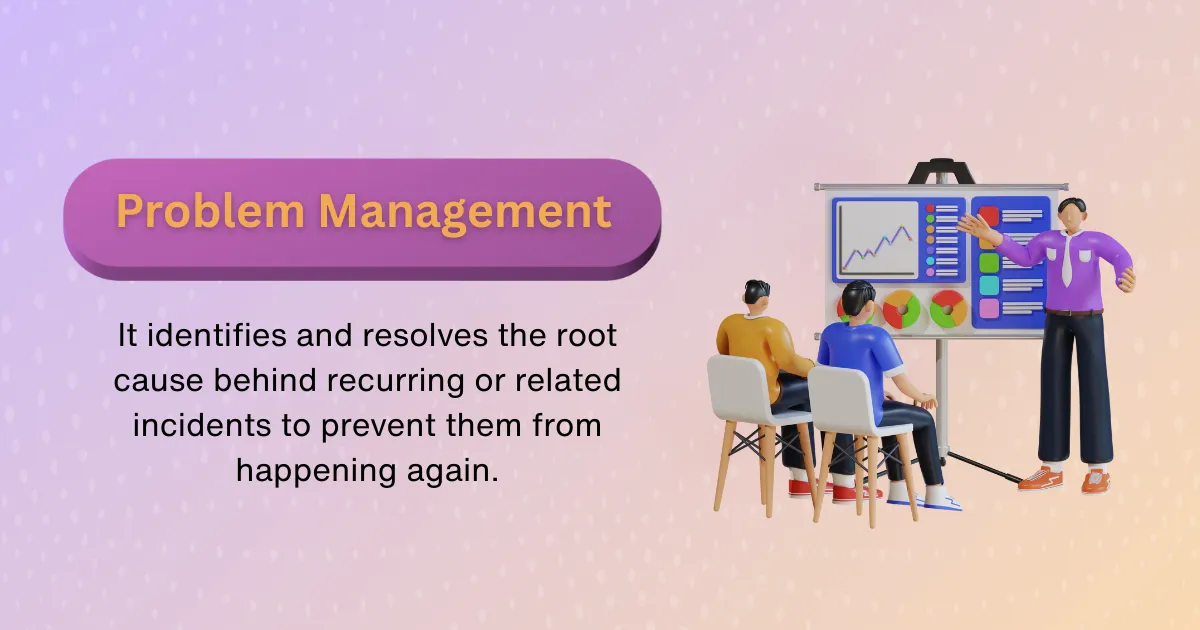
A problem is the underlying cause of one or more incidents. Where incident management asks, “How do we stop the bleeding?”, problem management asks, “Why did we start bleeding in the first place?”
Goals of problem management
- Root cause identification. Not just what broke—but why.
- Long-term resilience. Eliminate recurring pain points.
- Proactive prevention. Get ahead of systemic risk.
Reactive vs proactive problem management
- Reactive: Investigating after a spike in incidents or a major outage.
- Proactive: Analyzing logs and metrics to spot and fix vulnerabilities before they manifest.
Example: A database timeout may trigger several incident alerts. Fixing the timeout (incident management) doesn’t prevent it from recurring. Rewriting the query structure or refactoring the architecture (problem management) does.
Common problem scenarios
- Recurring latency issues from an overloaded service
- Chronic 5xx errors tied to a third-party API
- Performance degradation every time traffic peaks
Problem management workflow
- Detection – Triggered by pattern recognition or incident trends
- Logging – Centralized in your CMDB or issue tracker
- Investigation – Deep-dive into contributing factors
- Root Cause Analysis – Use fishbone diagrams, 5 Whys, or Fault Tree Analysis
- Resolution – Apply long-term corrective action
- Closure – Validate outcomes, update knowledge base
Incident vs. problem management: side-by-side comparison
| Criteria | Incident Management | Problem Management |
|---|---|---|
| Objective | Restore service | Find root cause |
| Trigger | Disruption occurs | Often after repeated incidents |
| Time Sensitivity | Immediate | Long-term solution |
| Example | Email not working | Email server bug |
| Responsible Team | Help Desk, Tier 1 | Tier 2/3, Engineering |
Objective
An incident’s objective is to get things back to normal—quickly. The priority is speed, not necessarily full understanding. In contrast, a problem’s goal is to prevent the issue from happening again.
Trigger
Incidents are triggered in real-time when something breaks or impacts users. Problem triggers come from patterns—repeated failures, trend analysis, or persistent symptoms. The former is loud and obvious; the latter, more subtle.
Time sensitivity
Incidents require immediate action to restore functionality and meet SLAs. Problems, while important, allow for deeper investigation over time. It’s a sprint versus a marathon.
Example
A user login failure is an incident—it stops people cold. A recurring cache misfire under heavy load is a problem—it signals fragility under the surface. One gets fixed fast; the other needs root cause attention.
Responsible team
Incidents are typically owned by Help Desk or Tier 1 teams who restore service. Problems are escalated to Tier 2/3 engineers or SREs with system-level access. Responsibility shifts from operators to investigators.
How incident and problem management work together

Think of it this way: incident management patches the tire; problem management finds and removes the nail from the road.
Both are essential. One buys you time, the other buys you trust. Effective teams coordinate these roles intentionally. A well-run PIR (Post-Incident Review) almost always identifies a handoff moment—when the issue should have gone from incident to problem.
In an ideal world, your ITSM system creates a linked problem ticket every time a major incident closes. This makes it easier to follow through with the deeper fix.
How do you connect incident response with problem management?
Connect them at the retrospective. Incident response restores service; the retrospective names the contributing factors; and every factor that could cause the same incident again becomes a tracked action item or a problem record with an owner and a due date. Problem management then owns the slower fix, and the next incident with the same signature is linked to that record instead of starting from zero. Rootly connects the two by drafting the retrospective from the incident timeline and exporting its action items to Jira, Linear or Zendesk.
In practice that handoff has five steps:
- Resolve the incident first. Restoring service is incident response’s only job while users are affected. Root-cause work waits until the impact is over.
- Run a retrospective within a few days. Work from the incident timeline and list the contributing factors in the system and the process.
- Turn each factor into an owned action item. Anything systemic or recurring opens a problem record in your ITSM tool or issue tracker, linked to the incident that exposed it.
- Link repeat incidents to the open problem. When the same symptoms come back, the responder finds the existing record and its history instead of re-diagnosing.
- Close the problem only when the fix is verified. Close it when a test, a drill or the next similar event shows the failure mode is gone.
In Rootly, the retrospective is drafted from the incident timeline, its action items carry owners and due dates and can be exported to Jira, Linear or Zendesk, and similar past incidents are surfaced when a new one starts. That puts a repeat incident next to the problem it belongs to in the first minutes of the response.
Tools that connect incident response and problem management
- Rootly: incident response in Slack and Microsoft Teams, retrospectives drafted from the incident timeline, action items tracked to completion and exported to Jira or Linear, and similar-incident matching when a new incident opens.
- Jira Service Management: Atlassian’s ITSM product, with incident and problem records in the same system. A natural fit for teams already running ITIL processes in Jira.
- ServiceNow: an enterprise ITSM suite with a dedicated problem management module, common where IT operations and engineering share one service desk.
- PagerDuty: alerting, on-call and incident workflows. Teams usually pair it with an ITSM tool or tracker for problem records.
When to use incident management
During a major outage
A major outage brings everything to a halt and demands an immediate response. Your dashboards light up, teams mobilize, and the clock starts ticking. Incident management is your fastest path to recovery.
Urgent issues impacting users
Any disruption to access, billing, or user data creates real friction. These issues affect customer trust and must be addressed on the spot. Quick action through incident management helps avoid escalation.
High SLA pressure
Service Level Agreements set the standard for uptime and responsiveness. If they’re at risk, there’s no time to hesitate. Fast incident resolution protects both your reputation and contractual commitments.
When to use problem management
Repeated or complex incidents
Recurring issues aren’t just annoying—they’re a signal something deeper is wrong. When fixes feel familiar, it’s time to stop patching and start investigating. Problem management turns repetition into insight.
Trend analysis or systemic issues
Small anomalies often foreshadow bigger breakdowns. Recognizing patterns before they escalate is the heart of proactive problem management. It helps teams stay ahead instead of constantly reacting.
Post-incident reviews (PIRs)
Every incident leaves a trail of clues. PIRs are your chance to ask hard questions, connect dots, and build smarter systems. It’s not just about what went wrong—but what you’ll change going forward.
Benefits of incident management
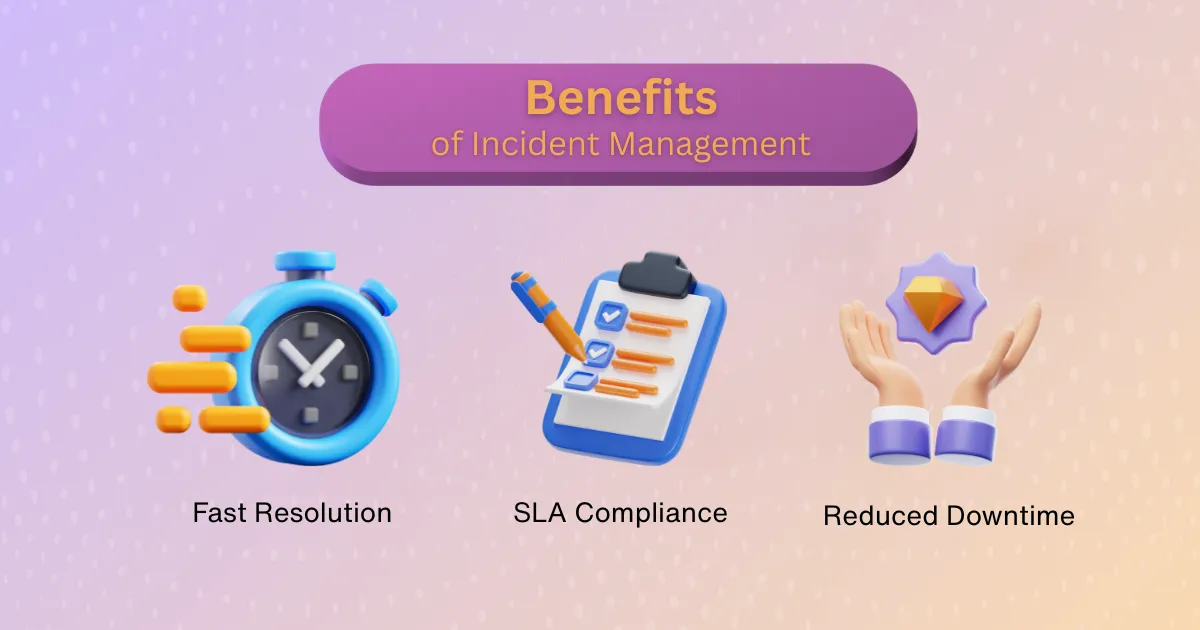
Fast resolution
Quick action keeps services online and customer satisfaction high. Users experience minimal disruption, and confidence in your systems stays intact. A swift fix reduces stress across the board.
SLA compliance
Meeting SLAs protects your credibility and prevents financial penalties. It reflects your team’s reliability under pressure. Incident management helps hit those targets consistently.
Reduced downtime
Downtime erodes trust and drains resources. The less time your team spends firefighting, the more time they can spend building value. Fast incident response lets teams shift focus from crisis to progress.
Benefits of problem management
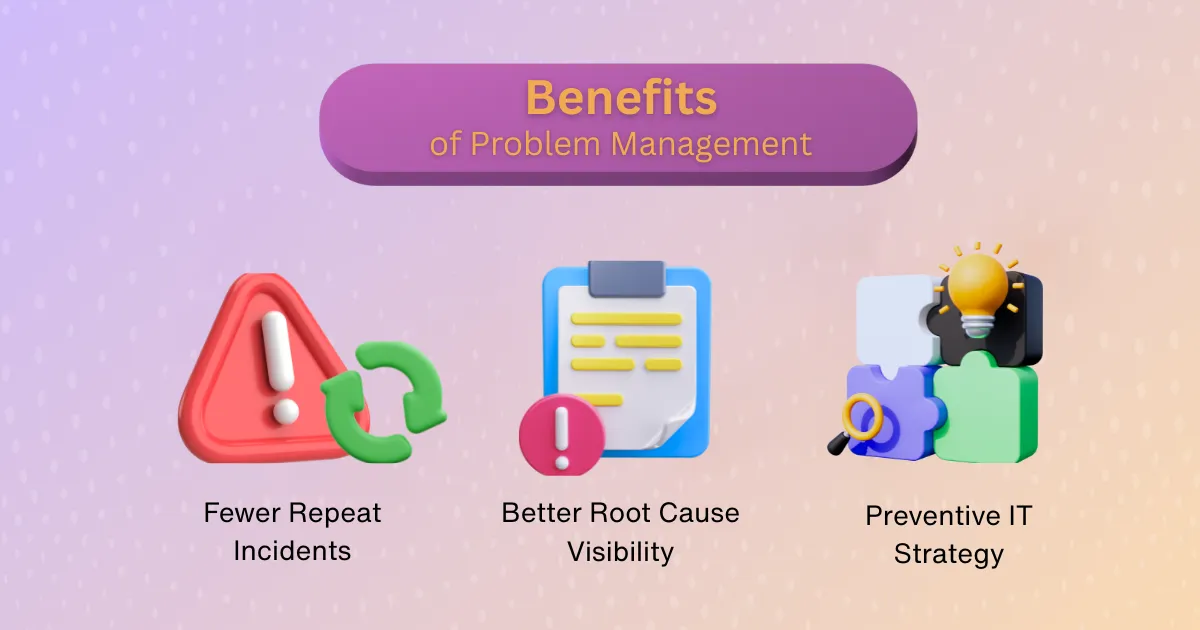
Fewer repeat incidents
Temporary fixes might hold, but they don’t last. Problem management digs deeper to solve the root cause, eliminating recurring disruptions. Over time, this reduces support burden and builds system stability.
Better root cause visibility
Understanding what truly broke means fewer surprises later. Visibility into the core issue allows leaders to make informed, strategic decisions. It shifts teams from guessing to knowing.
Preventive IT strategy
Problem management turns hindsight into foresight. By learning from past issues, teams can build systems that anticipate and withstand future ones. It helps create a culture where prevention is just as important as resolution.
Challenges in incident management
- Misclassification: Too many tickets get misrouted, slowing everything down.
- Alert Fatigue: Too many low-signal alerts bury the real threats.
- SLA Breaches: Without clear ownership or workflows, deadlines slip.
How to solve: Automate triage, normalize severity scales, and build smart alert routing.
Challenges in problem management
- Lack of Trend Data: Without solid logging, patterns go unnoticed.
- Slow RCA: Teams get stuck in “what-if” mode.
- Siloed Ownership: Problems straddle multiple systems, and no one takes the lead.
How to solve: Invest in observability, create structured RCA frameworks, assign cross-functional leads.
Best practices for ITSM Teams
Automate ticket routing and prioritization
Use AI and machine learning to intelligently route tickets based on priority and type. This reduces manual triage and helps surface the right issues to the right teams. Smarter routing clears the queue and improves resolution time.
Use knowledge management to reduce incident volume
A centralized, easy-to-navigate knowledge base empowers teams to solve recurring issues faster. When fixes and RCA insights are documented well, they’re reused more often. Less guesswork means fewer escalations.
Establish clear escalation paths
Every team member should know when to escalate and to whom. Defined pathways prevent bottlenecks and reduce finger-pointing. Clear boundaries help incidents move smoothly through the resolution process.
Invest in root cause analysis training
Surface-level fixes aren’t enough—engineers must be equipped to uncover what really caused the issue. Structured RCA training fosters deeper thinking and better outcomes. It turns every incident into an opportunity to strengthen systems.
Integrating incident and problem management in your workflow
Unified dashboards and reporting
Shared dashboards bring visibility to key metrics like MTTA, MTTR, and recurring problems. They create alignment across teams by showing what’s working—and what’s not. Consistent data helps drive smarter decisions and faster improvements.
Cross-team collaboration techniques
Effective collaboration doesn’t happen by accident—it’s built through shared rituals. Blameless retrospectives, transparent handoffs, and clear documentation keep everyone informed and engaged. The result is smoother coordination and fewer dropped balls.
Communication protocols
Escalating an incident into a problem shouldn’t rely on gut instinct. Standardized communication flows, consistent terminology, and decision trees make the process predictable. Clear expectations build trust and speed up outcomes.
Why strong incident and problem management matter for resilient IT operations
The boundary between incident and problem management doesn’t have to be complicated—it just needs to be clear. Incidents need speed. Problems need depth.
Each serves a different purpose, but together, they build stronger, more resilient operations. We’ve seen that the more intentional the connection between the two, the less room there is for surprises.
If you’re ready to tighten your handoffs and build smarter workflows, check outRootly—we’re here to make your incident and problem management seamless.
Frequently asked questions
How can we connect incident response with problem management?
Make the retrospective the handoff. Each contributing factor from the retrospective becomes an owned action item, and anything systemic opens a problem record linked to the incident. Rootly drafts the retrospective from the incident timeline and exports action items to Jira, Linear or Zendesk, so the problem work lands in the tracker your engineers already use.
What is the difference between incident management and problem management for software teams?
Incident management restores service as fast as possible while users are affected. Problem management finds and removes the underlying cause so the incident doesn’t happen again. Incident work is measured in minutes and hours; problem work in days and weeks. Rootly runs the incident side and exports retrospective action items to the tracker where problem work is planned.
What is the difference between an incident, a problem, and an alert?
An alert is a signal from a monitoring tool that something needs attention. An incident is a declared disruption with responders, a timeline and a retrospective. A problem is the underlying cause behind one or more incidents, tracked until it is fixed.
How do incident management and ITSM work together?
ITSM frameworks such as ITIL define incident, problem and change management as separate practices. Engineering teams often run incident response in a dedicated tool like Rootly, where responders already work in Slack or Microsoft Teams, and sync the resulting action items and problem records into the ITSM or tracker the rest of the organization uses.
Related articles

Why our retrospective template doesn't ask for root cause
The seven sections of the Rootly Retrospective Template, why each one is there, and where AI helps a retrospective and where it should stay out.

Audit-ready incident records: what SOC 2 auditors look for and how to evaluate tools
How to create incident records that hold up in SOC 2 audits and reviews, what evidence auditors ask for, and a checklist for evaluating incident management software on audit readiness.

Best Incident Response Tools for SRE and Platform Engineering Teams
Platform teams buy incident tooling for other teams to use. A comparison built around that constraint — adoption, multi-team governance, and what breaks at scale.