Getting hired as an SRE is changing

Getting hired as an SRE is changing
On this page
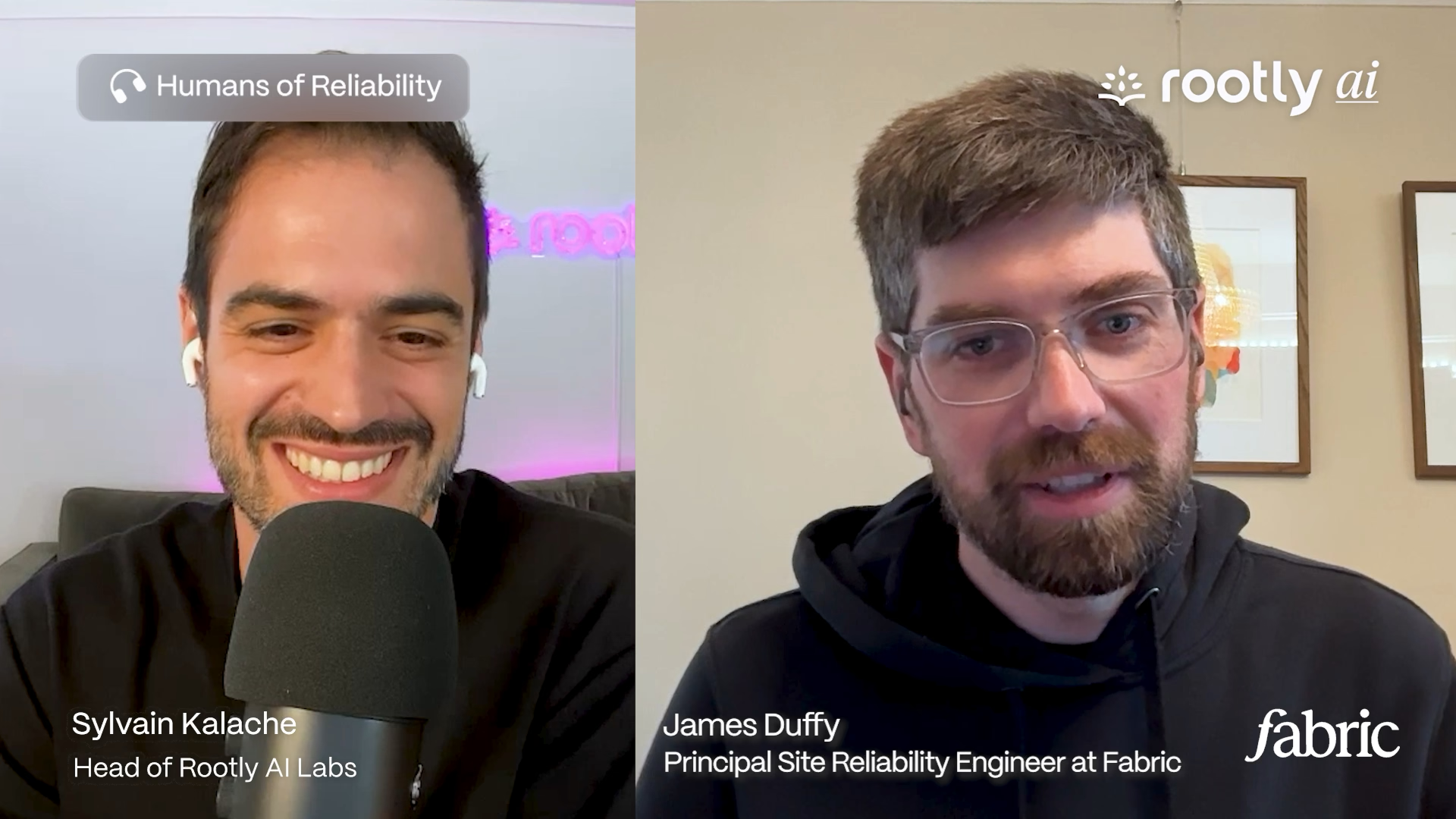
AI is changing the entire path into and through reliability engineering. James Duffy, Principal SRE at Fabric, rebuilt his interview process around evaluating AI-generated Terraform. He explains why that exercise surfaces production judgment instead of memorization, why junior hiring still matters, and why continuous learning connects today’s interview to tomorrow’s reliability work.
1. Why is the traditional engineering interview obsolete?
For most of my career, the interview process has been disconnected from the actual job. That tends to identify people who are good at interviewing, not necessarily people who are good at the job.
AI has broken even that imperfect signal. Almost anyone can now pass a simple programming test because AI can complete it faster than the best engineer. The old process was already flawed, but it worked just well enough. Now it fundamentally does not work.
2. How did you redesign the technical interview?
I first tried to make the interview resemble the job. It was open book, and candidates could research or use documentation while building something like a Terraform module. But AI quickly made the exercise too easy. A task meant to take an hour could be finished in five minutes.
Now I give candidates pre-generated AI code and ask whether it is ready for production. It is not. Their job is to find and fix the integration gaps, security holes, and deprecated patterns. As the models improved and failed less often, I switched to a fixed sample with known problems.
3. How can candidates stand out when companies also use AI to filter applications?
The hardest part is getting the first interview. Many applications now share the same structure, formatting, and sentence patterns. If you squint, they look identical.
One useful approach is to give an AI the job description, your resume, and your cover letter, then ask it to act as a skeptical recruiter. Ask whether it would move you forward and what concerns it sees. Use that feedback to revise the application yourself. The feedback can come from AI, but the correction should sound like you.
4. What happens when companies stop hiring juniors?
Companies that stop investing in junior talent are not building a pipeline for future engineering teams. They will become top-heavy with senior people, and when those engineers move up or leave, nobody will be ready to fill their roles. Senior engineers are being asked to take on more with AI, which creates a burnout risk.
AI pricing is another reason to keep a balanced team. We may still be in the subsidized ride-share phase, when a service looks much cheaper than it will be later. As prices rise, companies may rediscover that junior engineers are effective at smaller tasks while AI is better reserved for difficult debugging and research.
5. Why is starting an SRE career harder today?
SRE and DevOps have always required broad knowledge. When I started, knowing four or five technologies deeply already felt difficult. Someone beginning today may be expected to understand 15 or 20 technologies inside and out, and that list keeps growing.
You have to be a continuous learner. If I had been frozen in time at the start of my career, I would never have learned containers or Kubernetes because they did not exist in the form we use now. The strongest people I hire show a deeper drive to keep learning. They want to learn because the subject is interesting.
6. What is AI platform engineering?
SRE and platform teams are beginning to absorb AI governance. The standards are still emerging, and a control that works well with one provider may not exist with three others.
Traditional platform engineering grew around containers and Kubernetes. Platform teams made those complicated systems easier for product engineers who did not want to become experts in the underlying infrastructure. AI platform engineering will do something similar around LLM gateways. It is separate today, but as standards mature, it will become part of platform engineering.
This is especially important in regulated healthcare. A public AI jailbreak may look funny online, but a similar failure inside a regulated product can do enormous damage.
7. What would you put on a billboard in San Francisco?
Your AI is not the risk. Your blind trust in it is.
About James Duffy
James Duffy is Principal SRE at Fabric. He writes about platform engineering at duffy.xyz and posts most often on LinkedIn.
Watch the conversation
Related human stories
Re-thinking candidate take-homes in the AI Era: transcripts over code
When everyone can ship clean code with AI, the transcript of how they got there becomes a key signal.

Code is cheap, reliability isn’t: Owning production in the AI era

Swizec Teller
Bestselling Author
AI can produce the first 90% of an application in minutes. Swizec Teller is interested in the other 190%: the judgment, ownership, and production scars that turn code into a service people trust.
 Podcast
Your next internal developer platform is a library of agent skills

Michael Kutsch
Staff SRE and Team Lead, Cloud Foundations at PostHog
PostHog's Michael Kutsch explains why agent skills are becoming an internal developer platform, how autonomy drives adoption, and where deterministic guardrails still matter.