
Best Opsgenie Alternatives for Incident Management in 2026
Opsgenie support ends April 5, 2027. Compare the best Opsgenie alternatives for engineering teams, what transfers on migration, and how to choose.

Best Opsgenie Alternatives for Incident Management in 2026
On this page
Opsgenie has been a trusted on-call and alerting tool for many engineering teams, but Atlassian is retiring it: Opsgenie reached end of sale on June 4, 2025 and reaches end of support on April 5, 2027. That date is what makes migration planning urgent. As Atlassian sunsets Opsgenie, teams now need to compare platforms that can support alerting, escalation, incident response, automation, and long-term reliability.
Choosing the right Opsgenie alternative is not just about replacing one alerting tool with another. Modern incident management now requires structured workflows, fast communication, reliable on-call coverage, post-incident learning, and better visibility across the full incident lifecycle.
Learning about the best Opsgenie alternatives in 2026 means comparing each platform across alerting reliability, on-call management, automation depth, integrations, ease of adoption, scalability, and incident response maturity.
Key Takeaways
- Opsgenie reaches end of support on April 5, 2027, so teams that rely on it for alerting and on-call management need a migration plan before then.
- The best Opsgenie alternative should cover more than alerts, including incident response, automation, stakeholder updates, and post-incident reviews.
- Rootly is the strongest overall choice for teams that want scalable incident operations, workflow automation, and full lifecycle incident management.
- PagerDuty is a strong option for enterprise-grade alerting, while Squadcast is better suited for SRE-focused reliability workflows.
- Smaller teams may prefer TaskCall or All Quiet, while teams needing migration support may consider Xurrent IMR.
- Choosing the right platform depends on team size, alerting complexity, automation needs, integrations, and long-term reliability goals.
Opsgenie end of support: what changes on April 5, 2027
Atlassian stopped selling standalone Opsgenie on June 4, 2025, and support ends on April 5, 2027. Atlassian points existing customers to Jira Service Management or Compass. For a team still paging through Opsgenie, the date sets three deadlines:
- Choose a destination early. As of October 2026 there are less than six months left, and a migration that runs in parallel needs a full on-call rotation per wave.
- Move configuration, then people. Schedules, rotations, overrides, teams, routing rules, and notification rules need to land in the new tool, and every responder needs a working way to be paged before cutover.
- Export what you need to keep. Decide whether historical alert and incident data must be retained for compliance or reporting, and export it before access ends.
Rootly runs Opsgenie migrations for you through a read-only API import, documented on docs.rootly.com. The step-by-step Opsgenie migration guide covers the plan, the timeline, and the cutover.
What to Look for in an Opsgenie Alternative
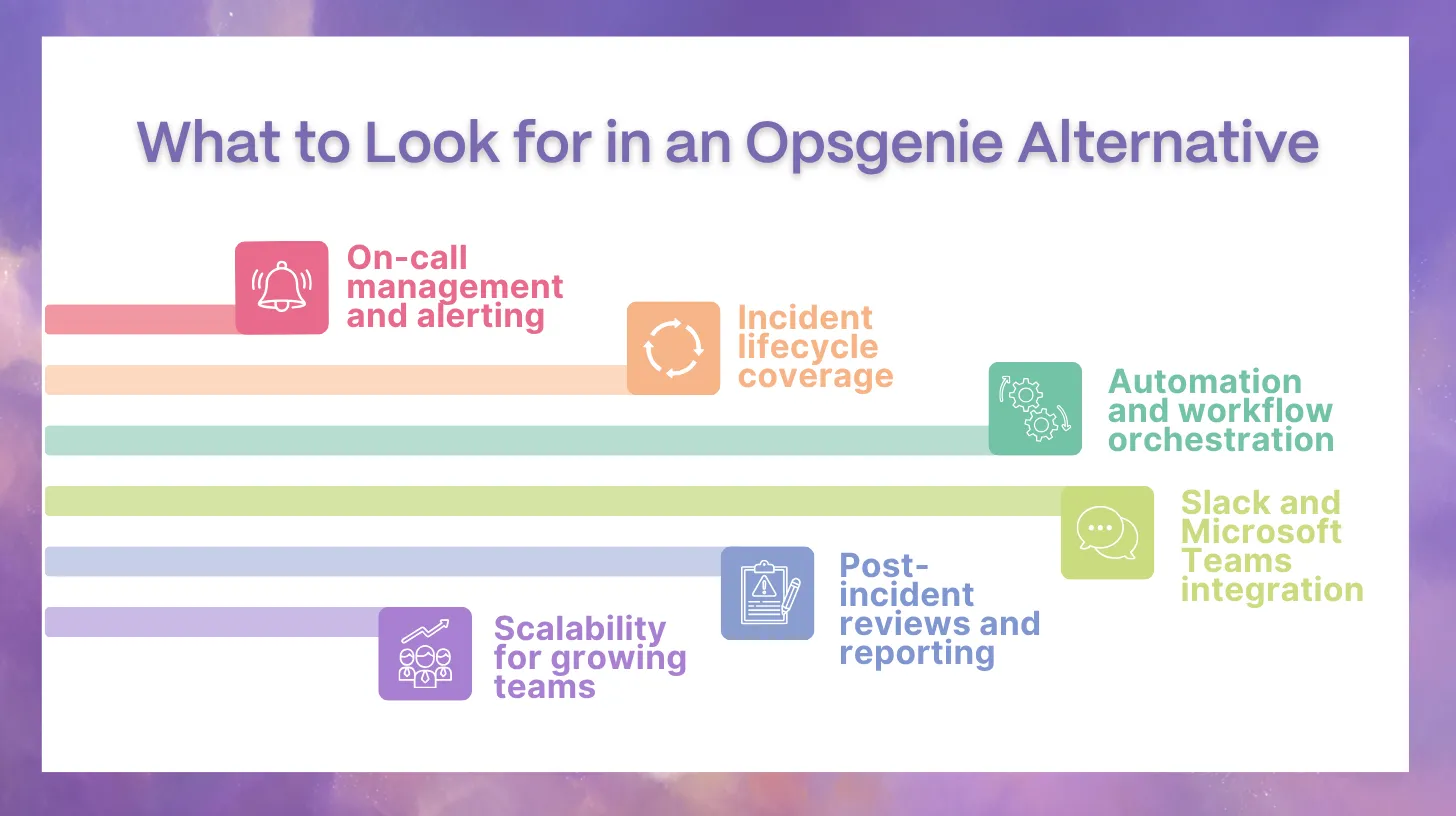
Choosing the right Opsgenie replacement starts with understanding how your team handles incidents from the first alert to final review.
On-call management and alerting
Opsgenie is best known for alerting and on-call scheduling, so any replacement should cover this foundation well. Look for flexible rotations, escalation policies, alert routing, and multi-channel notifications through SMS, phone, email, mobile push, Slack, or Microsoft Teams.
Incident lifecycle coverage
A modern incident platform should do more than notify responders. It should help teams create incidents, assign roles, coordinate response, send updates, track timelines, resolve issues, and complete post-incident reviews.
Automation and workflow orchestration
During incidents, manual coordination can slow teams down. A strong alternative should automate repeatable actions such as creating incident channels, assigning responders, paging the right team, sending stakeholder updates, opening tickets, and preparing postmortem documents.
Slack and Microsoft Teams integration
Many incidents are managed in chat, so communication integrations matter. The best platforms allow teams to coordinate response inside Slack or Microsoft Teams while still keeping incident records organized.
Post-incident reviews and reporting
Reliable teams do not stop once the issue is resolved. Look for tools that support incident timelines, postmortems, analytics, and learning workflows so teams can identify patterns and prevent repeat incidents.
Scalability for growing teams
Small teams may only need basic alerting, but larger engineering organizations often need service ownership, multiple escalation paths, automation rules, stakeholder communication, and reporting across many teams and systems.
How We Evaluated the Best Opsgenie Alternatives
To compare the strongest Opsgenie alternatives, each platform was evaluated using the same core criteria.
On-call and alerting capabilities
We looked at how well each tool supports schedules, rotations, escalation policies, alert routing, and notification reliability.
End-to-end incident management
We assessed whether each platform supports the full incident process, including detection, response, coordination, resolution, and post-incident review.
Automation depth
We considered how well each tool reduces manual work through automated workflows, runbooks, stakeholder updates, and post-incident documentation.
Collaboration features
We evaluated how each platform supports real-time communication through Slack, Microsoft Teams, dashboards, and incident channels.
Integration ecosystem
We looked at integrations with monitoring, ticketing, DevOps, SRE, communication, and cloud tools.
Ease of setup and adoption
We considered how quickly teams can get started and whether the platform requires heavy configuration to become useful.
Pricing and scalability
We reviewed how suitable each tool is for startups, growing engineering teams, and larger enterprise environments.
Best Opsgenie Alternatives
1. Rootly — Best Overall Alternative for Scalable Incident Operations
Why teams choose Rootly
Rootly is built for teams that want to move beyond alerting and manage the full incident lifecycle in one place. It combines on-call management, alerting, incident response, automation, stakeholder communication, AI-assisted workflows, status pages, and post-incident reviews.
For teams migrating away from Opsgenie, Rootly is a strong option because it can replace core alerting and escalation needs while also giving teams more structure around incident coordination and learning.
Rootly is especially useful for scaling engineering, SRE, and platform teams that want repeatable processes without slowing down response times.
Standout capabilities
- Native on-call scheduling and alerting
- Escalation policies and alert routing
- Slack and Microsoft Teams workflows
- Automated incident response playbooks
- AI-assisted summaries, timelines, and reports
- Built-in status pages and stakeholder updates
- Postmortem and incident review support
- Broad DevOps and SRE integrations
Where Rootly goes beyond Opsgenie
Opsgenie is mainly focused on alerting, escalation, and on-call management. Rootly goes further by supporting the entire incident lifecycle.
Teams can use Rootly to automate workflows, coordinate responders, keep stakeholders updated, document what happened, and turn incidents into structured learning opportunities. This makes it a stronger long-term choice for teams that want more than a direct alerting replacement.
Trade-offs to consider
- Requires thoughtful setup to get the most value
- May feel more advanced than what very small teams need
- Best suited for teams ready to formalize incident response
Best fit teams
- Scaling engineering teams
- SRE and platform teams
- Teams replacing Opsgenie with a broader platform
- Organizations prioritizing automation and operational maturity
2. PagerDuty — Best for Enterprise-Grade Reliability
Why teams choose PagerDuty
PagerDuty is one of the most established incident response and on-call management platforms. It is widely used by larger organizations that need reliable alerting, escalation policies, event intelligence, and broad integration support.
PagerDuty is a strong choice for teams that manage mission-critical infrastructure and need a mature platform that can handle high alert volume across many services and teams.
Standout capabilities
- Advanced alerting and escalation
- Flexible on-call scheduling
- Event intelligence and noise reduction
- Large integration ecosystem
- Enterprise-grade reliability and reporting
How it compares to Opsgenie
PagerDuty is stronger than Opsgenie for large-scale enterprise incident response and mature alerting operations. However, it can be more complex and costly, especially for teams that need advanced capabilities or multiple add-ons.
Trade-offs to consider
- Higher cost as teams scale
- More complex than lightweight alternatives
- Less focused on Slack-native incident workflows
Best fit teams
- Large enterprises
- Teams managing critical infrastructure
- Organizations that need mature alerting and escalation
- Companies with complex service environments
3. Squadcast — Best for SRE-Focused Incident Management
Why teams choose Squadcast
Squadcast is designed for teams that want to connect incident response with reliability practices. It combines on-call management, alerting, incident response, status pages, and SRE-focused insights.
This makes it useful for teams that want to improve how they respond to incidents while also tracking reliability over time.
Standout capabilities
- On-call scheduling and escalation
- Incident response workflows
- Built-in runbooks
- Status pages
- Reliability insights and reporting
- SRE-focused workflows
How it compares to Opsgenie
Squadcast offers broader reliability workflows than Opsgenie. While Opsgenie is centered on alert delivery and escalation, Squadcast connects alerting with incident response and reliability improvement.
Limitations to be aware of
- Integration ecosystem may be smaller than PagerDuty
- May not offer the same automation depth as Rootly
- Best value comes from teams already following SRE practices
Best fit teams
- SRE teams
- Cloud-native engineering teams
- Teams focused on reliability improvement
- Organizations that want alerting plus incident response
4. TaskCall — Best for Affordable Incident Response
Why teams choose TaskCall
TaskCall is a practical option for teams that want an affordable Opsgenie replacement with core alerting, on-call, and incident response functionality.
It is designed to help teams route alerts, manage escalations, and coordinate incidents without the heavier complexity of larger enterprise platforms.
Standout capabilities
- On-call scheduling
- Alert routing
- Escalation management
- Incident response workflows
- Operational efficiency features
- Cost-conscious pricing
How it compares to Opsgenie
TaskCall can work well for teams that mainly need to replace Opsgenie’s core alerting and escalation features. It may not offer the same full lifecycle incident management depth as more advanced platforms, but it can be suitable for smaller teams or cost-sensitive organizations.
Limitations to be aware of
- Less advanced automation than Rootly
- Smaller ecosystem than PagerDuty
- May not be ideal for complex enterprise environments
Best fit teams
- Small to mid-sized engineering teams
- Teams looking for an affordable Opsgenie replacement
- Organizations focused on essential alerting and incident response
5. Xurrent IMR — Best for Opsgenie Migration Support
Why teams choose Xurrent IMR
Xurrent IMR is positioned as a migration-friendly option for teams moving away from Opsgenie. It may appeal to organizations that want a smoother transition from existing Opsgenie workflows into a new incident management system.
Its value is strongest for teams that want help moving alerting processes, integrations, and incident workflows without rebuilding everything manually.
Standout capabilities
- Opsgenie migration support
- Incident response functionality
- Alerting and escalation workflows
- Slack and Jira integrations
- Transition support for existing teams
How it compares to Opsgenie
Xurrent IMR is focused on helping teams replace Opsgenie with less disruption. Compared with broader platforms, its strongest appeal is migration support rather than advanced automation or full lifecycle incident orchestration.
Limitations to be aware of
- Less widely known than PagerDuty or Rootly
- May be more migration-focused than feature-rich
- Best suited for teams prioritizing transition support
Best fit teams
- Current Opsgenie users
- Teams that need migration assistance
- Organizations already using Slack and Jira
- Teams that want a guided transition path
6. All Quiet — Best for Lightweight Alerting and Smaller Teams
Why teams choose All Quiet
All Quiet is a newer alerting and incident management tool that focuses on simplicity, affordability, and practical response workflows.
It may be a good fit for startups or smaller engineering teams that want dependable alerting and on-call functionality without adopting a larger enterprise platform.
Standout capabilities
- On-call scheduling
- Alerting and escalation
- Incident coordination
- Simple setup
- Lower entry pricing
- Terraform support
How it compares to Opsgenie
All Quiet can be a practical replacement for teams that mainly need alerting and basic incident response. It may not offer the same advanced workflow orchestration or enterprise ecosystem as larger platforms, but it gives smaller teams a simpler way to stay organized.
Limitations to be aware of
- Less mature than older platforms
- Limited advanced automation
- May not be ideal for larger enterprises
Best fit teams
- Startups
- Smaller engineering teams
- Teams with straightforward on-call needs
- Organizations looking for a lightweight alerting tool
At-a-Glance: Opsgenie Alternatives Feature Matrix
| Feature | Opsgenie / (Baseline) | PagerDuty | Squadcast | TaskCall | Xurrent IMR | All Quiet | Rootly |
|---|---|---|---|---|---|---|---|
| Platform | |||||||
| Unified Platform (On-Call + IM) | 🟡 | 🟡 | ✅ | 🟡 | 🟡 | 🟡 | ✅ |
| Chat-Native (Slack & Teams) | 🟡 | 🟡 | 🟡 | 🟡 | ✅ | 🟡 | ✅ |
| Modern Mobile App | ✅ | ✅ | ✅ | ✅ | 🟡 | ✅ | ✅ |
| AI Intelligence | |||||||
| AI-Generated Summaries | ❌ | 🟡 | ❌ | ❌ | ❌ | ❌ | ✅ |
| AI Root Cause Insights | ❌ | 🟡 | ❌ | ❌ | ❌ | ❌ | ✅ |
| AI-Suggested Responders | ❌ | ❌ | ❌ | ❌ | ❌ | ❌ | ✅ |
| AI-Generated Post-mortems | ❌ | 🟡 | ❌ | ❌ | ❌ | ❌ | ✅ |
| Automation | |||||||
| Customizable Workflow Engine | 🟡 | 🟡 | 🟡 | 🟡 | 🟡 | ❌ | ✅ |
| Self-Healing Actions (HTTP client) | ❌ | 🟡 | ❌ | ❌ | ❌ | ❌ | ✅ |
| Automated Timeline Generation | ✅ | ✅ | ✅ | 🟡 | 🟡 | 🟡 | ✅ |
| On-Call Experience | |||||||
| Multi-Cloud Alerting Redundancy | ❌ | ❌ | ❌ | ❌ | ❌ | ❌ | ✅ |
| Live Call Routing | ✅ | 🟡 | ✅ | ✅ | 🟡 | ✅ | ✅ |
| Vacation-Aware Scheduling | ❌ | 🟡 | 🟡 | 🟡 | 🟡 | 🟡 | ✅ |
| Delay Paging | ❌ | ❌ | ❌ | ❌ | ❌ | ❌ | ✅ |
| Heartbeat Monitoring | ✅ | ❌ | ✅ | 🟡 | 🟡 | 🟡 | ✅ |
| DevEx & Enterprise | |||||||
| Comprehensive Terraform Provider | ❌ | ✅ | 🟡 | ❌ | ❌ | 🟡 | ✅ |
| Deep Granular RBAC | 🟡 | 🟡 | 🟡 | 🟡 | 🟡 | ❌ | ✅ |
| Branded Status Pages | 🟡 | 🟡 | ✅ | 🟡 | 🟡 | 🟡 | ✅ |
| SSO (No Surcharge) | ✅ | ❌ | 🟡 | 🟡 | 🟡 | 🟡 | ✅ |
| SCIM/HRIS Sync | ✅ | ✅ | 🟡 | ❌ | ❌ | ❌ | ✅ |
| Pricing Model | |||||||
| Predictable Per-User | ✅ | ❌ | 🟡 | ✅ | 🟡 | ✅ | ✅ |
| Per-Alert Fees | ✅ | ❌ | 🟡 | 🟡 | 🟡 | 🟡 | ✅ |
| Required Add-ons for Core Features | ❌ | ✅ | ❌ | ❌ | ❌ | ❌ | ❌ |
Rootly vs Opsgenie: Key Differences
The core difference between Rootly and Opsgenie is scope.
Opsgenie is primarily an on-call and alerting tool. It helps teams route alerts, manage schedules, and escalate issues to the right responders.
Rootly is a broader incident management platform. It supports alerting and on-call needs, but also helps teams coordinate incidents, automate workflows, communicate with stakeholders, generate timelines, run postmortems, and improve reliability over time.
Alerting and on-call
Opsgenie is strong for alerting, routing, and escalation. Rootly also supports these needs while connecting them to the broader incident workflow.
Incident response
Opsgenie helps notify the right people. Rootly helps teams manage what happens after the alert, including triage, role assignment, communication, updates, and resolution.
Automation
Rootly provides more advanced automation for incident workflows, stakeholder communication, post-incident documentation, and response consistency.
Post-incident learning
Opsgenie is limited when it comes to full post-incident review workflows. Rootly is stronger for teams that want timelines, summaries, reports, and continuous improvement.
Best fit
Opsgenie worked well for alerting-focused teams. Rootly is a better fit for teams that want to replace Opsgenie with a more complete platform for modern incident operations.
Migrate to Rootly in Minutes
Rootly removes the fear of migration with a fast, automated, and fully supported process.
-
Rootly-led import: Rootly imports users, teams and routing rules, schedules, services, and notification rules over the Opsgenie API with read-only access, starting with a dry run. See the step-by-step migration guide for the full plan.
-
Expert Support - Rootly’s migration team includes former PagerDuty and Opsgenie employees who have onboarded over 50,000 users and provide hands-on guidance.
Compare Opsgenie vs. Rootly
Opsgenie
★★★★★ 4.3 / 5
(Based on 48 G2 reviews)
Rootly
★★★★★ 4.8 / 5
(Based on G2 user reviews)
Case Study: How Motive Upgraded from Opsgenie to Rootly for Faster Resolution
About Motive: A leader in the physical economy, Motive provides a full suite of products to manage fleets of all sizes, supporting over 150,000 customers and more than a million vehicles where 99.99% reliability isn’t just a goal—it’s a necessity.
Even before Atlassian announced it was sunsetting Opsgenie, the engineering team at Motive knew they had a problem. Their incident response process was manual, slow, and fragmented. Kicking off an incident could take anywhere from 15 minutes to over an hour, precious time lost to logistical overhead instead of problem-solving.
Their on-call system, built on Opsgenie, required a “patchwork of custom bots and manual workarounds” just to function within Slack. This setup created constant friction, pulling engineers away from their core focus and bogging them down with administrative tasks.

Which Opsgenie Alternative Should You Choose?
| Tool | Best For | Pricing Model | Key Differentiator |
|---|---|---|---|
| PagerDuty | Large enterprises that need mature alerting, escalation, and reliability operations | Per-user pricing with advanced capabilities often tied to higher plans or add-ons | Enterprise-grade alerting, event intelligence, and a broad integration ecosystem |
| Squadcast | SRE and reliability teams that want alerting connected to incident response workflows | Tiered subscription pricing based on feature depth and team size | Reliability-focused incident management designed for SRE and platform teams |
| TaskCall | Small to mid-sized teams that want affordable alerting and incident response | Affordable subscription pricing focused on alerting and on-call workflows | Practical incident response without enterprise-level complexity |
| Xurrent IMR | Teams migrating away from Opsgenie that want transition support | Subscription pricing for incident management and migration workflows | Migration-friendly incident response for Opsgenie users |
| All Quiet | Startups and smaller engineering teams with straightforward on-call needs | Simple subscription pricing for lightweight alerting and response | Lightweight setup with practical on-call functionality |
| Rootly | Scaling engineering, SRE, and platform teams that need full incident lifecycle management | Subscription pricing built for incident response and automation | End-to-end incident management with workflow automation, AI assistance, and ChatOps |
FAQs
What is the best alternative to Opsgenie?
Rootly is one of the strongest Opsgenie alternatives for teams that want more than basic alerting. It combines on-call management, alerting, incident response, automation, stakeholder updates, and post-incident learning in one platform.
Why are teams looking for Opsgenie alternatives?
Teams are looking for Opsgenie alternatives because Atlassian is retiring Opsgenie: end of sale was June 4, 2025 and end of support is April 5, 2027. Current users need to plan a migration to another alerting or incident management platform before support ends.
Is Rootly better than Opsgenie?
Rootly is better for teams that need full incident lifecycle management, workflow automation, Slack-native coordination, stakeholder communication, and post-incident reporting. Opsgenie is mainly focused on alerting, on-call schedules, and escalation policies.
Can Opsgenie alternatives replace separate on-call tools?
Yes. Some Opsgenie alternatives can replace separate on-call tools if they include scheduling, escalation policies, alert routing, notifications, and incident response workflows.
Which Opsgenie alternative is best for enterprise teams?
PagerDuty is a strong option for enterprise-grade alerting and reliability. Rootly is also a strong fit for scaling engineering teams that want deeper automation and full incident management coverage.
Which Opsgenie alternative is best for SRE teams?
Rootly and Squadcast are both strong options for SRE teams. Rootly is better suited for teams that want advanced automation and incident orchestration, while Squadcast is useful for reliability-focused workflows.
Do teams still need PagerDuty after leaving Opsgenie?
Some teams may choose PagerDuty if they need mature enterprise alerting. However, teams that want to consolidate alerting, incident response, automation, and post-incident learning may prefer a broader platform like Rootly.
What should teams compare before switching from Opsgenie?
Teams should compare on-call scheduling, escalation policies, alert routing, integrations, automation depth, communication workflows, reporting, postmortem features, pricing, and scalability.
Can small teams use Opsgenie alternatives?
Yes. Smaller teams may prefer lightweight tools such as TaskCall or All Quiet. However, teams that expect to scale may benefit from choosing a platform that can grow with them.
Is Jira Service Management a good replacement for Opsgenie?
It depends on who responds to incidents. Jira Service Management is an IT service desk product and fits teams whose incident process is ticket-centric and owned by IT operations. It is a weaker fit for engineering-led incident response, where the work happens in Slack or Microsoft Teams and coordination speed matters more than ticket handling. Atlassian is steering Opsgenie customers toward it, which is convenient, so evaluate it against the same criteria as any other option.
When does Opsgenie support end?
Opsgenie support ends on April 5, 2027. New sales and trials ended on June 4, 2025.
Why do teams move from alerting tools to full incident management platforms?
Teams often move when alerting alone is no longer enough. As systems become more complex, teams need better coordination, automation, stakeholder updates, post-incident reviews, and reliability insights.
Choosing the Right Opsgenie Replacement for Long-Term Reliability
Selecting an Opsgenie alternative is not just a migration task. It is an opportunity to improve how your team responds to incidents, communicates during high-pressure moments, and learns from operational failures.
A basic alerting tool may be enough for teams with simple needs. But as engineering systems grow more distributed, incident response requires more structure. Teams need clear ownership, reliable escalation, automated workflows, real-time collaboration, and post-incident learning.
At Rootly, incident management is treated as a full lifecycle process, not just an alerting function. The platform helps teams manage on-call workflows, automate response steps, coordinate communication, use AI-assisted incident intelligence, and improve reliability after each incident.
The best Opsgenie alternative depends on your team’s size, complexity, and goals. If your priority is basic alerting, a lightweight tool may be enough. If your team is scaling and wants to build stronger incident operations, a platform with automation, orchestration, and full lifecycle support will provide more long-term value.
Ultimately, the goal is not only to replace Opsgenie. The goal is to choose a platform that helps your team respond faster, work more consistently, reduce manual effort, and build more reliable systems over time.
Related articles
Why our retrospective template doesn't ask for root cause
The seven sections of the Rootly Retrospective Template, why each one is there, and where AI helps a retrospective and where it should stay out.

Audit-ready incident records: what SOC 2 auditors look for and how to evaluate tools
How to create incident records that hold up in SOC 2 audits and reviews, what evidence auditors ask for, and a checklist for evaluating incident management software on audit readiness.

Best Incident Response Tools for SRE and Platform Engineering Teams
Platform teams buy incident tooling for other teams to use. A comparison built around that constraint — adoption, multi-team governance, and what breaks at scale.