
AI-powered alert management helps engineering teams understand what an alert means, how urgent it is, who may need to respond, and which actions could help resolve the issue. Instead of presenting responders with raw monitoring data, AI converts alerts into operational context that supports faster, more confident decisions.
This matters because modern production incidents rarely generate one perfectly descriptive alert. They often produce incomplete signals across metrics, logs, traces, deployments, services, and communication tools. Alert management integrations make that context available, while responders otherwise have to assemble those fragments as customers may already be experiencing an outage.
AI can accelerate that initial investigation by analyzing the available context, summarizing the situation, estimating impact, identifying relevant responders, and recommending what to investigate next. These capabilities reflect the broader role of AI in site reliability engineering, where AI helps teams interpret operational data and coordinate incident response. It does not eliminate the need for experienced engineers. Instead, it gives them a clearer starting point and helps them focus on restoring service.
Understanding how AI improves alert management can help engineering teams respond faster while keeping critical decisions in human hands.
What is AI-powered alert management?
AI-powered alert management is the use of machine learning, natural language processing, generative AI, and related technologies to interpret alerts and support response decisions.
Traditional alert management systems primarily use predefined conditions. A rule may state that when CPU usage exceeds a threshold, the system should notify a particular team. These rules remain important because they provide predictable behavior.
AI adds another layer of interpretation. It can examine an alert alongside information such as:
- The affected service and its dependencies
- Recent code or infrastructure changes
- Related logs, metrics, and traces
- Previous incidents with similar symptoms
- Service ownership and on-call information
- Current incident communications
- Known runbooks and troubleshooting procedures
- Customer or business impact
By combining these inputs, AI can help answer questions that a basic notification cannot:
- What appears to be happening?
- Is this likely to require immediate intervention?
- Which services and customers may be affected?
- Who has the most relevant knowledge?
- Has the organization encountered something similar before?
- What should responders investigate first?
The result is not simply a better-formatted alert. It is a more informed entry point into incident response.
How AI-powered alert triage works
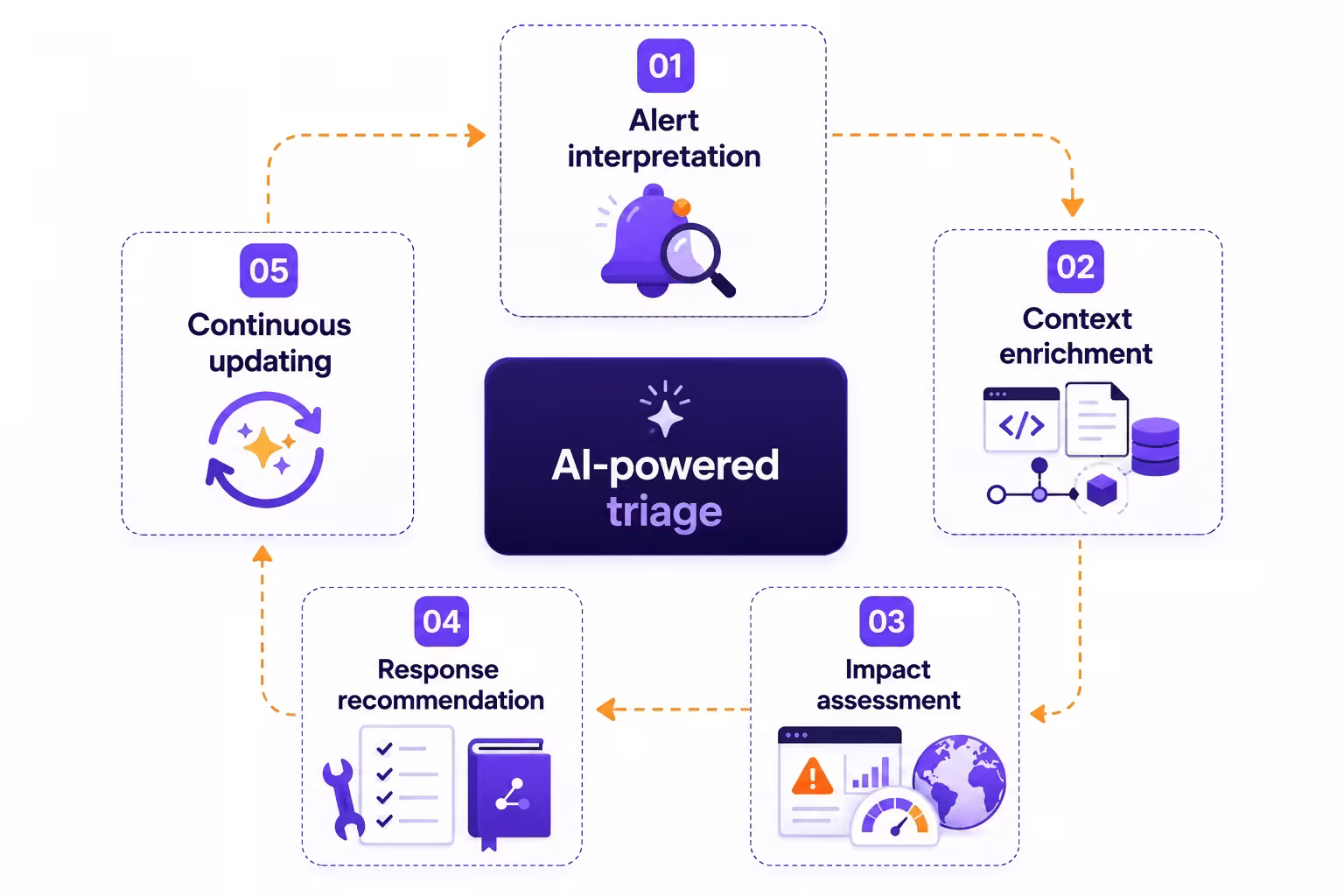
AI-powered triage begins when an alert enters the incident management environment. The system analyzes both the alert itself and the operational context available through connected tools.
A typical process includes five stages.
1. Alert Interpretation
AI first extracts the meaningful details from the incoming alert, including:
- Alert source
- Triggering condition
- Affected resource
- Service or component
- Environment
- Timestamp
- Current value
- Expected value
- Tags and labels
- Error messages
Natural language processing can turn technical alert payloads into a concise explanation that is easier to scan under pressure.
For example, instead of showing only that a latency threshold was exceeded, the system may explain that checkout API latency increased shortly after a deployment and is affecting requests in one production region.
2. Context Enrichment
An alert rarely contains everything responders need. AI can retrieve related context from connected engineering systems and place it alongside the original signal.
Relevant context may include:
- Recent deployments
- Code commits
- Infrastructure changes
- Service dependencies
- Current on-call assignments
- Runbook documentation
- Related support reports
- Previous incident records
- Active incident-channel discussions
This reduces the amount of manual searching required before investigation can begin.
3. Impact Assessment
AI can evaluate the available evidence to estimate the probable scope and urgency of the issue.
The assessment may consider:
- Whether the affected service is customer-facing
- How many regions or environments are involved
- Whether the condition is worsening
- Whether dependent services are also failing
- Whether a similar pattern caused a major incident previously
- Whether customers are reporting errors
- Whether an important business workflow is affected
The output should be treated as a recommendation rather than an unquestionable determination. However, even an early impact estimate can help an incident commander decide whether to broaden the response.
4. Response Recommendation
Once the alert has been interpreted and enriched, AI can recommend the next appropriate steps.
Recommendations might include:
- Inspecting a recent deployment
- Checking a specific dashboard
- Reviewing logs for a known error signature
- Contacting a service owner
- Consulting a relevant runbook
- Comparing the incident with a similar past event
- Rolling back a suspected change
- Escalating the incident for additional review
These suggestions are most valuable when they reference evidence. A recommendation to inspect a deployment is more useful when the system explains that error rates increased three minutes after that deployment completed.
5. Continuous Updating
Incident conditions change as responders investigate. New alerts, messages, status changes, and mitigation actions may alter the initial assessment.
AI can update its summary as more information becomes available. It may revise the suspected cause, recognize that additional services are affected, or incorporate a mitigation that has reduced customer impact.
This creates a living view of the incident instead of a static description of its first alert.
Five ways AI improves alert triage and response
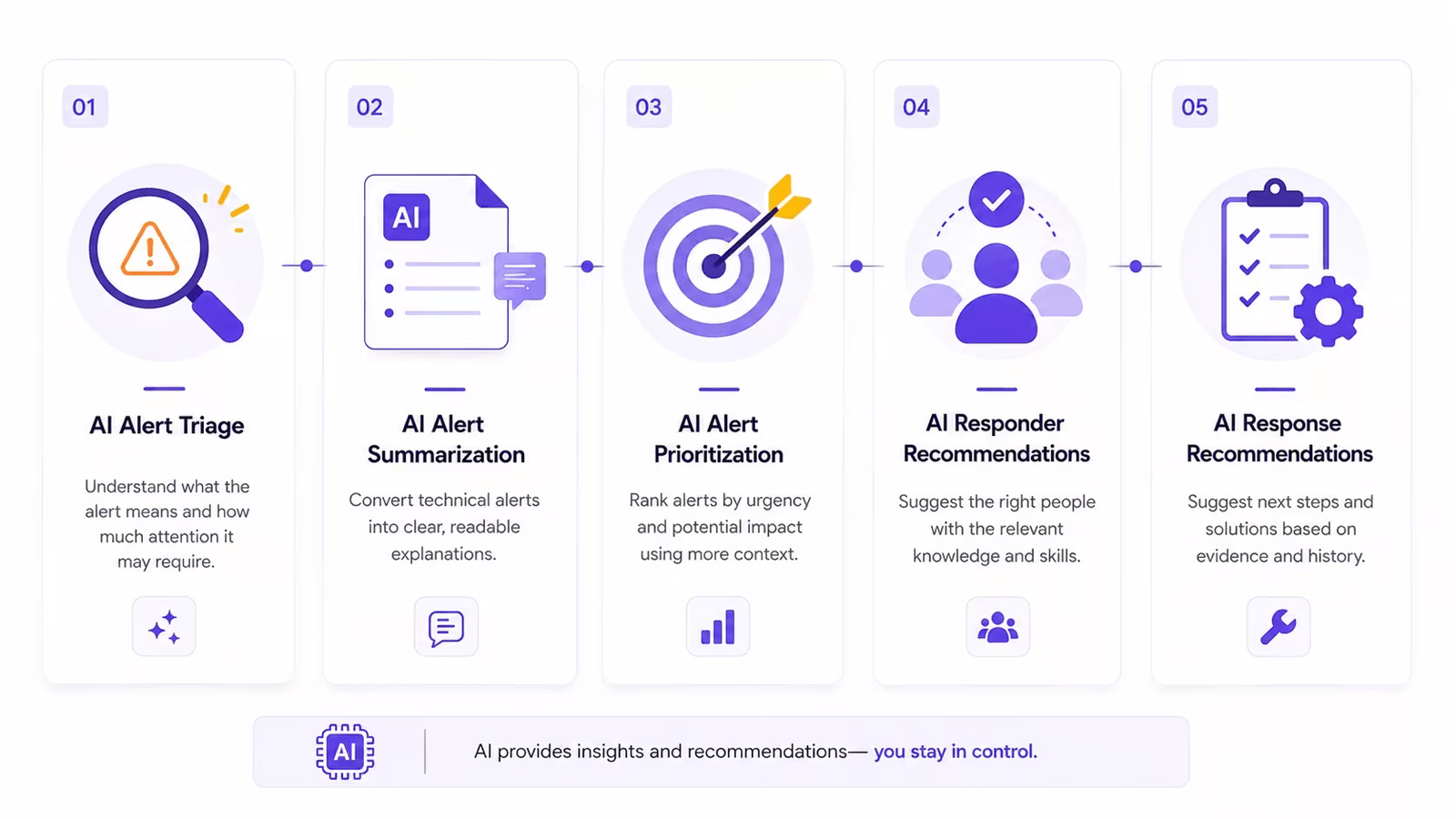
AI Alert Triage
AI triage helps determine what an incoming alert represents and what level of attention it may require.
The system can analyze signal characteristics, affected resources, historical patterns, and organizational context. It may recognize that a technically severe-looking alert is connected to a non-production test, while a modest change in a business-critical service deserves immediate investigation.
Effective AI triage can help responders:
- Understand an unfamiliar alert
- Identify the likely affected service
- Recognize potential customer impact
- Find connected operational signals
- Determine whether a broader incident response is appropriate
The goal is not to let AI make every decision. It is to reduce the uncertainty responders face when an alert first arrives.
AI Alert Summarization
Production alerts are often written for machines or monitoring specialists rather than for incident commanders, customer support teams, or business leaders.
AI summarization converts technical data into a short, readable explanation. A strong alert summary should state:
- What changed
- Where the problem is occurring
- When it began
- What may be affected
- What evidence is available
- What remains unknown
Summaries become even more valuable as an incident progresses. Engineers joining the response late can review the current situation without reading an entire Slack thread or reconstructing the timeline manually.
AI Alert Prioritization
AI prioritization evaluates alerts using more context than a static severity label alone.
A monitoring tool might label an alert as critical because a fixed technical threshold has been crossed. AI can assess whether the affected system is customer-facing, whether the behavior is spreading, and whether the organization has encountered the pattern before.
Useful prioritization signals include:
- Service criticality
- Customer impact
- Number of affected components
- Rate of deterioration
- Dependency relationships
- Similar historical incidents
- Current traffic or business conditions
- Recent changes
- Confidence in the underlying alert
This produces a more operationally meaningful recommendation. However, organizations should retain explicit severity criteria and allow responders to override AI classifications.
AI Responder Recommendations
An ownership directory can identify the team assigned to a service. AI can go further by suggesting people with relevant operational knowledge.
A responder recommendation may consider:
- Current on-call assignments
- Service ownership
- Previous incident participation
- Recent code contributions
- Familiarity with the affected component
- Availability and regional coverage
- Expertise demonstrated in similar incidents
This can be especially useful when the primary on-call engineer needs support from someone who understands a specific dependency or recent change.
AI should not silently page additional people based solely on an uncertain prediction. The recommendation should explain why a person or team appears relevant, allowing the incident commander to make the final decision.
AI Response Recommendations
During an incident, responders may know that something is wrong without knowing where to begin. AI can use current evidence and organizational history to suggest investigation and mitigation options.
For example, it may surface:
- A runbook linked to the affected service
- A similar incident resolved by restarting a failed worker
- A deployment associated with the first error spike
- A dashboard showing an upstream dependency failure
- A previous mitigation that restored service
- An engineer who resolved a related incident
Recommendations should be presented as hypotheses. The AI may identify a correlation that is not causal or retrieve a past solution that does not fit the current conditions.
The responder remains responsible for validating the evidence and considering the risk before performing any production action.
What context does AI need to make useful decisions?
An AI system cannot provide reliable operational guidance when it sees only a vague alert title. Its usefulness depends on the quality, coverage, and relevance of the context available to it.
Observability Data
Metrics, logs, traces, and monitoring events show what the system is doing. AI can examine these signals together to construct a more complete explanation of the failure.
Service Catalog Data
A service catalog provides ownership, tier, dependency, repository, and documentation information. This helps AI understand whether a service is business-critical and which teams may need to participate.
Change Data
Deployments, configuration updates, feature flag changes, and infrastructure modifications are often important during early investigation. AI can compare the timing of these changes with the start of the alert.
Incident History
Past incidents preserve information about symptoms, affected services, responders, mitigation actions, and root causes. AI can retrieve similar events and turn incident history into usable operational memory.
Runbooks and Documentation
Runbooks give AI organization-approved procedures to reference. Recommendations grounded in current internal documentation are generally more useful than generic troubleshooting advice.
Collaboration Data
Incident channels, bridge transcripts, status updates, and action items reveal what responders have already discovered. This prevents the AI from repeatedly suggesting steps the team has completed.
Example of AI-powered alert triage
Consider an online retailer whose checkout error rate rises from 1% to 12%.
A traditional alert may tell the on-call engineer that a threshold has been exceeded. The engineer must then identify the affected endpoint, inspect dashboards, search logs, review deployments, locate the service owner, and determine whether customers are affected.
An AI-assisted workflow could provide this initial brief:
Checkout failures increased in the production environment at 14:06 UTC. The issue is concentrated in payment authorization requests in the Asia-Pacific region. A payment-service deployment completed eight minutes before the increase. Two similar incidents were previously associated with invalid regional configuration. No mitigation has been confirmed.
The system could then recommend:
- Reviewing the latest payment-service deployment
- Comparing regional configuration values
- Opening the relevant checkout failure runbook
- Bringing in the payment platform owner
- Checking whether rollback conditions have been met
The AI has not resolved the incident or proven its cause. It has reduced the number of disconnected facts the engineer must assemble before taking action.
AI-powered alert management versus rule-based management
AI and predefined rules solve different problems and usually work best together.
| Capability | Rule-Based Management | AI-Powered Management |
|---|---|---|
| Decision method | Predefined conditions | Contextual analysis and learned patterns |
| Predictability | Highly predictable | May vary with context and confidence |
| Alert interpretation | Limited to configured fields | Can interpret technical and natural-language data |
| Impact assessment | Based on static severity rules | Can consider services, history, changes, and business context |
| Recommendations | Preconfigured actions | Context-dependent investigation suggestions |
| Explainability | Usually straightforward | Requires evidence and reasoning to be shown |
| Best use | Deterministic operational controls | Analysis, summarization, and decision support |
Rules remain appropriate for deterministic actions, compliance requirements, and well-understood failure conditions. AI is most useful where teams must interpret ambiguous information or assemble context from multiple systems.
Keeping humans in control
The strongest AI-powered alert management systems assist responders without removing accountability.
Human review is particularly important when a proposed action could:
- Restart or terminate production resources
- Roll back a deployment
- Modify customer data
- Disable a security control
- Change network access
- Affect several regions
- Trigger customer or regulatory communication
- Extend the duration or scope of an outage
Organizations can use different levels of autonomy based on risk:
- Read-only assistance: AI summarizes information and answers questions.
- Recommendations: AI proposes actions that require responder approval.
- Controlled execution: AI performs approved actions through restricted workflows.
- Limited autonomy: AI performs low-risk, reversible actions within defined boundaries.
Most teams should begin with read-only assistance and recommendations. Greater autonomy can be introduced after the system has been tested on real incidents and appropriate safeguards are established.
Risks and limitations of AI alert management
AI can accelerate response, but it also introduces risks that must be actively managed.
Incorrect Conclusions
AI may confuse correlation with causation or generate a confident explanation from incomplete evidence. Recommendations should link back to the alerts, changes, incidents, or documentation supporting them.
Outdated Operational Context
An old runbook or inaccurate ownership record can produce a technically reasonable but operationally incorrect recommendation. Connected systems must be maintained.
Automation Bias
Responders may accept an AI suggestion because it appears authoritative. Training should encourage engineers to verify the evidence, particularly during high-severity incidents.
Sensitive Data Exposure
Alerts and incident channels may contain customer information, internal architecture details, credentials, or security findings. Teams should evaluate how incident data is transmitted, stored, retained, and used by AI providers.
Limited Organizational Knowledge
AI cannot reliably infer processes or system relationships that have never been documented or connected. Improving service catalogs, runbooks, incident records, and integration coverage will also improve AI output.
Unclear Accountability
Organizations need to define who approves AI-recommended actions and who remains accountable when a recommendation is incorrect. Responsibility should stay with clearly identified human operators.
How to introduce AI into alert management safely
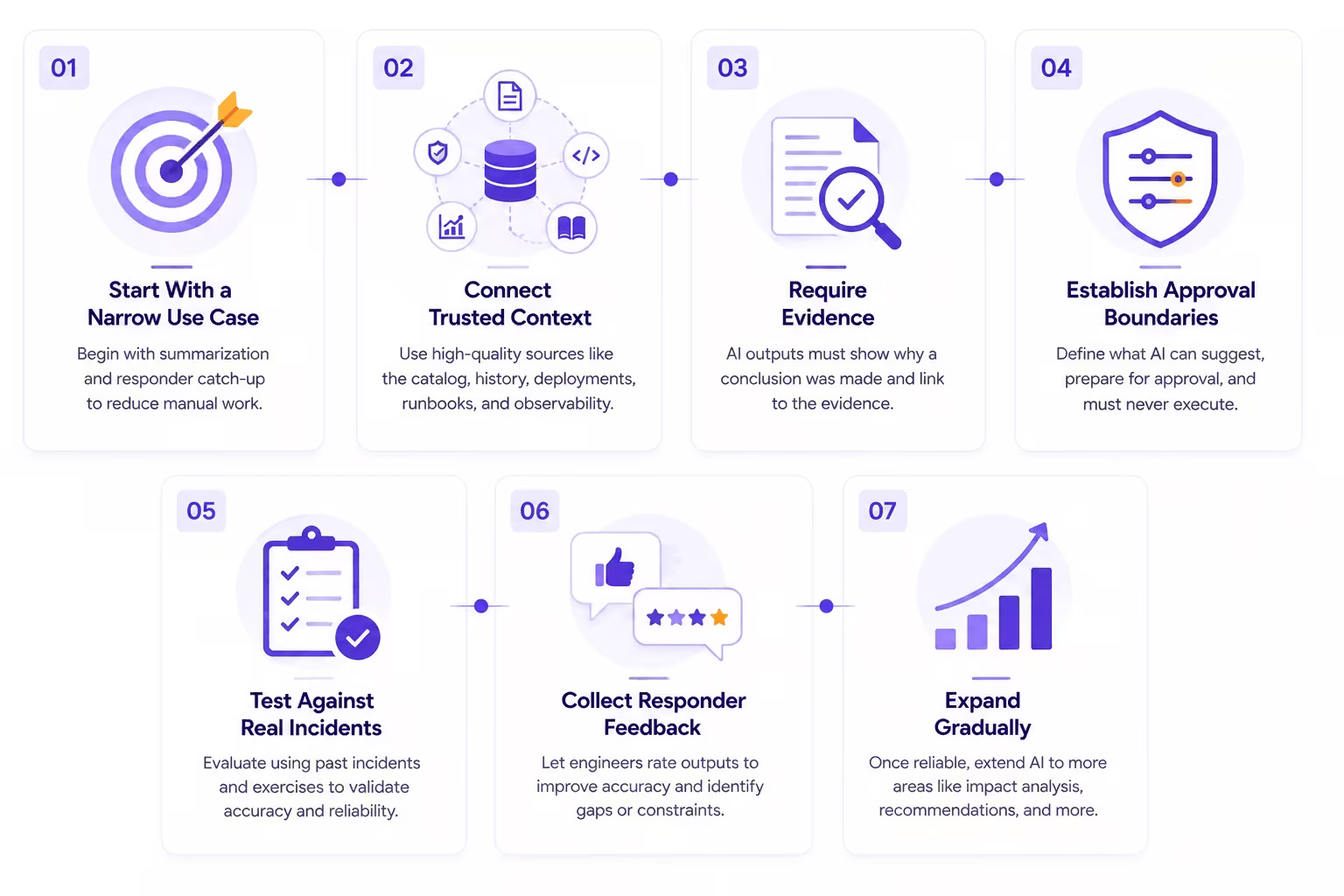
Start With a Narrow Use Case
Incident summarization and responder catch-up are practical starting points. They reduce manual work without giving AI control over production systems.
Connect Trusted Context
Prioritize high-quality sources such as the service catalog, incident history, deployment platform, runbooks, and observability tools.
Require Evidence
AI outputs should show why a conclusion or recommendation was made. Responders need to inspect the underlying evidence rather than receiving an unexplained answer.
Establish Approval Boundaries
Define which actions AI may suggest, which it may prepare for approval, and which it must never execute automatically.
Test Against Real Incidents
Evaluate the system using resolved incidents and controlled exercises. Check whether it correctly identifies affected services, retrieves useful precedents, and avoids unsupported conclusions.
Collect Responder Feedback
Let engineers rate summaries and recommendations. Feedback can reveal missing integrations, inaccurate documentation, and situations where the AI requires tighter constraints.
Expand Gradually
After a use case performs reliably, extend AI into additional areas such as impact assessment, responder recommendations, troubleshooting guidance, and communication drafting.
How Rootly supports AI-powered alert management
Rootly AI is embedded across the incident lifecycle rather than operating as a separate chatbot disconnected from response activity.
Teams can use Rootly AI to:
- Generate concise incident titles
- Create and update incident summaries
- Help late-joining responders catch up
- Ask contextual questions in Slack, web, or mobile
- Draft incident communications
- Suggest relevant actions and investigation paths
- Update severity, status, and action items with existing user permissions
- Capture bridge-call transcripts and summaries
- Draft mitigation and resolution explanations
- Prepare structured sections for an incident postmortem
Because the AI works within the incident record, it can use alerts, timeline events, metadata, action items, communications, and other available context to support responders. Rootly’s approach keeps humans in control of operational decisions while reducing the manual coordination surrounding them.
Rootly AI SRE can also analyze telemetry, code changes, and previous incidents to help teams investigate likely causes and potential fixes.
Build a faster, better-informed alert response
AI-powered alert management gives engineering teams a faster way to understand production signals. It can interpret technical alerts, gather operational context, estimate probable impact, recommend relevant responders, and suggest where an investigation should begin.
Its greatest value is not replacing on-call engineers. It is reducing the fragmented, repetitive work that prevents those engineers from applying their judgment quickly.
Successful adoption requires trusted data, clear approval boundaries, explainable recommendations, privacy controls, and continuous responder feedback. When those foundations are in place, AI can help teams move from an ambiguous alert to a coordinated, informed response with less delay.
Book a demo to see how Rootly brings AI-powered context, guidance, and incident coordination into the tools your responders already use.
Frequently asked questions
Can AI determine the root cause of an alert?
AI can identify likely causes by examining telemetry, recent changes, service relationships, and past incidents. Its conclusion should be treated as a hypothesis until responders validate it with direct evidence.
Does AI-powered alert management replace on-call engineers?
No. AI reduces manual investigation and coordination work, but engineers remain responsible for evaluating risk, validating recommendations, and approving consequential production actions.
What is the difference between AI triage and AI summarization?
AI triage evaluates what an alert represents, how urgent it may be, and what response it may require. AI summarization converts the available information into a concise explanation for responders and stakeholders.
Can AI learn from previous incidents?
Yes. When connected to an organization’s incident history, AI can retrieve similar events, previous mitigation steps, relevant responders, and recurring failure patterns.
How accurate is AI alert prioritization?
Accuracy depends on the quality of the alert data, service catalog, historical incidents, integrations, and feedback available to the system. Teams should monitor results and preserve manual override controls.
What should teams evaluate before adopting AI alert management?
Teams should evaluate context coverage, output explainability, privacy controls, human approval options, integration depth, permission enforcement, auditability, and performance against their own historical incidents.
AI-powered alert management: how AI improves alert triage and response