

A single service failure can generate hundreds of alerts across infrastructure monitoring, application logs, network tools, and Application Performance Monitoring (APM) platforms. Without an effective way to organize these signals, responders may receive dozens of notifications that all point to the same underlying issue.
Alert deduplication and correlation help teams turn these repetitive event streams into a smaller number of actionable incidents. Deduplication consolidates repeated alerts about the same condition, while correlation identifies relationships between different alerts that may share a common cause.
Together, these processes reduce alert fatigue, support on-call teams, improve incident creation, and give responders a clearer picture of what is happening. The objective is not to remove alerts indiscriminately. It is to reduce unnecessary notifications while preserving the context engineers need to investigate and resolve incidents.
What is alert deduplication?
Alert deduplication is the process of identifying repeated notifications about the same condition and combining them into one alert or incident record.
For example, a monitoring tool may check disk usage every minute. If usage remains above the configured threshold for 30 minutes, the tool could generate 30 events. Without deduplication, each event might create a separate notification. With deduplication, the first event creates the alert, while later events update its occurrence count, timeline, or status.
The alert remains active until the condition is resolved. Responders see one ongoing issue instead of a series of nearly identical notifications.
Common sources of duplicate alerts include:
- Repeated threshold violations
- Recurring health checks
- Monitoring retries
- Multiple tools monitoring the same resource
- Duplicate integrations
- Short-lived state changes
- Misconfigured alert rules
- Repeated log entries during an outage
Deduplication is particularly useful during sustained failures. When a condition remains unchanged, repeatedly paging the same responder rarely provides additional value.
What is alert correlation?
Alert correlation is the process of identifying relationships among different alerts and grouping them into a broader incident.
Unlike deduplication, correlation does not require alerts to be identical. It connects signals based on shared characteristics such as timing, service ownership, infrastructure dependencies, affected environments, or historical behavior.
Consider an unavailable database. The database monitoring tool may report failed connections, while application services generate timeout alerts. An APM platform may detect increased latency, and a load balancer may report failed health checks. These alerts have different names and payloads, but they may all be symptoms of the same database failure.
Alert correlation brings those signals together so responders can investigate one incident with a complete view of the affected systems.
Alert deduplication vs alert correlation
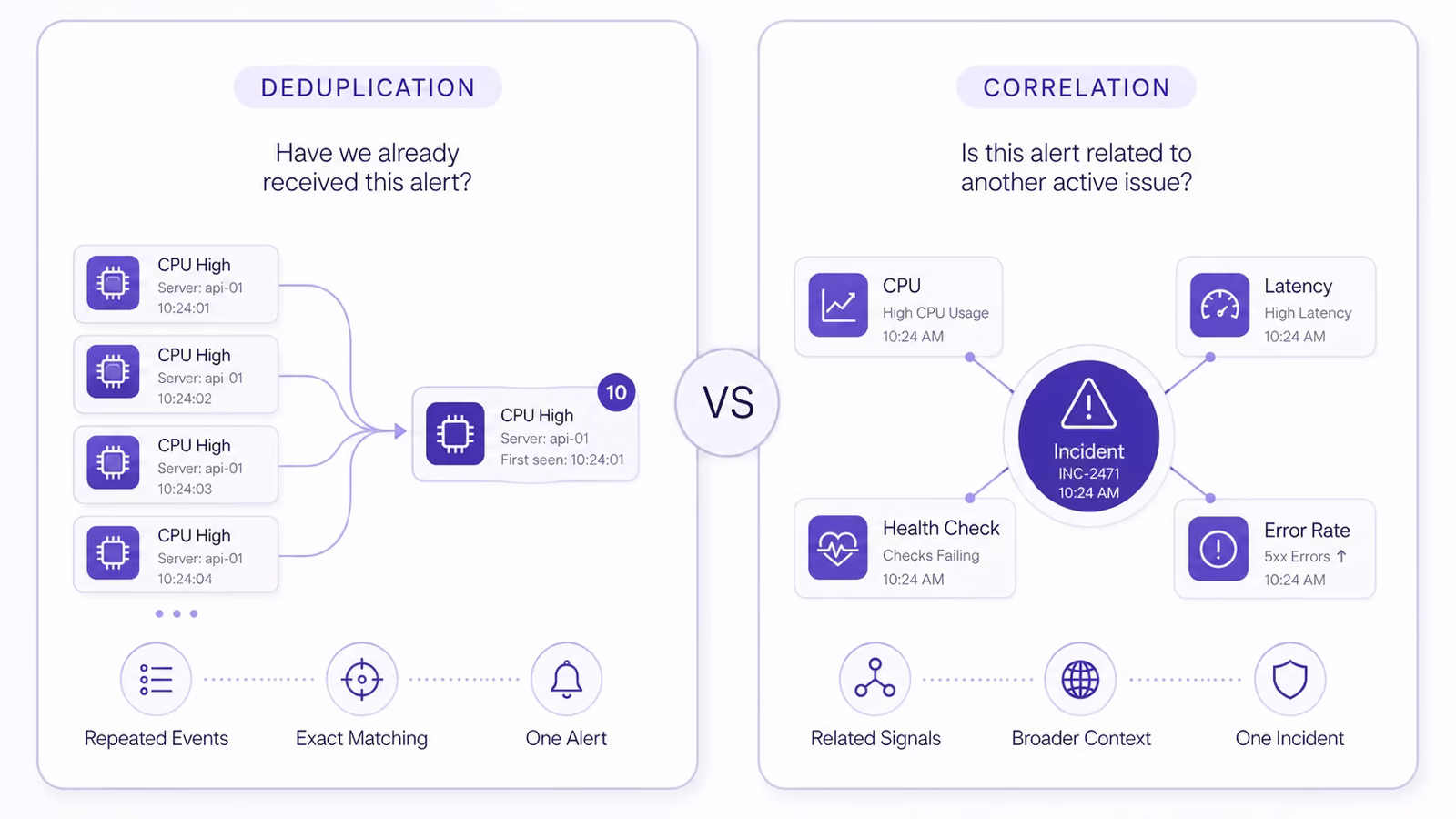
Alert deduplication and correlation solve different parts of the alert noise problem.
Deduplication asks:
Have we already received this alert?
Correlation asks:
Is this alert related to another active issue?
Deduplication generally uses exact or near-exact matching. It identifies repeated events for the same resource and condition, then updates an existing alert instead of creating a new one.
Correlation uses broader context. It may connect alerts with different titles, sources, and symptoms when they affect related services or occur as part of the same failure sequence.
For example:
- Ten repeated CPU threshold alerts from one server can be deduplicated into one alert.
- CPU alerts, latency warnings, failed health checks, and error-rate alerts can be correlated into one incident.
Modern alert management requires both capabilities. Deduplication reduces repetition, while correlation organizes the remaining signals into a meaningful operational picture.
Why duplicate alerts are an operational problem
Duplicate alerts create more than an inconvenient notification backlog. They can directly affect how quickly and accurately teams respond to incidents.
Alert Fatigue
Responders who receive frequent, repetitive, or low-value alerts may become desensitized to notifications. Over time, every alert can begin to feel equally unimportant, including the ones that require immediate action.
Slower Investigation
When the same issue appears across dozens of alert records, responders must spend time determining whether they are looking at separate failures or repeated symptoms of one failure.
Buried Critical Signals
A high-severity alert can be difficult to identify when it arrives among hundreds of repetitive notifications. Excessive noise reduces the visibility of changes in customer impact, scope, or severity.
Duplicate Incident Creation
If every alert creates an incident, multiple responders may begin investigating the same problem independently. This can lead to fragmented communication, conflicting actions, and unclear ownership.
Distorted Operational Metrics
Duplicate alerts can inflate alert volume, incident counts, and escalation statistics. Teams may then make decisions based on metrics that do not accurately represent the number of distinct problems.
Increased Cognitive Load
During an outage, responders already need to understand service behavior, recent changes, dependencies, and customer impact. Repetitive alerts add more information to process without necessarily adding more insight.
How alert deduplication works
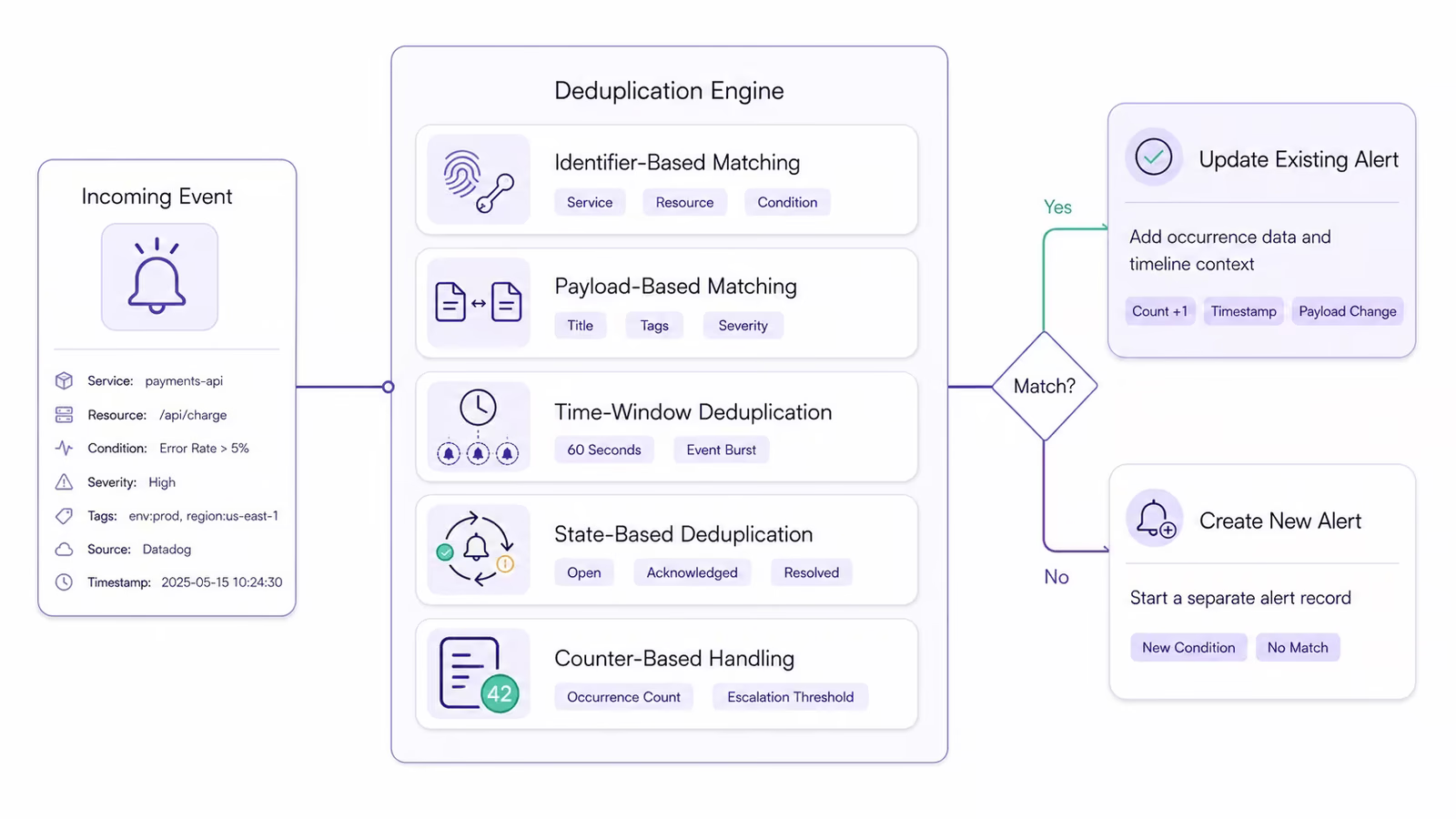
Alert deduplication relies on matching logic that determines whether an incoming event represents a new condition or an update to an existing one.
Identifier-Based Matching
Identifier-based deduplication uses a consistent key to represent a specific alert condition. This key may be built from fields such as:
- Service name
- Hostname
- Resource identifier
- Alert type
- Environment
- Region
- Monitoring check
- Custom alias
For example, an alert key such as host-01-disk-space identifies both the affected resource and the condition. Every event with the same key can update the existing alert rather than create another one.
Identifier-based matching is predictable and easy to audit, but it depends on consistent metadata. If one monitoring tool uses payment-api and another uses payments-service, the platform may treat them as separate resources unless those names are normalized.
Payload-Based Matching
Payload-based deduplication compares the content of incoming events. This may include the alert title, description, tags, severity, resource details, or the full event payload.
When the relevant fields match, the platform can classify the incoming event as a duplicate.
Payload matching is useful when monitoring tools do not provide a stable alert identifier. However, the matching logic must account for values that change with every event, such as timestamps, request identifiers, or metric values.
If the criteria are too strict, small payload differences can create unnecessary alerts. If they are too broad, unrelated conditions may be combined.
Time-Window Deduplication
Time-window deduplication groups matching events received within a specified period.
For example, a platform may collect similar events arriving within 60 seconds and consolidate them into one alert. This can be helpful when rapid state changes, retry loops, or distributed monitoring checks produce a burst of notifications.
The correct window depends on the system. A short window may work for high-volume services, while slower health checks may require a longer interval.
Time should not be the only matching signal. Two unrelated failures can happen within the same minute, especially in large environments.
State-Based Deduplication
State-based deduplication considers whether an alert is open, acknowledged, resolved, or reopened.
A common lifecycle looks like this:
- A failure event creates an open alert.
- Repeated failure events update that alert.
- A responder acknowledges the alert.
- Additional events continue to enrich its timeline.
- A recovery event resolves the alert.
- If the condition returns later, the platform reopens the alert or creates a new one.
This approach prevents new notifications from being created while a known condition remains active. It also preserves the distinction between one sustained outage and multiple separate occurrences.
Counter-Based Handling
Instead of creating a new alert for every repeated event, the platform can increase an occurrence counter.
Responders may see that an alert has occurred 150 times without receiving 150 separate pages. The counter preserves valuable information about frequency and persistence while avoiding repetitive notifications.
Teams can also configure escalation rules around the count. A condition that occurs twice may remain low priority, while the same condition occurring 100 times in five minutes may indicate a wider failure.
How alert correlation works
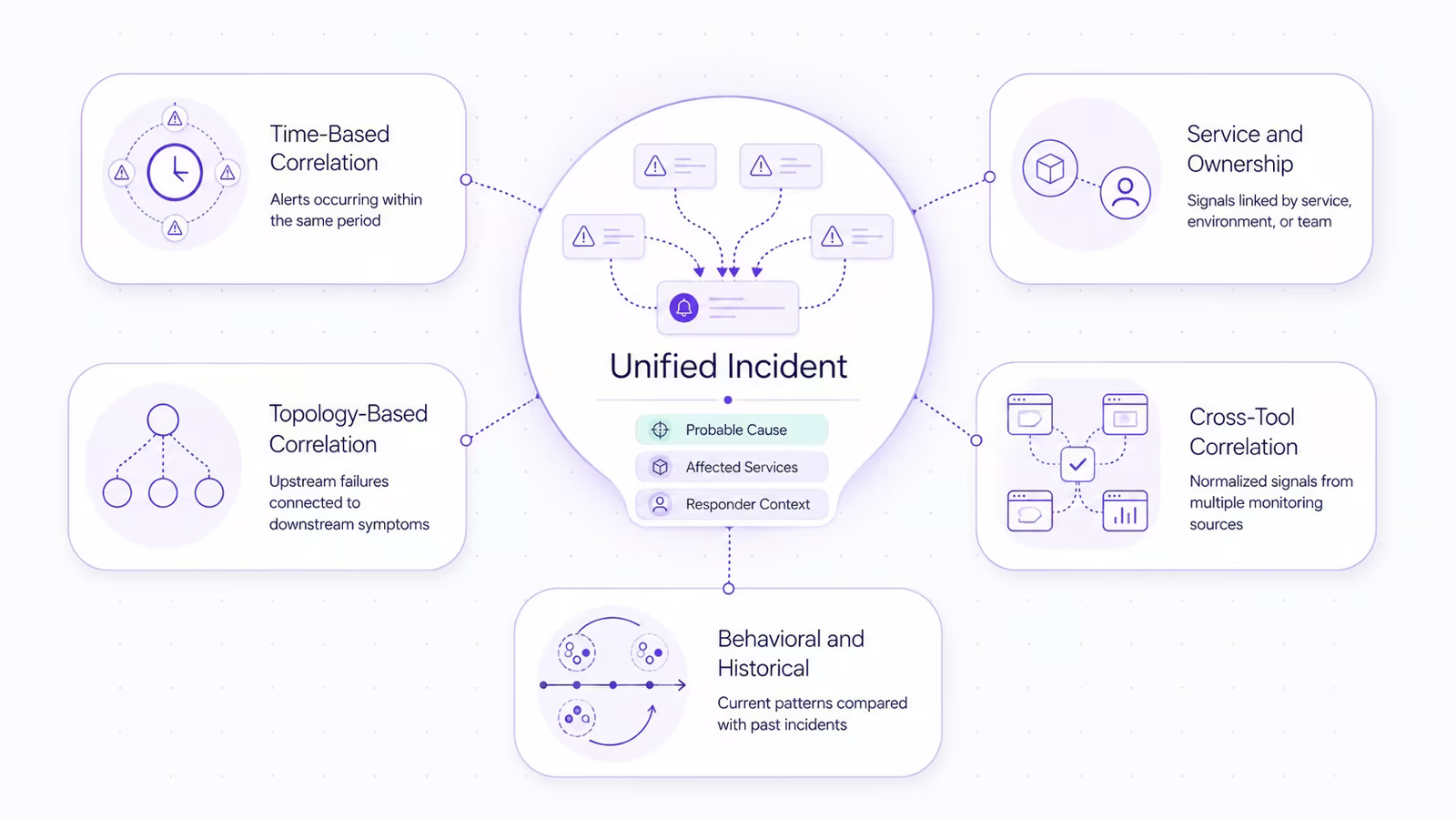
Alert correlation evaluates whether different alerts are likely to be part of the same incident. It may use several forms of context at once.
Time-Based Correlation
Time-based correlation groups alerts that begin within the same period.
If a database error, an application latency alert, and a failed health check appear within seconds of one another, their timing may suggest a relationship.
Timing is a useful starting signal, but it does not establish causation on its own. Large environments regularly experience unrelated events at the same time, so time-based correlation works best when combined with service, topology, and ownership data.
Service and Ownership Correlation
Alerts associated with the same service, application, environment, or responding team can be grouped together.
For example, several alerts may refer to different containers, endpoints, and dependencies but still belong to the checkout service. Grouping them by service gives the owning team a unified view of the problem.
Accurate service ownership also supports routing. Once the platform identifies the affected service, it can notify the correct on-call responder and apply the appropriate escalation policy.
Topology-Based Correlation
Topology-based correlation uses service maps and infrastructure relationships to understand how systems depend on one another.
These relationships may come from service catalogs, discovery tools, or a Configuration Management Database (CMDB). The platform can then distinguish an upstream failure from its downstream symptoms.
Suppose a shared authentication service becomes unavailable. Several customer-facing applications may begin returning authorization errors. Without topology context, each application alert may appear to be an independent incident. With dependency mapping, the platform can connect the alerts to the shared authentication service.
Topology-based correlation is especially valuable in distributed systems, where one component failure may affect dozens of dependent services.
Cross-Tool Correlation
Modern teams often collect signals from multiple sources, including:
- Infrastructure monitoring
- Application Performance Monitoring
- Log management
- Network monitoring
- Cloud platforms
- Security tools
- Synthetic monitoring
- Customer support systems
Each source may use a different format, naming convention, and severity model. Cross-tool correlation begins by normalizing this data into a consistent structure.
For example, one tool may describe severity as critical, another as P1, and another as severity_1. Normalization allows the incident management platform to recognize that these values represent the same general priority.
Once normalized, events can be compared and grouped into a unified incident queue.
Behavioral and Historical Correlation
Behavioral correlation looks for patterns across previous incidents and event sequences.
If a specific combination of database latency, connection exhaustion, and checkout errors has repeatedly appeared before the same type of outage, the platform can use that history when analyzing a new alert cluster.
Historical context may help teams:
- Recognize recurring failure patterns
- Identify alerts that frequently occur together
- Find similar past incidents
- Surface previous remediation steps
- Suggest a probable root cause
This approach can be valuable when relationships are too complex or variable for fixed rules alone.
How artificial intelligence improves alert correlation
Artificial Intelligence (AI) can analyze alert patterns across large volumes of operational data. Rather than depending only on fixed identifiers or manually configured rules, AI-assisted systems can evaluate multiple signals and identify clusters that may not be immediately obvious.
AI correlation may consider:
- Event timing
- Alert text and payload similarity
- Service ownership
- Infrastructure dependencies
- Recent deployments
- Configuration changes
- Historical incident patterns
- Common failure sequences
- Responder actions
- Resolution history
For example, an AI-assisted platform may recognize that several alerts with different names consistently appear after a particular deployment type. It can group the events, highlight the recent change, and suggest that the deployment may be related to the incident.
AI can also support probable root cause identification. If an upstream service alert occurs before dozens of downstream errors, the platform may rank the upstream alert as the likely cause.
However, AI correlation should not become an uncontrolled suppression mechanism. A low-confidence grouping decision should not hide a critical alert from responders. Teams need visibility into why alerts were grouped and the ability to correct inaccurate results.
The strongest approach combines deterministic rules with AI assistance. Fixed rules handle known relationships, while AI helps identify more complex or changing patterns.
From raw events to a single incident
A modern alert management workflow typically moves through several stages.
1. Event Ingestion
Monitoring and observability tools send raw events to the alert management platform.
2. Normalization
The platform converts different event formats into a consistent structure. It may standardize service names, severity values, environments, regions, and resource identifiers.
3. Deduplication
Incoming events are compared with active alerts. Repeated events update an existing alert rather than creating new records.
4. Correlation
The remaining alerts are evaluated for relationships based on time, service ownership, dependencies, topology, and historical patterns.
5. Incident Creation
If the grouped signals meet the incident criteria, the platform creates an incident or updates an existing one.
6. Routing and Escalation
The incident is routed to the correct on-call responder according to service ownership, severity, schedule, and escalation policy.
7. Context Enrichment
New alerts, changes, logs, and responder actions continue to update the incident timeline. Responders receive one operational record with the supporting evidence needed for investigation.
Example: correlating a cascading service failure
Consider an online platform that relies on a shared database.
The database becomes unavailable. Within a few minutes:
- Database monitoring detects connection failures.
- Application services report request timeouts.
- An APM platform detects increased latency.
- Load balancers report failed health checks.
- Customer-facing error rates increase.
- Synthetic monitoring reports failed transactions.
- Several teams receive separate alerts.
Deduplication first consolidates repeated notifications from each source. Instead of receiving 50 identical database connection alerts, responders see one alert with an occurrence count.
Correlation then connects the database alert with application timeouts, failed health checks, and customer-facing errors. Topology data shows that the affected applications all depend on the same database.
The incident management platform creates one incident, identifies the database as the probable upstream cause, attaches the downstream symptoms, and routes the incident to the responsible team.
Responders can now see the failure sequence and customer impact without sorting through hundreds of separate notifications.
Key signals used for alert grouping
Effective alert grouping depends on the quality and consistency of the available data.
Common correlation signals include:
- Alert title and description
- Service or component name
- Host, container, or cloud resource identifier
- Environment
- Region or availability zone
- Severity
- Alert source
- Timestamp
- Service owner
- Deployment activity
- Configuration changes
- Infrastructure dependencies
- Historical co-occurrence
- Current incident status
- Customer impact
No single signal is reliable in every situation. Combining several signals generally produces more accurate grouping decisions.
For example, two alerts with similar titles may be unrelated if they affect different services and regions. Two alerts with different titles may be connected if they affect dependent services immediately after the same deployment.
How deduplication and correlation improve incident creation
Incident creation is the point where alerts become coordinated response work. Poorly designed alert pipelines can create too many incidents, assign them to the wrong teams, or split one failure across several response channels.
Deduplication and correlation improve this process in several ways.
Fewer Unnecessary Incidents
Repeated signals update one incident instead of creating separate response efforts.
Clearer Ownership
Service and topology context help identify the team responsible for the likely source of the failure.
Faster Acknowledgment
Responders receive a focused notification instead of searching through repeated pages.
Better Incident Timelines
Deduplicated events can still be recorded in the timeline, preserving changes in frequency, severity, and scope.
More Complete Context
Correlated incidents can include upstream failures, downstream symptoms, recent changes, and customer impact in one place.
More Accurate Reporting
Incident metrics more closely reflect distinct operational problems rather than the raw number of alerts received.
Common deduplication and correlation mistakes
Poorly configured grouping can hide useful signals or create misleading incidents. Teams should watch for several common mistakes.
Using Overly Broad Matching Rules
A generic rule that groups every high latency alert may combine failures from unrelated services, environments, or regions.
Matching logic should include enough context to distinguish separate conditions.
Using Overly Narrow Identifiers
If the deduplication key includes a changing value, every event may appear unique. Timestamps, request identifiers, and fluctuating metric values usually should not be part of a stable key.
Relying Only on Timing
Alerts that occur near each other are not necessarily related. Time-based grouping should be supported by service, resource, ownership, or dependency information.
Discarding Repeated Events
Suppressing duplicate notifications does not require deleting the underlying events. Repeat counts and payload changes can show whether the condition is worsening.
Ignoring Service Dependencies
Without accurate dependency data, downstream symptoms may be treated as separate failures. This creates more incidents and can send responders toward the wrong component.
Grouping Across Unrelated Environments
A production failure and a development alert may share the same name but require completely different responses. Environment should usually be included in matching and correlation logic.
Failing to Review Grouping Decisions
Systems, service names, and ownership structures change over time. Rules that once worked well may become inaccurate as the environment evolves.
How to build an effective deduplication strategy
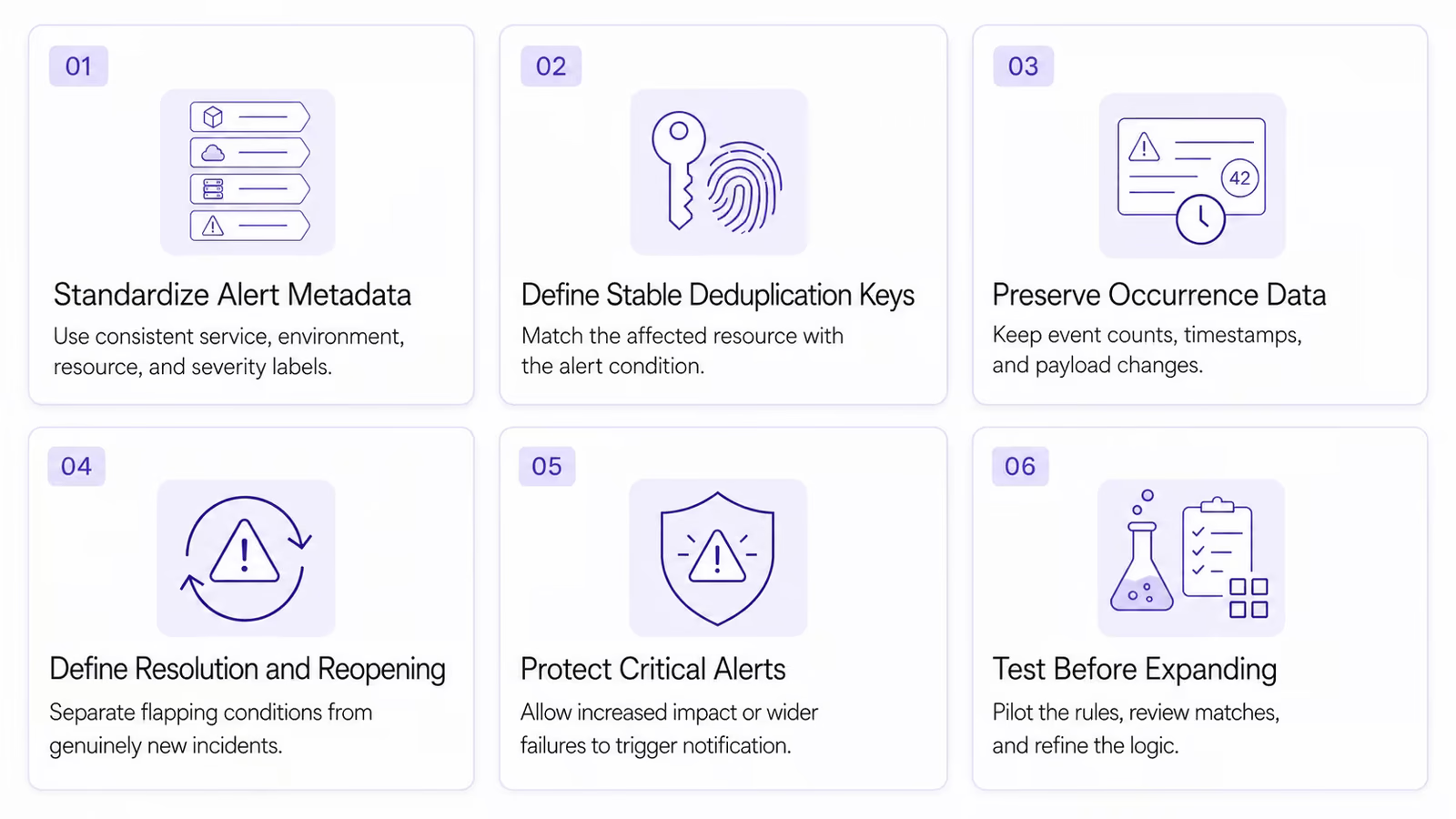
A reliable deduplication strategy begins with consistent alert data and clearly defined matching rules.
Standardize Alert Metadata
Use consistent names for services, teams, environments, regions, resources, and severity levels. Standardized metadata allows alerts from different tools to be compared accurately.
Define Stable Deduplication Keys
A good key identifies the affected resource and failure condition without including values that change on every event.
For example, a key may combine:
- Service name
- Environment
- Resource identifier
- Alert condition
Preserve Occurrence Data
Repeated events should update the active alert with occurrence counts, timestamps, or payload changes. This reduces notifications without removing operational history.
Define Resolution and Reopening Behavior
Teams should decide when a returning condition represents the same alert and when it should create a new one.
A condition that returns seconds after resolution may be a flapping alert. The same condition returning several days later may be a separate incident.
Protect Critical Alerts
High-severity events should have additional safeguards. If a new alert indicates increased customer impact or a wider failure scope, it may need to generate a notification even when a related incident already exists.
Test Before Expanding
Start with a limited set of services or alert types. Review the grouping results, correct false matches, and refine the logic before applying it across the organization.
How to build an effective correlation strategy
Correlation requires both technical data and operational context.
Map Service Relationships
Document which services depend on databases, networks, queues, third-party providers, and shared internal platforms. Update these relationships as the architecture changes.
Normalize Cross-Tool Events
Convert alerts from different tools into a consistent model. At minimum, each event should identify the affected service, environment, resource, severity, source, and timestamp.
Start With High-Confidence Relationships
Begin with known dependencies and recurring failure patterns. A documented database-to-application relationship is usually a stronger correlation signal than similar alert wording alone.
Combine Multiple Signals
Use time, topology, ownership, deployment data, and event similarity together. Requiring supporting signals can reduce false groupings.
Use AI With Clear Guardrails
AI can help discover patterns, but teams should define confidence thresholds and critical-alert protections. Responders should be able to inspect, separate, and merge grouped alerts.
Learn From Incident Reviews
Post-incident reviews can reveal which alerts were duplicates, which symptoms shared a cause, and which signals should have been grouped earlier. These findings should be used to improve future rules and models.
Metrics for measuring effectiveness
Reducing raw alert volume does not automatically mean the alerting system has improved. Teams should measure both noise reduction and detection quality.
Useful metrics include:
- Total events received
- Total alerts created
- Percentage of events deduplicated
- Percentage of alerts correlated
- Incidents created per alert volume
- Notifications sent per incident
- False grouping rate
- Missed correlation rate
- Mean Time to Acknowledge (MTTA)
- Mean Time to Resolve (MTTR)
- Escalation frequency
- Reopened alert frequency
- Responder feedback
A successful strategy should reduce unnecessary pages without increasing missed incidents, delayed detection, or incorrect routing.
For example, a large reduction in alert volume may look positive. If responders also report that important changes are being hidden inside existing incidents, the rules may be too aggressive.
Alert deduplication and correlation best practices
Modern teams can improve alert quality by following a few practical principles:
- Deduplicate notifications without deleting event history.
- Use stable identifiers across monitoring integrations.
- Standardize service, environment, severity, and ownership fields.
- Combine several correlation signals instead of relying on timing alone.
- Maintain accurate service dependency maps.
- Protect high-severity and customer-impacting alerts.
- Keep occurrence counts and payload changes visible.
- Let responders correct inaccurate alert groupings.
- Review false groupings and missed correlations regularly.
- Use post-incident findings to improve future logic.
- Measure response outcomes, not only alert reduction.
- Revisit rules as systems, teams, and dependencies change.
How modern incident management platforms support alert correlation
Modern incident management platforms provide a centralized layer between monitoring signals and human response.
Their deduplication and correlation capabilities may include:
- Event ingestion from multiple monitoring tools
- Cross-tool field normalization
- Configurable deduplication keys
- Payload and time-window matching
- Service and topology-based grouping
- AI-assisted correlation
- Automated incident creation
- Ownership-based routing
- On-call schedule integration
- Escalation policy automation
- Context-rich incident timelines
- Collaboration platform integrations
- Feedback mechanisms for correcting groupings
This centralization helps teams apply consistent alert-handling rules across their operational toolset. Instead of configuring unrelated workflows in every monitoring platform, teams can establish a shared incident creation and routing process.
Reduce noise without losing critical context
Alert deduplication and correlation help modern teams manage high event volumes without forcing responders to investigate every notification separately.
Deduplication consolidates repeated signals about the same condition. Correlation connects different symptoms that belong to the same underlying incident. Together, they create fewer, clearer, and more actionable incident records.
The most effective approach combines standardized alert data, stable identifiers, service dependency context, carefully designed rules, and AI-assisted analysis. It also preserves the underlying event history so responders can see changes in frequency, severity, and customer impact.
At Rootly, we help teams reduce duplicate alerts, connect related signals, and give responders the context they need to act with confidence. Book a demo to see how Rootly can help your team reduce alert noise and improve incident response.
Alert deduplication and correlation: how modern teams reduce duplicate alerts