

Modern engineering environments generate an enormous volume of operational data across applications, cloud services, infrastructure, databases, and security tools. Monitoring platforms convert these signals into alerts, but not every alert deserves immediate attention. As systems become more distributed and organizations adopt multiple monitoring tools, duplicate alerts, false positives, outdated rules, and poorly configured thresholds can overwhelm teams and reduce confidence in the alerting system.
This places additional pressure on on-call responders, who must quickly determine which alerts require immediate action and which are only background noise.
Alert fatigue is the gradual decline in attention and responsiveness caused by excessive, repetitive, or low-value alerts. Within alert management, it occurs when monitoring systems generate more notifications than teams can effectively evaluate, making it harder to recognize critical issues, prioritize incidents, and maintain reliable operations.
This is why alert fatigue is fundamentally an alert management challenge rather than simply an on-call inconvenience. Effective alert management focuses on delivering the right alerts to the right responders with the context needed to act quickly. By improving alert quality, reducing unnecessary notifications, automating repetitive workflows, and continuously refining monitoring rules, organizations can protect on-call teams, strengthen incident response, and maintain more reliable services.
Key Takeaways
- Alert fatigue occurs when excessive or low-value notifications reduce a team’s ability to recognize and respond to critical issues.
- Poor alert management practices, including duplicate alerts, weak prioritization, and outdated monitoring rules, are among the leading causes of alert fatigue.
- Alert fatigue affects operational performance by delaying incident detection, increasing MTTR, and reducing confidence in monitoring systems.
- Modern alert management platforms reduce notification overload through intelligent routing, correlation, suppression, automation, and AI-assisted prioritization.
- Continuous review and optimization of alert quality help organizations maintain reliable monitoring systems as infrastructure evolves.
What is alert fatigue in alert management?
Alert fatigue occurs when engineering teams receive so many repetitive, low-value, or poorly prioritized alerts that it becomes harder to identify genuine operational issues. Instead of helping responders act quickly, the alert stream creates noise, delays incident detection, and reduces trust in monitoring systems.
Effective alert management prevents this by filtering, prioritizing, enriching, and routing alerts before they reach responders. The goal is not to generate more notifications, but to deliver fewer, higher-quality alerts that are actionable, contextual, and relevant.
Why alert fatigue is an alert management problem
Alert fatigue is often treated as an unavoidable result of complex infrastructure, but it usually points to weaknesses in the alert management process. Monitoring tools detect changes in system behavior, while alert management determines whether those signals become useful notifications or unnecessary noise.
A strong alert management process should:
- Evaluate alert severity
- Add operational context
- Correlate related events
- Remove duplicate notifications
- Route alerts to the correct team
Without these controls, a single issue can trigger alerts across multiple monitoring tools, forcing responders to sort through symptoms instead of focusing on the root cause.
Alert fatigue also grows when monitoring rules are not regularly reviewed. Outdated thresholds, default configurations, and obsolete monitors continue generating notifications even after systems and priorities change. Mature engineering teams treat alert quality as an ongoing discipline, continuously refining rules and removing low-value alerts to improve the reliability of incident response.
Alert fatigue vs. alert overload vs. alert noise
The terms alert fatigue, alert overload, and alert noise are often used interchangeably, but they describe different aspects of the same problem. Understanding these differences helps engineering teams identify whether they need to improve monitoring, alert management, or operational processes.
| Term | Definition |
|---|---|
| Alert Overload | Receiving more alerts than responders can reasonably process within a given period. |
| Alert Noise | Low-value, duplicate, false positive, or non-actionable alerts that provide little operational value. |
| Alert Fatigue | The decline in attention and responsiveness caused by prolonged exposure to alert overload and alert noise. |
Alert overload is primarily a volume problem, while alert noise is a quality problem. Alert fatigue is the result of both. When teams receive too many low-value notifications, they gradually lose confidence in the alerting system and become less responsive to alerts overall.
Effective alert management addresses all three issues by reducing unnecessary notifications, improving alert quality, and ensuring that only meaningful, actionable alerts reach responders. This allows engineering teams to focus on resolving incidents instead of filtering operational noise.
The most common causes of alert fatigue
Alert fatigue usually develops gradually as monitoring environments become more complex and alert management practices fail to keep pace. The most common causes include excessive volume, low-quality alerts, poor prioritization, and a lack of ongoing review.
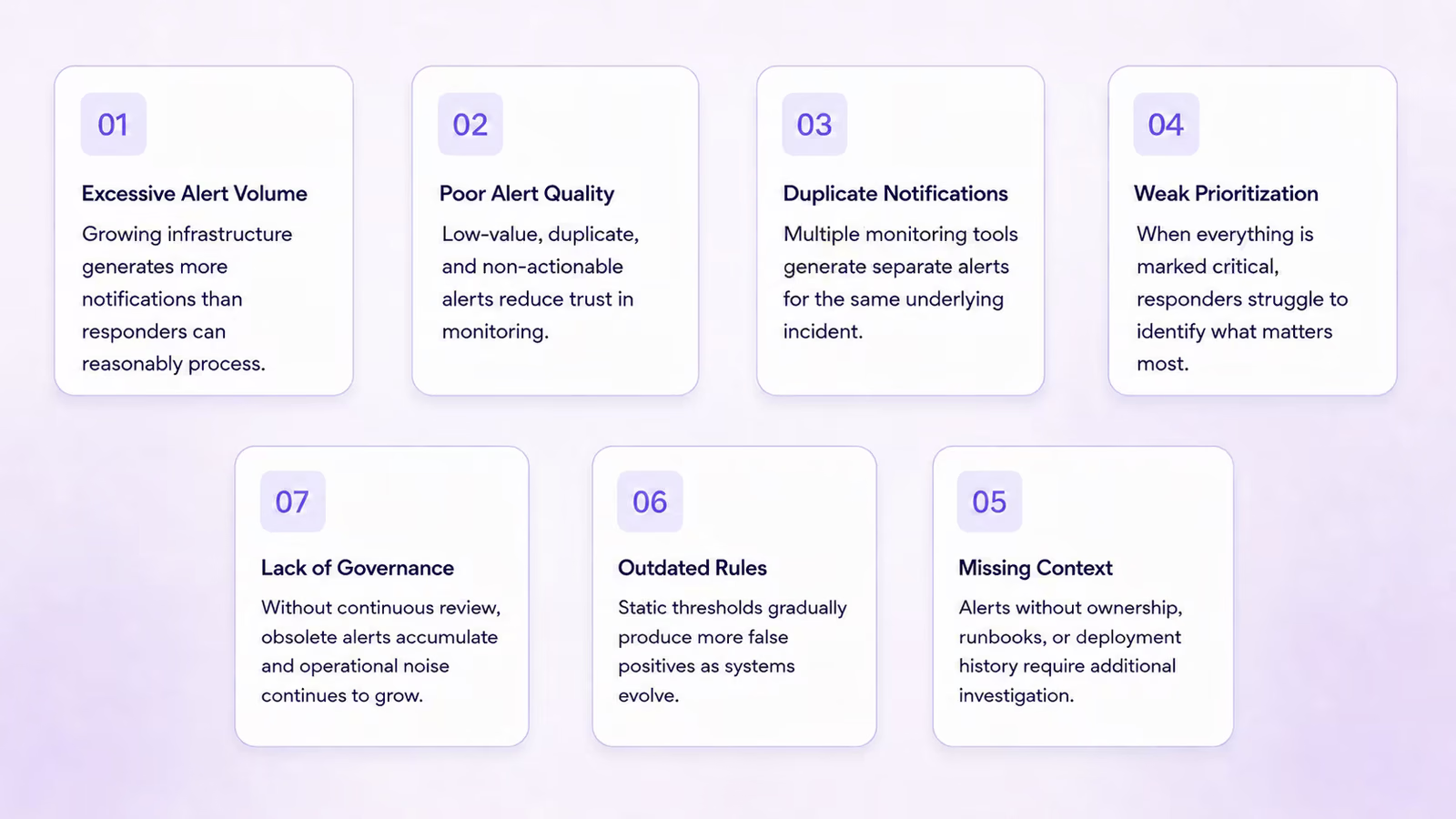
Symptoms of alert fatigue across an organization
Alert fatigue affects more than individual responders. It weakens monitoring reliability, slows incident response, and creates operational inefficiencies across engineering teams.
Common warning signs include:
- Alert volume rising without a similar increase in real incidents
- Higher false positive and duplicate alert rates
- Slower acknowledgment and investigation times
- More frequent manual silencing or suppression
- Increased escalations because initial notifications were missed
- Engineers manually verifying alerts before trusting them
- Declining confidence in monitoring dashboards and alerting systems
These symptoms suggest that the organization needs better alert management rather than simply more monitoring. Improving alert quality, prioritization, context, and governance helps restore trust and ensures each notification provides meaningful operational value.
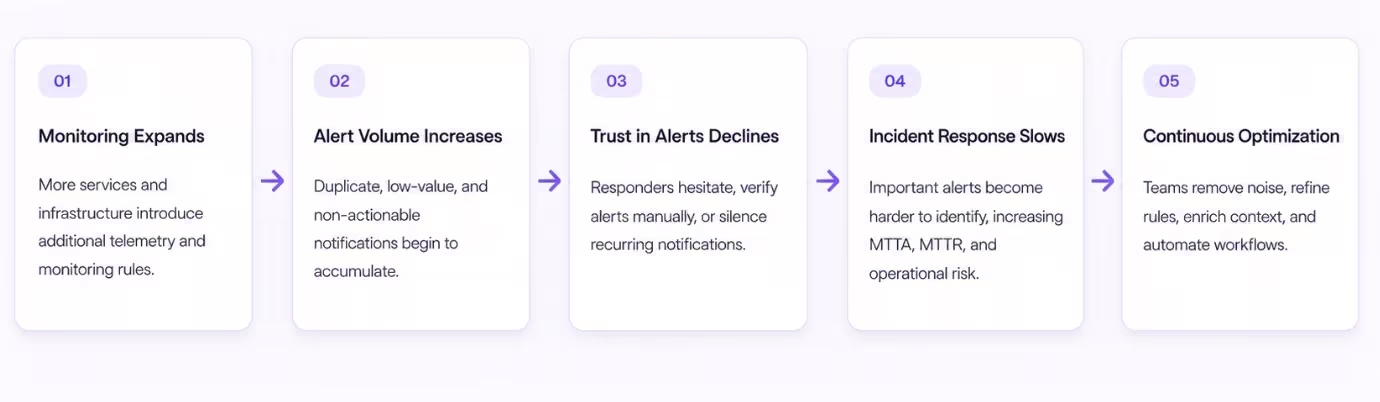
The alert fatigue lifecycle
Alert fatigue rarely appears overnight. It develops gradually as monitoring environments grow more complex and alert management practices fail to evolve. Understanding this lifecycle helps organizations identify where unnecessary notifications accumulate and where improvements can have the greatest impact.
The business cost of alert fatigue
Alert fatigue affects far more than incident response. As unnecessary notifications consume engineering time and attention, the impact extends across operational efficiency, customer experience, and business performance.
1. Increased SLA Violations
When critical alerts are delayed or overlooked, incidents often take longer to acknowledge and resolve. This increases the risk of missing internal service level objectives (SLOs) and customer-facing service level agreements (SLAs), potentially leading to contractual penalties and reduced service reliability.
2. Reduced Customer Trust
Customers rarely see the alerts themselves, but they experience the consequences. Slower incident response can lead to prolonged outages, degraded application performance, and recurring service disruptions that erode confidence in the organization’s ability to deliver reliable products.
3. Higher Operational Costs
Every unnecessary alert requires engineering attention. Teams spend valuable time reviewing false positives, investigating duplicate notifications, and manually correlating related events instead of focusing on higher-value operational improvements. Over time, these inefficiencies increase operational costs without improving reliability.
4. Lower Engineering Productivity
Frequent interruptions reduce engineers’ ability to focus on development, infrastructure improvements, and reliability initiatives. Instead of proactively improving systems, teams become increasingly reactive as they spend more time responding to low-value notifications.
5. Inefficient Infrastructure Utilization
Poorly configured monitoring often triggers unnecessary scaling events or operational investigations. Teams may allocate additional cloud resources or perform manual troubleshooting for issues that pose little actual risk, increasing infrastructure costs while delivering limited operational benefit.
Reducing alert fatigue allows engineering teams to spend less time managing notifications and more time improving service reliability, operational efficiency, and customer experience.
Alert fatigue throughout the alert lifecycle
Alert fatigue can develop at every stage of the alert lifecycle—not just after a notification reaches a responder. Weak alert management practices allow unnecessary noise to accumulate long before an incident is created.
| Alert Lifecycle Stage | How Alert Fatigue Develops | Operational Impact |
|---|---|---|
| Monitoring | Too many monitors collect overlapping signals without clear objectives. | Engineers receive unnecessary notifications before any real incident is confirmed. |
| Alert Generation | Static thresholds and sensitive rules produce excessive or false-positive alerts. | Alert volume increases while trust in the signal begins to decline. |
| Prioritization | Poor severity classification makes routine alerts appear as urgent as critical incidents. | Responders struggle to identify which issues require immediate attention. |
| Correlation | Related alerts are not grouped, resulting in multiple notifications for the same issue. | Teams waste time manually connecting symptoms to one underlying failure. |
| Routing | Alerts are sent to unnecessary teams or responders without clear ownership. | Response slows while teams determine who should investigate. |
| Acknowledgement | Responders delay or ignore notifications because they no longer trust the alert stream. | MTTA increases and important alerts are more likely to be missed. |
| Incident Response | Teams spend valuable time separating meaningful alerts from operational noise. | Investigation starts later and MTTR increases. |
| Resolution and Review | Alert rules are never refined, allowing the same notification patterns to repeat. | Noise accumulates and future incidents become harder to manage. |
Understanding where alert fatigue develops helps organizations improve the entire alert management lifecycle rather than focusing solely on reducing notification volume. By optimizing each stage—from monitoring and alert generation through post-incident review—engineering teams can deliver more actionable alerts and build greater trust in their monitoring systems.
Real-world examples of alert fatigue
Alert fatigue affects organizations of every size, from startups to large enterprises. While the underlying causes vary, the outcome is often the same: responders spend more time filtering notifications than resolving incidents.
Example 1: Duplicate Infrastructure Alerts
A database failure triggers alerts from infrastructure monitoring, application performance monitoring, log management, and synthetic monitoring tools. Although every notification relates to the same outage, responders receive multiple pages before anyone begins investigating the root cause.
Example 2: Overly Sensitive Thresholds
An application experiences a brief spike in CPU utilization during normal traffic. Static thresholds trigger high-priority alerts even though performance returns to normal within minutes. After repeated false positives, engineers begin questioning whether future alerts truly require immediate action.
Example 3: Missing Operational Context
A monitoring platform detects elevated error rates but provides no information about the affected service, recent deployments, or system owner. Responders spend valuable time gathering context before they can begin troubleshooting, delaying incident resolution.
Who is most affected by alert fatigue?
Alert fatigue affects everyone involved in maintaining production systems, not just the engineer receiving notifications.
Teams commonly impacted include:
- Site Reliability Engineering (SRE) teams responsible for maintaining service reliability.
- DevOps engineers managing infrastructure, deployments, and cloud operations.
- Platform engineering teams supporting internal developer platforms and shared services.
- Application engineering teams responsible for individual products and microservices.
- Operations and incident management teams coordinating response during major outages.
As infrastructure becomes increasingly distributed, reducing alert fatigue requires collaboration across multiple engineering functions rather than relying solely on individual responders.
Frequently asked questions
What is a false positive alert?
A false positive alert is a notification that indicates a potential issue even though no meaningful operational problem exists. False positives are often caused by overly sensitive thresholds, temporary performance fluctuations, or poorly configured monitoring rules. Reducing false positives helps improve alert quality and prevents unnecessary interruptions.
How many alerts are too many?
There is no universal number because acceptable alert volume depends on an organization’s size, infrastructure, and operational model. Instead of focusing solely on alert count, engineering teams should monitor the percentage of actionable alerts. If responders regularly ignore notifications or spend more time filtering alerts than resolving incidents, alert volume is likely too high.
What is a good signal-to-noise ratio?
A good signal-to-noise ratio means that most alerts require meaningful action while very few are false positives, duplicates, or informational notifications. Although the ideal ratio varies between organizations, mature alert management programs continuously improve signal quality so responders can trust that each alert deserves attention.
How often should alert rules be reviewed?
Alert rules should be reviewed regularly, particularly after major infrastructure changes, new service deployments, or significant incidents. Many engineering teams perform quarterly alert reviews to remove obsolete monitors, adjust thresholds, eliminate duplicate notifications, and ensure alerts continue reflecting current operational priorities.
Can alert fatigue be completely eliminated?
No. Modern systems will always generate alerts, and some operational noise is unavoidable. The goal of alert management is not to eliminate alerts entirely but to minimize unnecessary notifications through better prioritization, correlation, routing, automation, and continuous optimization.
What role does alert correlation play in reducing alert fatigue?
Alert correlation groups related notifications that originate from the same underlying issue into a single incident. Instead of receiving multiple alerts from different monitoring tools, responders receive one consolidated notification with additional context, reducing operational noise and simplifying incident triage.
Why is continuous alert optimization important?
Monitoring environments constantly evolve as organizations add new services, applications, and infrastructure. Without regular optimization, outdated thresholds, obsolete monitors, and duplicate alerts accumulate over time. Continuous alert optimization ensures monitoring systems remain accurate, actionable, and aligned with current operational requirements.
Build an alert management process teams can trust
Alert fatigue is not an inevitable part of operating modern systems. More often, it reflects an alert management process that has allowed unnecessary notifications to accumulate over time. By continuously improving alert quality, refining monitoring rules, eliminating duplicate alerts, and providing responders with richer context, organizations can transform alerting from a source of operational noise into a trusted decision-making system.
Effective alert management is about delivering the right alert to the right responder at the right time, not generating the highest volume of notifications. As infrastructure continues to grow in complexity, engineering teams that prioritize actionable alerts, intelligent automation, and continuous optimization will be better positioned to detect incidents faster, improve operational efficiency, and maintain reliable services at scale.
At Rootly, we help engineering teams reduce alert fatigue by bringing intelligent routing, event correlation, automation, AI-powered alert handling, and incident response workflows into one platform. By reducing notification overload and making every alert more actionable, we help teams spend less time managing noise and more time resolving the incidents that matter most.
Alert fatigue: causes, risks, and how to reduce notification overload