

Alert management is the process of turning monitoring signals into prioritized, actionable notifications that reach the right responder at the right time. Its purpose is not to report every unusual system condition. It is to identify meaningful service risk, provide enough context for action, and support a fast, coordinated incident response. Effectiveon-call management strengthens this process by routing urgent alerts, managing escalations, and connecting incidents with the responders best equipped to act.
Poor alert management creates more than technical noise. It produces alert fatigue, delayed acknowledgment, incorrect escalations, unnecessary interruptions, and longer recovery times. Reliable alert management protects responder attention by ensuring that every page has a clear reason, owner, and expected action.
Key Takeaways
- Alerts should represent urgent, actionable risks rather than every technical abnormality.
- Thresholds should reflect user impact, normal system behavior, and service objectives.
- Every production alert needs a clear owner, runbook, route, and escalation policy.
- Grouping, deduplication, and correlation reduce noise without reducing visibility.
- Regular reviews are necessary to keep alerts accurate as services and teams change.
What is alert management?
Alert management covers the complete journey from detecting a possible problem to improving the alert after the incident. It includes evaluating severity, enriching the alert with context, grouping related signals, routing the notification, escalating missed acknowledgments, and reviewing whether the alert worked as intended.
An event, alert, notification, and incident are related but distinct concepts.
| TERM | MEANING |
|---|---|
| Event | An observed change or occurrence within a system |
| Alert | A rule-based indication that a condition may require attention |
| Notification | The message delivered to a person or automated system |
| Incident | A disruption, degradation, or risk requiring coordinated action |
Not every event should generate an alert, and not every alert should interrupt an on-call engineer. When a signal does not require immediate human action, it is usually better handled through a dashboard, log, ticket, or automated workflow.
Prioritize alert quality over alert volume
A high-quality alert identifies a meaningful problem, reaches the correct owner, and provides a clear next step.
Monitoring more metrics does not automatically improve reliability. A large collection of poorly designed alerts can make incident detection less effective because responders must separate important signals from repetitive or irrelevant notifications.
Paging alerts should generally focus on symptoms that users or business processes experience. These include elevated error rates, unavailable services, slow response times, failed payments, incomplete transactions, and delayed data processing.
Infrastructure metrics such as Central Processing Unit (CPU) utilization, memory pressure, queue depth, and container restarts still provide valuable context. However, they should trigger an urgent page only when they indicate an immediate service risk. Google Site Reliability Engineering (SRE) guidance recommends focusing on customer-impacting symptoms because symptom-based alerts reduce monitoring gaps and align the response with actual service reliability.
Make Every Alert Actionable
A responder should not have to reverse-engineer the monitoring rule before beginning an investigation. The alert should clearly explain what happened, which service is affected, how serious the condition is, and what action should be taken first.
A useful production alert normally includes the service and environment, current value, triggering threshold, duration, severity, owning team, user impact, dashboard, runbook, and escalation policy. Recent deployment or configuration data can provide additional context when a change may have triggered the issue.
Alert names should also be specific. “Checkout Application Programming Interface (API) payment failures in production” provides far more operational value than “API error” or “threshold exceeded.”
Before an alert enters production, teams should test the condition, notification delivery, routing logic, escalation process, supporting links, and recovery behavior. An alert is not reliable simply because its configuration is syntactically correct.
Set thresholds around risk and service behavior
An effective threshold detects a meaningful risk early enough for action without repeatedly firing on normal variation.
Thresholds should be based on how the service behaves, not on copied defaults. Traffic volume, expected variance, regional differences, release patterns, peak periods, and historical incidents can all affect what represents an abnormal condition.
Different situations require different threshold approaches. Static thresholds work well when a fixed limit has operational meaning, such as disk capacity or certificate expiration. Dynamic thresholds can identify unusual deviations from historical behavior. Composite thresholds combine several conditions, such as an elevated error rate and a minimum request volume.
For customer-facing reliability, alerting based onservice level objectives (SLOs) is often more useful than relying on arbitrary infrastructure limits. SLO-based rules measure how quickly a service is consuming its error budget. Multi-window, multi-burn-rate alerting can distinguish fast-moving outages that require paging from slower degradation that can be handled through a ticket.
Separate Pages From Tickets and Informational Signals
The notification method should match the urgency of the required action.
| ALERT OUTCOME | WHEN TO USE IT | EXPECTED RESPONSE |
|---|---|---|
| Page | Service reliability is under immediate threat | Investigate immediately |
| Ticket | Corrective work is required but can wait | Address during normal working hours |
| Informational Signal | The condition supports analysis or trend monitoring | No direct response required |
| Automated Action | The response is safe, repeatable, and reversible | Execute within defined controls |
Evaluation windows can prevent short-lived spikes from generating pages, while separate firing and recovery thresholds can reduce alert flapping. For low-traffic services, percentage-based rules should be paired with minimum event counts or absolute failure counts so that a single failed request does not create a misleading severity level.
Missing telemetry should also be monitored separately. No data may indicate a failed collector, broken instrumentation, network issue, or unavailable service rather than a healthy system.
Establish clear alert ownership
Every production alert must have one accountable owner who can investigate the condition or coordinate the appropriate response.
Ownership affects routing, rule maintenance, threshold changes, runbook accuracy, and post-incident improvement. Sending an alert to an entire department may appear inclusive, but it often delays action because no individual team knows who is responsible.
Alerts should be connected to an authoritative service catalog or ownership system. Labels such as service, team, environment, region, component, and severity can then be used to route notifications consistently. Grafana recommends beginning with essential routing labels, using standardized keys, and regularly auditing alerts that fall through to default routes.
Ownership must also be reviewed over time. Team reorganizations, service transfers, employee departures, repository migrations, and system retirement can leave alerts pointing to outdated rotations.
A central operations team may temporarily receive unmatched alerts, but fallback routing should not become permanent ownership. An alert that cannot identify its responsible team has a governance problem that needs to be corrected.
Reduce alert noise without hiding incidents
Noise reduction should decrease unnecessary interruptions while preserving visibility into genuine service risk.
Deduplication prevents the same continuing condition from creating repeated pages. Grouping combines related alerts into one manageable signal. Correlation adds dependency, deployment, topology, trace, and infrastructure context to help responders understand whether several symptoms share a likely cause.
For example, one network failure may cause dozens of applications to lose access to a database. Paging separately for every affected instance creates an alert storm without improving the response. Grouping those alerts by service, region, cluster, or failure domain gives the responder a clearer view of the incident.
Grafana describes alert grouping as one of the most consequential alert-management configurations because effective grouping can turn many individual notifications into one coherent response unit.
Suppressions and maintenance windows should be used carefully. Every silence should have a documented reason, named owner, limited scope, and automatic expiration. Permanent suppressions can quietly create serious monitoring gaps.
Design reliable routing and escalation
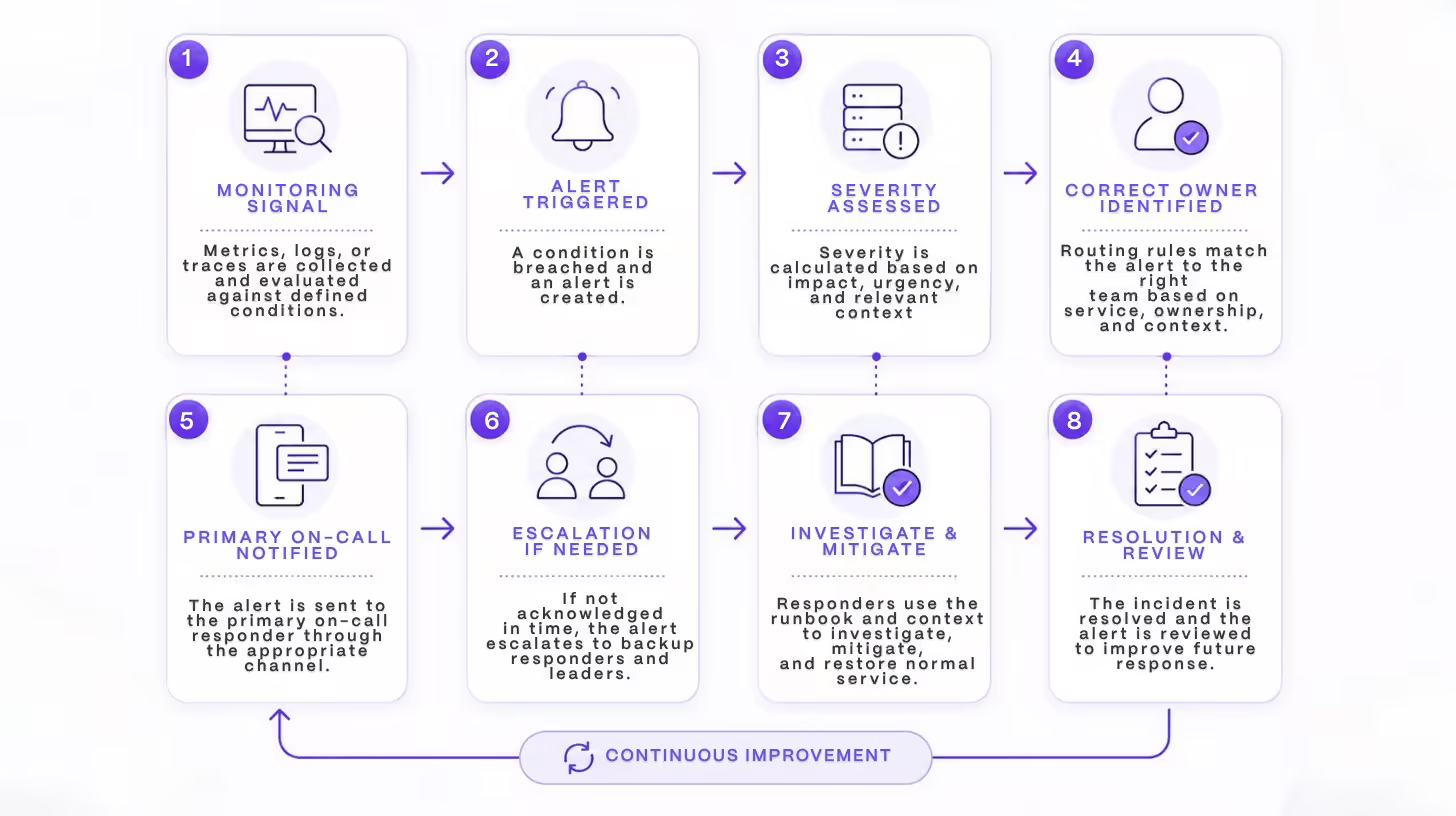
Alert routing should identify the team closest to the affected service and capable of taking action. Service ownership, severity, environment, region, customer impact, and incident type can all influence the route.
When the primary responder does not acknowledge the alert within the required window, escalation should happen automatically. A typicalescalation policy moves from the primary on-call responder to a backup responder, followed by a service lead or incident commander.
Acknowledgment only confirms that someone has accepted responsibility for the investigation. It does not mean that the incident has been mitigated or resolved.
Communication channels should also reflect urgency. Critical conditions may require a phone call or page. Lower-priority operational issues may need a mobile notification or ticket. Informational conditions should remain in dashboards or scheduled reports.
Using the most disruptive communication method for every alert weakens trust. Responders eventually learn that a page does not always indicate a genuine emergency.
Connect every important alert to a runbook
A runbook gives responders the immediate guidance needed to validate, diagnose, mitigate, and escalate a known condition.
Aneffective runbook explains what the alert means, its likely user impact, the first validation steps, relevant dashboards, dependency checks, safe mitigation options, escalation criteria, and recovery checks.
Runbooks should be written for engineers working under pressure. The safest actions should appear first, while destructive or difficult-to-reverse actions should be clearly identified.
Documentation also needs an owner and review date. A runbook that references an old dashboard, retired service, or invalid command can delay the response instead of accelerating it.
Protect the on-call team
Alert management is also a workload-management discipline. Frequent interruptions, overnight pages, repeated false positives, and unclear ownership increase fatigue and reduce confidence in the alerting system.
Teams should track pages per shift, after-hours interruptions, repeated alerts, escalation frequency, investigation time, and how alert volume is distributed across responders. These measures can reveal an unsustainable operational burden even when response-time metrics appear acceptable.
Engineers should complete shadow rotations, incident simulations, tool training, and escalation exercises before working alone. Early escalation should be encouraged rather than treated as a failure. Reliable incident response depends on getting the correct expertise involved quickly, not on expecting a single responder to solve every problem independently.
Review alerts as part of continuous improvement
Alert rules must evolve as services, traffic patterns, architecture, and ownership change.
After a significant incident, the review should examine which alerts fired, which alerts failed to fire, whether detection occurred early enough, whether the correct team was notified, and whether the runbook supported the response.
Teams should also review noisy alerts, repeated pages, incorrect routes, expired ownership, and long-running suppressions on a regular schedule. Current incident response guidance from the National Institute of Standards and Technology (NIST) emphasizes that lessons from detection, response, and recovery should feed directly into continuous improvement rather than being treated as a separate final activity.
The review process should lead to specific changes, such as adjusting a threshold, improving alert context, updating a runbook, correcting ownership, adding missing coverage, or retiring a rule that no longer provides operational value.
Measure what improves the response
No single metric can describe alert management effectiveness. Teams need a balanced view of signal quality, response speed, and human workload.
| MEASUREMENT AREA | USEFUL METRICS |
|---|---|
| Alert Quality | Actionable-alert rate, false-positive rate, and alert-to-incident conversion |
| Routing Quality | Reassignment rate, unmatched alerts, and escalation frequency |
| Response Performance | Mean time to detect, acknowledge, engage, mitigate, and recover |
| Operational Health | Pages per responder, after-hours interruptions, and repeated toil |
| Process Improvement | Rules tuned, runbooks updated, and monitoring gaps closed |
Metrics should be interpreted together. A reduction in alert volume may represent successful tuning, but it could also indicate lost monitoring coverage. Faster acknowledgment may improve one number without improving mitigation or recovery.
The most valuable question is whether alerts help responders identify real incidents, understand their impact, and take effective action sooner.
Use automation and artificial intelligence (AI) with clear guardrails
Automation can enrich alerts, retrieve deployment information, group related notifications, create incident channels, collect diagnostic evidence, and execute safe remediation. AI can also support summarization, investigation, timeline creation, and comparisons with previous incidents.
These capabilities should strengthen human decision-making rather than hide the evidence behind an automated conclusion. High-risk actions still require appropriate approvals, access controls, audit logs, rate limits, and rollback mechanisms.
Automation should be evaluated by the investigation time it saves, the reliability of its actions, and the operational work it removes. Automating a noisy or poorly routed alert only allows the underlying problem to spread faster.
From alert volume to response confidence
Reliable alert management is not about generating more notifications. It is about creating confidence that every interruption deserves attention.
That confidence comes from actionable alert quality, risk-based thresholds, accurate ownership, controlled noise reduction, dependable escalation, useful runbooks, and regular reviews. When these elements work together, responders spend less time interpreting notifications and more time protecting the services customers depend on.
Building a more reliable alert management practice
Effective alert management depends on the quality of the decisions built into the process. Alerts must reflect meaningful service risk, reach a clearly defined owner, include enough context for immediate action, and trigger an escalation path that works under pressure.
The strongest alerting programs also treat every incident as feedback. Thresholds are refined, noisy rules are removed, runbooks are updated, and ownership is reviewed as systems and teams evolve. This continuous improvement turns alert management from a collection of monitoring rules into a dependable part of incident response.
Rootly helps teams bring alerting, on-call coordination, incident workflows, automation, and post-incident learning into one connected platform. Explore Rootly to reduce alert noise, improve response consistency, and give responders the context they need to resolve incidents faster.
Frequently asked questions
What is alert management?
Alert management is the process of detecting, prioritizing, enriching, routing, acknowledging, and reviewing alerts. Its purpose is to ensure meaningful system risks reach the correct responder with enough context for immediate action.
What makes an alert actionable?
An actionable alert clearly explains what happened, which service is affected, how serious the issue is, who owns the response, and what the responder should do next. It should also include a relevant dashboard, runbook, and escalation path.
How can teams reduce alert fatigue?
Teams can reduce alert fatigue by removing obsolete rules, tuning thresholds, grouping related alerts, deduplicating repeated notifications, limiting pages to urgent conditions, and reviewing noisy alerts regularly.
How should alert thresholds be set?
Alert thresholds should reflect normal service behavior, customer impact, traffic volume, historical incidents, expected variation, and service level objectives. They should detect meaningful risk without repeatedly firing on temporary or harmless changes.
Who should own an alert?
The team responsible for operating and maintaining the affected service should own the alert. Each alert should have one accountable owner, even when multiple teams may be involved in resolving the incident.
How often should alerts be reviewed?
Alerts should be reviewed after relevant incidents and major system changes. Noisy rules may require weekly review, while ownership, threshold performance, runbooks, routing, and overall alert health should be assessed regularly.
Alert management best practices for reliable incident response